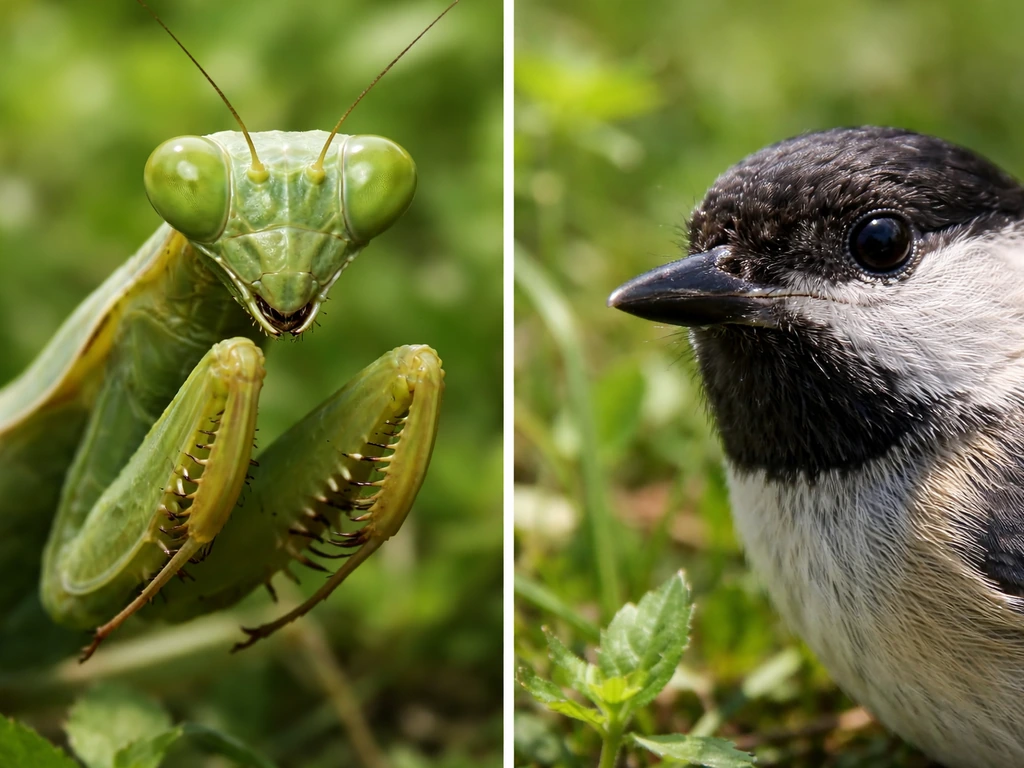
A mantis is not a bird. Full stop. They belong to entirely different kingdoms of life: birds are vertebrates in the class Aves, while praying mantises sit in Kingdom Animalia → Class Insecta → Order Mantodea. In the field, they look nothing alike once you know what to check. But searches for "mantis vs bird" are real, and the confusion usually comes from one of three situations: you spotted something triangular-headed and still in your garden and weren't sure what it was, you saw a photo of a mantis striking something and wondered if it could take a bird, or you read that mantises can actually prey on birds and want to understand how that works. This guide covers all three angles with fast identification cues, anatomy breakdowns, and practical next steps.
Mantis vs Bird: How to Tell the Difference Fast

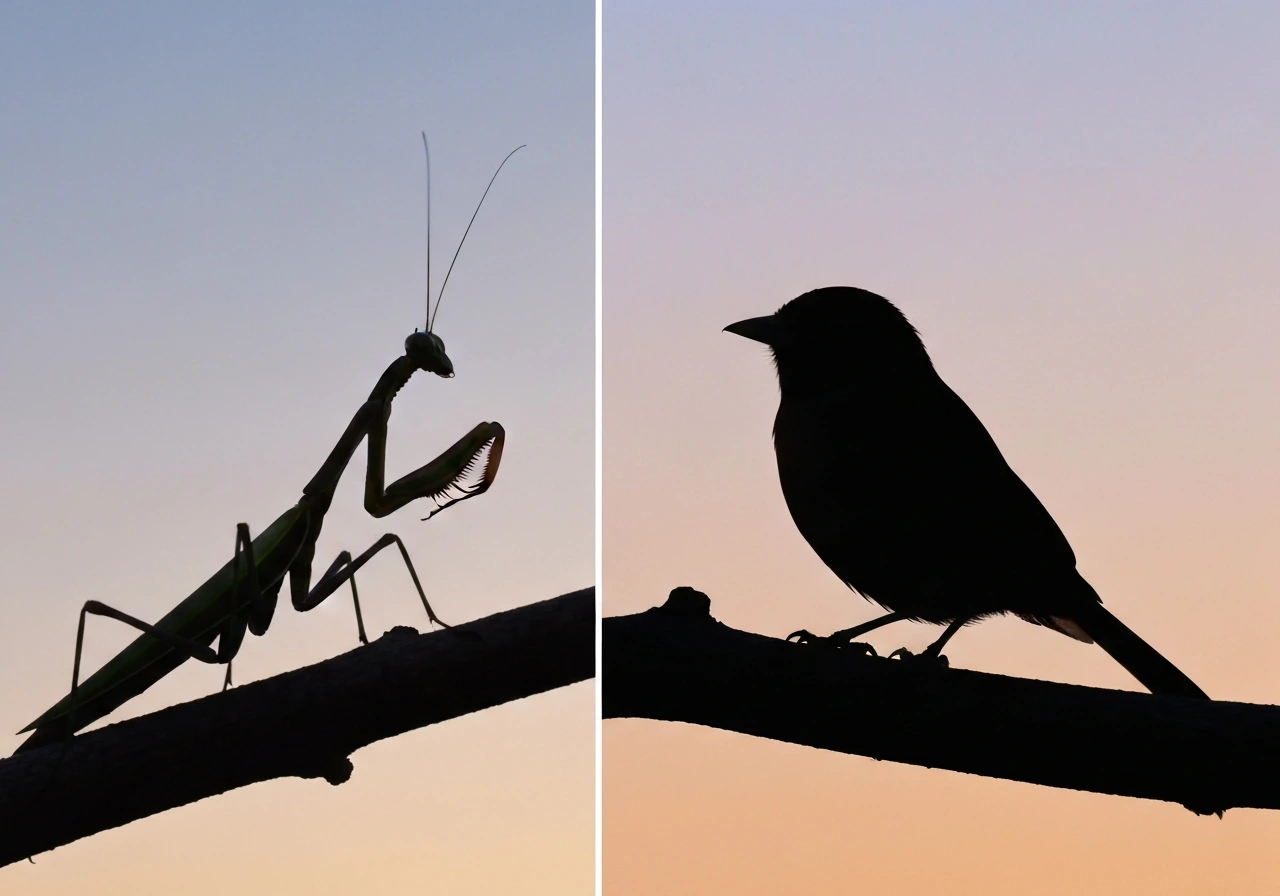
Quick identification: key features to tell a mantis from a bird
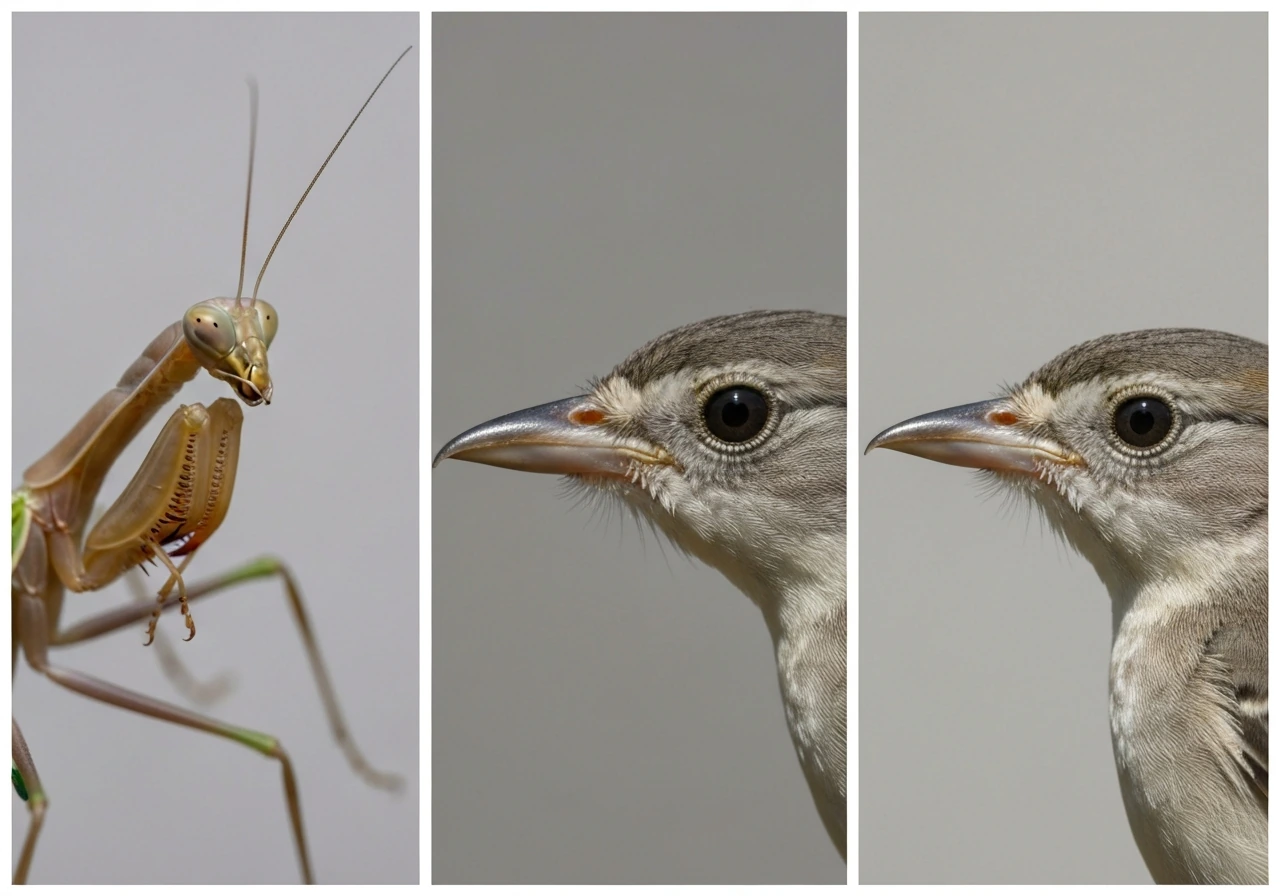
If you have a photo or a live subject in front of you, run through this checklist in order. You'll almost always get your answer by the third feature.
- Check for feathers. Birds have them everywhere on the body. Mantises have none. A mantis has a rigid, segmented exoskeleton that can be green, brown, or cryptically patterned, but never feathered.
- Look at the head shape. A mantis has a large, distinctly triangular head with two bulbous compound eyes set wide apart, three small ocelli (simple eyes) between them, and a pair of antennae. No bird has antennae or compound eyes.
- Count the limbs. Mantises have six legs. Birds have two legs and two wings. The mantis's front two legs are greatly enlarged raptorial forelegs held folded in front of the body, which from a distance can look like talons or folded wings, but they're limbs used for grabbing prey.
- Note the posture. A mantis typically holds its forelegs raised in a "prayer" position while the rest of the body stays almost perfectly still. Birds shift weight, blink, ruffle feathers, and reposition constantly.
- Watch for head rotation. A mantis can swivel its head nearly 180 degrees on a flexible joint between head and thorax, turning to look directly at you. Birds can turn their heads, but the triangular mantis head doing this is unmistakable once you've seen it.
- Look for antennae and wing covers. Mantises have two antennae and protective forewings covering folded membranous hindwings. Birds have a bill, no antennae, and fully feathered wings.
If you're working from a photo, zoom in on the head first. The combination of forward-facing compound eyes, antennae, and triangular profile is a locked identification. No small bird or raptor shares that head geometry. The praying mantis vs bird comparison really does come down to that one feature more than anything else when photos are blurry or the animal is partially hidden.
Behavior and movement differences
Behavior is your second-fastest identifier, especially when the subject is too far away to see fine detail. Birds and mantises move in fundamentally opposite ways.
Mantises are ambush predators that depend on stillness. They blend into plant material, stay motionless for long periods, and wait for prey to walk within range. When they do move, it's either a slow, swaying creep that mimics a plant stem shifting in wind, or an explosive strike. That strike is shockingly fast: high-speed video documents the foreleg movement completing in microseconds, with angular velocity exceeding 600 degrees per second at key joints. The mantis can extend its raptorial forelegs to roughly 1.5 times its body length during a lunge, then immediately resets to the folded posture. You won't see that coming in real time. What you will notice is that the animal was completely still, then prey was caught, and then it was still again.
Birds are rarely that still for that long, and their movement patterns are completely different. Insect-eating birds like swallows use hawking (catching insects mid-flight), while warblers and vireos use gleaning (picking insects off leaves and bark), and other species use hover gleaning to pluck prey from surfaces. Small raptors like the American Kestrel actively hunt from perches or hover in place before diving. Shorebirds like Killdeer use a run-and-stop feeding pattern, sprinting short distances and then stopping abruptly to peck. None of these birds wait motionlessly for prey to come to them the way a mantis does, and none of them reset to a folded-foreleg posture after catching something.
The other behavioral tell is timing. Mantises tend to be most active in the cooler morning and evening hours, especially when summer temperatures climb above about 95°F (35°C). They're sometimes easier to spot in garden plantings during morning hours when they're less active and simply resting. Birds have their own activity peaks tied to feeding cycles, migration, and tidal patterns for shorebirds, but small raptors and common garden birds are broadly active throughout daylight.
Body plan anatomy: how wings and feathers compare to mantis limbs
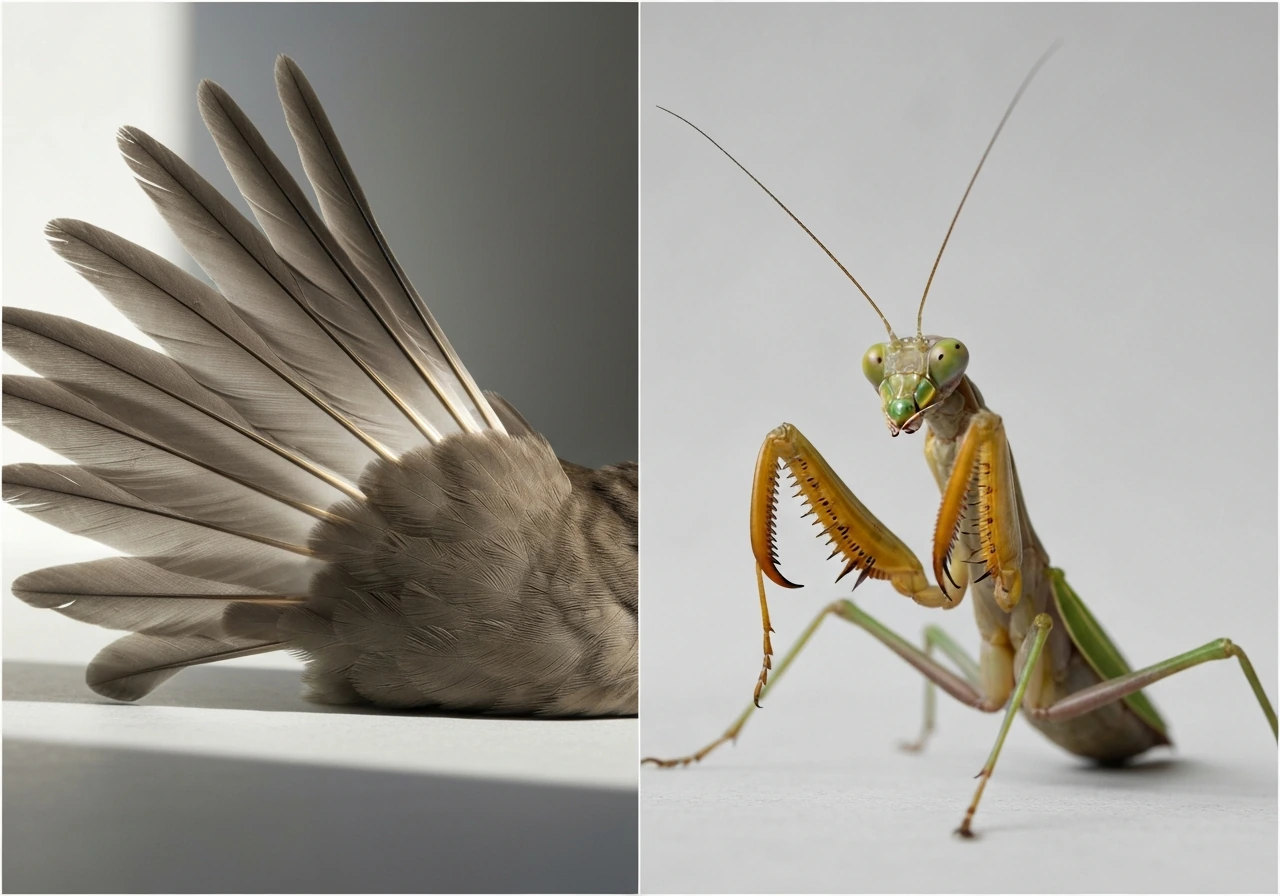
Understanding the underlying anatomy explains why these animals look and move the way they do, and it gives you a framework for interpreting photos where individual features might be obscured.
The mantis body plan
A mantis body is divided into three segments: head, thorax, and abdomen. Six legs attach to the thorax. The front pair is the standout feature: greatly enlarged, with rows of sharp spine-like teeth along the inner surface for gripping prey. These are purely for catching and holding, not for walking. The mantis walks on its remaining four legs. The wings, when present, consist of protective leathery forewings and larger membranous hindwings that fold against the body when not in use. The hindwings are generally larger than the forewings and fold neatly, which is why a resting mantis can look wingless at first glance.
Internally, a mantis breathes through a tracheal system rather than lungs. Air enters through spiracles, small pores running along the sides of the thorax and abdomen. Oxygen moves through a network of air tubes directly to the tissues without needing the circulatory system to carry it the way blood carries oxygen in vertebrates. This system works efficiently for small animals but can't scale up to bird-sized organisms.
The bird body plan
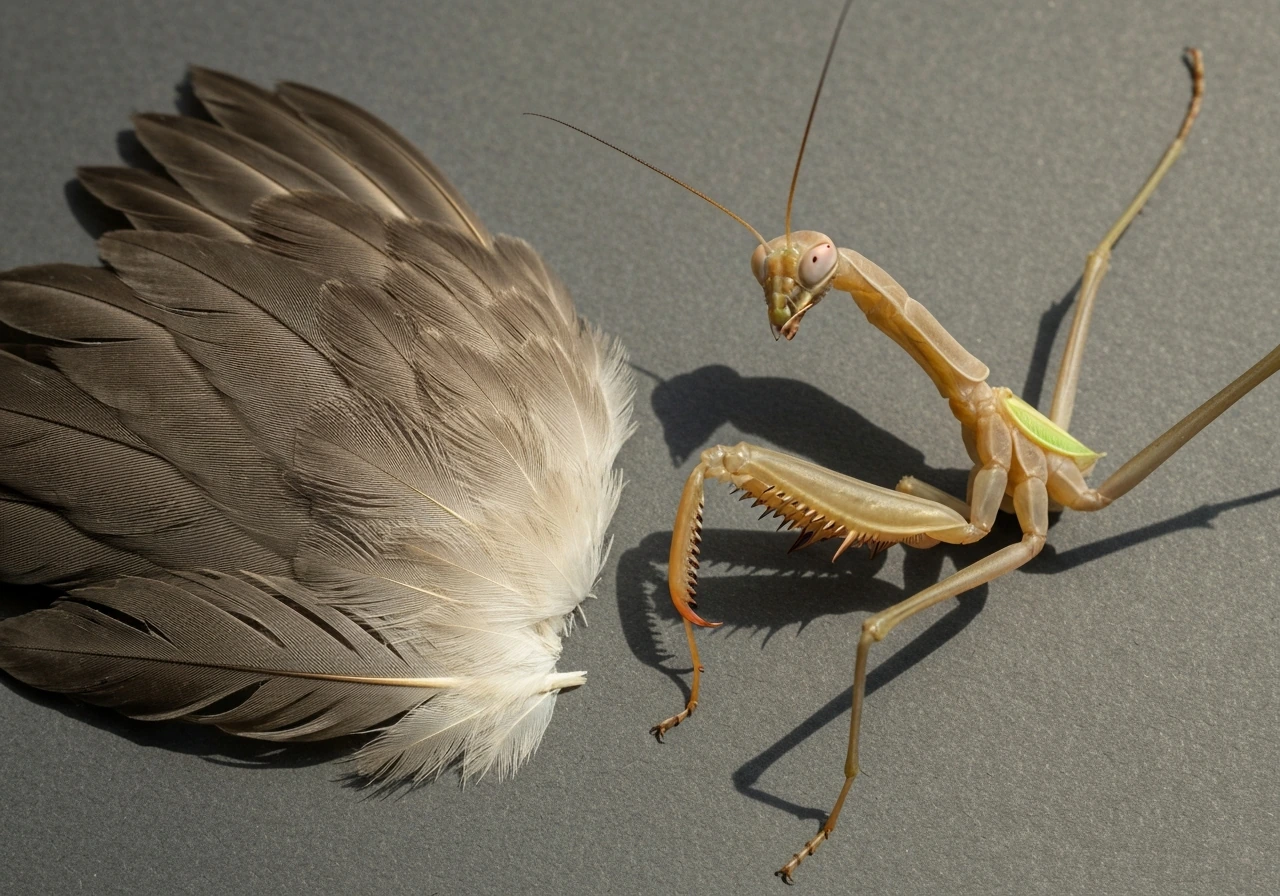
Birds have a vertebrate skeleton with hollow bones, a four-chambered heart, and a respiratory system built around lungs connected to a series of voluminous air sacs. Those air sacs create roughly twice the total respiratory volume you'd expect from a mammal of comparable size, and they drive continuous unidirectional airflow through the lungs on both inhalation and exhalation. This gives birds the oxygen efficiency needed for powered flight. Two legs provide locomotion on the ground; two feathered wings provide lift and maneuver in air. Feathers are complex structures attached to the skin, and they cover virtually the entire body. There are no antennae, no compound eyes, no exoskeleton, and no raptorial forelegs. The "talons" on raptors like hawks or kestrels are keratin claws on the toes of the feet, not modified forelegs.
| Feature | Praying Mantis | Bird |
|---|---|---|
| Body covering | Rigid exoskeleton | Feathers over skin |
| Limbs | 6 legs (2 raptorial forelegs + 4 walking legs) | 2 legs + 2 feathered wings |
| Head | Triangular, compound eyes, antennae | Rounded or streamlined, simple eyes, bill |
| Wings | Leathery forewings + folded membranous hindwings | Feathered, used for flight |
| Respiration | Tracheal tubes via spiracles | Lungs + air sacs, unidirectional airflow |
| Skeleton | External exoskeleton | Internal vertebrate skeleton with hollow bones |
| Head rotation | ~180 degrees via flexible joint | Variable, no flexible joint equivalent |
| Foreleg reach | Up to ~1.5x body length during strike | No raptorial forelegs |
Habitat and where you're likely to see each
Where and when you encounter an animal is one of the fastest context clues you have. Mantises are overwhelmingly associated with vegetation: garden plants, tall grasses, shrubs, and the edges of fields where plant cover is dense enough to hide in. They're almost always found clinging to stems, leaves, or flower heads, positioned where insects are likely to pass. You'll rarely find a mantis on open ground without vegetation nearby, and you'll almost never find one near water unless there's adjacent plantings.
Birds occupy a much wider range of habitats and tend to use open or semi-open spaces more comfortably. Shorebirds like Killdeer and dowitchers feed on gently sloping shorelines, mudflats, and beaches, timing their foraging to low-tide cycles when invertebrate-rich feeding areas are exposed. They roost on upper flats and nearby high ground as tides push in. Small raptors like American Kestrels perch on wires, fence posts, and dead branches with open sightlines. Songbirds and warblers work the interior of shrubs and tree canopies. The point is that the habitat you're in should strongly influence which identification you lean toward: vegetation-tangled garden bed with no open water suggests mantis; open shoreline, power line perch, or field edge with clear sightlines suggests a bird.
One interesting overlap: both mantises and certain birds (especially small raptors) are attracted to gardens because gardens attract insects. If something is hunting insects in your garden by sitting still on a plant, it's almost certainly a mantis. If something is hunting insects from a perch with clear airspace and diving repeatedly, it's likely a bird like a kestrel. Context wins.
Diet and hunting style: ambush predator vs forager
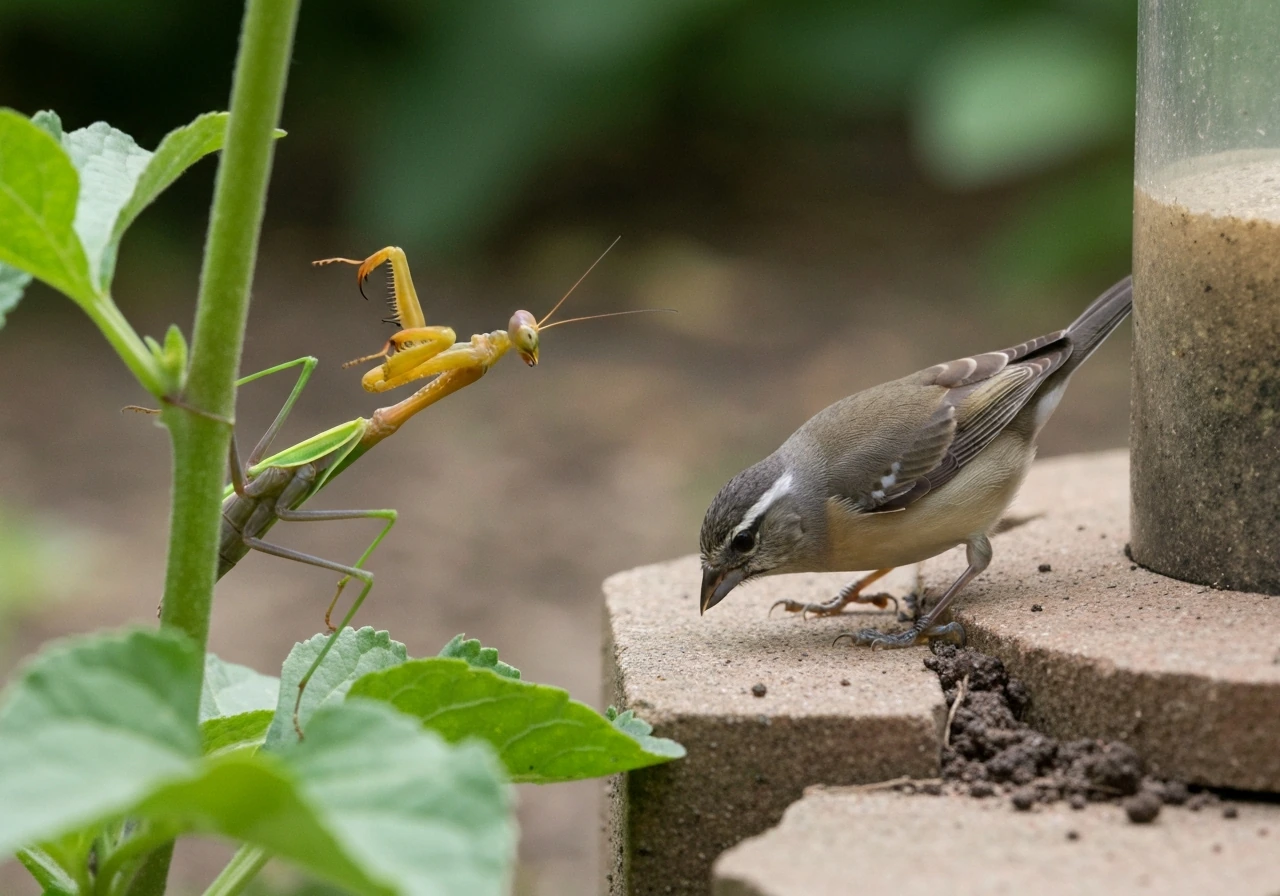
Both mantises and many birds eat insects, which is a common source of confusion when you see something actively hunting in a garden. The hunting methods are opposite in almost every respect.
A mantis hunts exclusively by ambush. It positions itself in vegetation, assumes a resting posture with forelegs folded in front of the prothorax, and waits. When prey moves into range, it calibrates the timing of its strike to the prey's movement and then lunges with those raptorial forelegs. The strike is one of the fastest movements in the insect world. After catching prey, the mantis holds it with those spiked forelegs and feeds while still largely motionless. Mantises do not chase prey, do not forage across open ground, and do not search through leaf litter. They wait.
Birds that eat insects use active foraging strategies. Kestrels, for example, eat grasshoppers, crickets, butterflies, moths, dragonflies, and beetles, pursuing them through a combination of hovering, perch-hunting, and short chasing flights. Warblers and other small songbirds glean insects off leaf surfaces as they move through vegetation. Swallows hawk insects continuously in flight. The difference in energy expenditure alone separates these animals: a mantis burns almost nothing waiting; an actively hawking swallow burns a great deal.
There is one well-documented scenario where mantises and birds directly interact as predator and prey: mantises, particularly large females, have been documented catching and eating small birds including hummingbirds at feeders. National Geographic describes a specific case in which a dead hummingbird at a backyard feeder was found in a praying mantis’s clutches and the mantis began feeding blank" rel="noopener noreferrer">mantises, particularly large females, have been documented catching and eating small birds including hummingbirds at feeders.. This is rare but real. If you've seen a report or photo of a mantis "eating a bird," that's what's happening. It doesn't change the classification of either animal; a mantis is still an insect, and the bird is still a bird. Just like a spider vs bird encounter at a feeder, the predation event is surprising but taxonomically straightforward.
For a sense of scale on unusual predator pairings, the hunting capabilities of large arachnids provide a useful comparison. If you're curious how other large invertebrates stack up against vertebrates as predators, reading about how a bird eating spider compares to a tarantula gives good context for understanding how invertebrate body size and hunting mechanics translate into prey size.
Common "is this a bird or a mantis?" scenarios
"It looks like it has talons"
If the "talons" are on the front limbs and the animal is holding them raised and folded while sitting on a plant stem, those are raptorial forelegs with spine-like teeth, not talons. A bird's talons are on its feet, and the feet are used for perching and gripping, not held up in front of the face. Check whether the animal is using those appendages for locomotion. If not, and they're held up near the head, you're looking at a mantis.
"It's completely still on my feeder or plant"
Extended, statue-like stillness on vegetation is a mantis hallmark. Birds perched at feeders shift, preen, look around, and react to movement. If something has been completely motionless on a plant for 20+ minutes and is triangular-headed, it's a mantis. You can confirm by gently nudging the stem with a stick: a mantis will sway with it or slowly reorient; a bird will fly away immediately.
"It's on the ground"
A ground-level sighting changes the odds somewhat. Mantises do end up on the ground, especially juveniles or adults that have dropped from vegetation, but they're not ground foragers. Birds, especially shorebirds and ground-feeding sparrows, are commonly on the ground by design. If the animal is actively walking and pecking, it's a bird. If it's sitting still and appears to be clinging rather than walking, get closer and check for antennae and compound eyes.
"It's in my yard and I'm not sure"
Photograph it and zoom in on the head immediately. Antennae and compound eyes confirm mantis. A bill and simple eyes confirm bird. If the photo is too blurry, check body symmetry: insect bodies are visibly segmented into head, thorax, and abdomen with legs attaching to the thorax. Bird bodies are continuous from neck to tail, with legs attaching toward the back of the torso. For local species verification, Cornell's All About Birds paired with iNaturalist lets you cross-reference your location and a photo to nail the ID in minutes.
"Is a praying mantis considered a bird?"
No. A praying mantis is an insect, classified under Kingdom Animalia, Class Insecta, Order Mantodea. Birds are in Class Aves. These are separate classes within the animal kingdom with no taxonomic overlap. The mantis's insect credentials are unambiguous: six legs, exoskeleton, tracheal respiration, compound eyes, and antennae. None of those features appear in birds.
"I saw a photo of a mantis eating a hummingbird. Does that make it a bird?"
No. Eating a bird doesn't reclassify the predator. Large female mantises, particularly the introduced Chinese mantis (Tenodera sinensis) in North America, have blank" rel="noopener noreferrer">documented cases of catching and consuming small birds at hummingbird feeders. The mantis is still an insect; it has just broadened its diet beyond what most people expect from a bug. This is the same logic that applies when we discuss the camel spider vs Goliath bird-eating spider comparison: the name "bird-eating" describes behavior, not taxonomy.
"It moved its head to look directly at me"
That nearly-human head turn is one of the most disorienting things about encountering a mantis for the first time. The flexible joint between a mantis's head and thorax allows approximately 180 degrees of rotation, so it can look directly over its shoulder at you while its body faces the other direction. Birds can turn their heads, but the mantis doing it from a motionless position on a plant stem, with a triangular head and visible compound eyes tracking you, is distinctive. Once you've seen it, you don't forget it, and you don't mistake it for a bird again.
Your next steps for a confident ID
Get a photo if you can, even a phone snapshot. Zoom into the head: antennae and compound eyes lock the ID as insect. No antennae, visible bill, and feathers lock it as bird. If the photo is ambiguous, note the habitat (dense vegetation vs open ground or sky), the behavior (motionless ambush posture vs active movement and pecking), and the time of day. For bird identification, Cornell's All About Birds and iNaturalist together give you species accounts and location-matched sightings that can confirm or rule out any local species in minutes. For mantis confirmation, the triangular head, raptorial forelegs held folded in front, and segmented body visible even in low-resolution photos are enough to close the case.
If you want a deeper dive into the full range of mantis-bird interactions including documented predation events and behavioral overlap, the complete praying mantis vs bird breakdown covers those scenarios in more detail. The short version: mantis is an insect, bird is a bird, and the observable differences between them are clear enough that a single good photograph resolves nearly every case.
FAQ
I saw a “bird” sitting perfectly still on a plant near my feeder. How can I tell which one it is without getting close?
Use distance-based cues. If you see a triangular head facing forward with noticeable antennae and the front limbs held folded in front of the body (not feet for perching), it is a mantis. If you see a beak, even from far away, or the head looks like a typical bird silhouette with feathers and a compact body, it is a bird. A mantis also tends to remain statue-still for long stretches, while a bird usually does small posture shifts like preening or head scanning.
Can a mantis fly, or is it always crawling?
Mantis species vary, but most can fly only in limited ways and many are primarily weak fliers. In practice, if you see sustained flight, hovering, or rapid wingbeats, you are looking at a bird. A mantis might have wings when present, but it does not use them like birds do for powered flight and aerial pursuit.
Are there any birds that mimic a mantis-like stillness in gardens?
Yes, some birds perch very still, especially small songbirds that pause between movements. The deciding feature is the head and appendage placement: mantises show segmented insect body form (head, thorax, abdomen), compound eyes and antennae, and raptorial forelegs held up or folded. Birds show feathers, a beak, and no antennae or compound-eye geometry.
What if the photo only shows the “front” shape, and the rest is blurry?
Zoom on the head first. Compound eyes plus antennae and a triangular, insect-like head profile point to a mantis. A bird will show a bill and an eye shape consistent with vertebrate anatomy. If you still cannot see the head clearly, look for the body segmentation pattern, insect legs attached to a central thorax, and whether the “talons” are actually forelegs held near the face.
How do I handle cases where a mantis drops to the ground?
Dropping can happen, especially with juveniles or after disturbance. Still, the mechanics differ: a mantis on the ground typically looks like it is clinging or slowly reorienting rather than actively foraging, and it will not repeatedly run-and-stop peck the way many ground-feeding birds do. If it is actively walking, pecking, and scanning, prioritize bird ID.
Is it possible for a mantis to catch a bird at my hummingbird feeder?
It is rare but documented, often involving large females and small birds at feeders. If you notice a mantis near the feeder, the correct approach is not to assume taxonomy changes. Take photos, look for mantis hallmarks (segmented insect body, antennae, raptorial forelegs held folded), and treat the event as predation behavior rather than “turning” the animal into a bird.
When should I suspect it is a bird and not a mantis, even if it is insect-eating?
Suspect bird if the hunting style includes repeated diving flights, hovering, or active movement through air space, rather than long periods of complete stillness on vegetation. Kestrel-like behavior from a wire or perch, and swallow-like hawking, are strong signs. Mantises almost always use a wait-and-lunge ambush, with a long rest posture before a sudden strike.
My yard has both open space and dense plants, so context is mixed. What is the fastest tie-breaker?
Use the appendage location. If the spined grabbing limbs are held raised and folded near the head or front, that is raptorial mantis forelegs. If the gripping structures are on the feet and the animal is perched or pecking, that is a bird. This single check often resolves “vegetation vs open” confusion.
What quick photo checklist should I use so I can identify it later?
Capture three things: (1) the head close-up (antennae and compound eyes vs bill), (2) the position of the front limbs (folded raptorial forelegs vs feet/perching talons), and (3) one wider shot for habitat (dense plant cover vs open shoreline or perch wires). Also note the time of day, since mantises are often more noticeable during cooler morning and evening periods.
Praying Mantis vs Bird: How to Tell Them Apart Fast
Fast field guide to distinguish praying mantis from birds by look, posture, movement, habitat, and safe documentation.