A praying mantis and a bird are not hard to tell apart once you know what to look for, but if you glimpsed something green, still, and vaguely upright in the bushes, the confusion is understandable. Here is a direct field guide to settling this question today, using body shape, behavior, and context cues that work even from a few feet away.
Praying Mantis vs Bird: How to Tell Them Apart Fast

Marcus Hendricks
8 Apr 2026
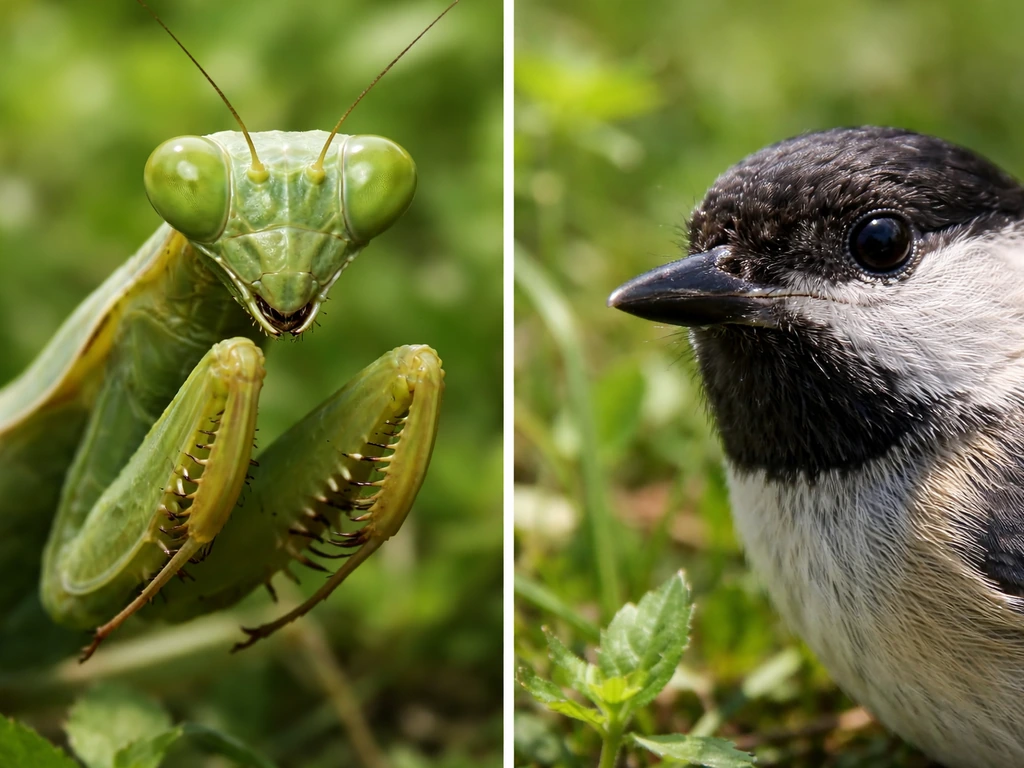
Quick ID: what each one looks like up close
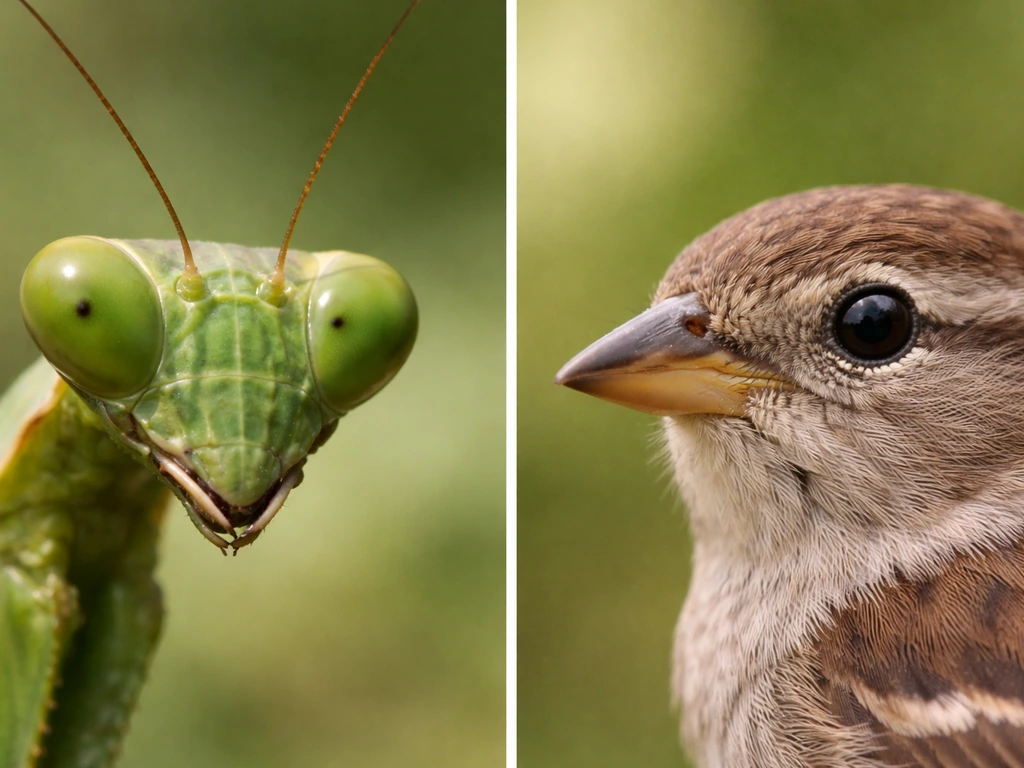
The single fastest way to ID a praying mantis is the head. It is triangular, very mobile, and dominated at its top corners by two bulging compound eyes that look almost too large for the body. The mantis also has an elongated prothorax, which works like a neck, letting the head swivel nearly all the way around. The forelegs are raptorial, meaning they are modified for grabbing prey, and at rest they are folded together in front of the body in the classic 'prayer' posture. Body length ranges from about 10 mm to 200 mm depending on species, with average adults of common U.S. species sitting somewhere around 5 to 7 cm.
A bird's head is rounded or domed, not triangular, and it carries a beak rather than mouthparts set into a flat insect face. The eyes on most birds are set on the sides of the head, giving a wide field of view. Wings are feathered and attached at the shoulder, and the feet have distinct toes, often with visible claws adapted for perching, gripping bark, or walking on the ground. Even the smallest songbird carries none of the angular, folded-foreleg geometry that defines a mantis.
| Feature | Praying Mantis | Bird |
|---|---|---|
| Head shape | Triangular, very mobile on jointed 'neck' | Rounded or domed, on a flexible neck |
| Eyes | Large, bulging compound eyes at head corners | Round eyes, typically on sides of head |
| Forelegs/wings | Raptorial forelegs folded in 'prayer' pose; wings (if present) lie flat on back | Feathered wings at shoulder; legs used only for perching/walking |
| Body plan | Head + elongated thorax + abdomen; six legs | Head + torso + tail; two legs, two wings |
| Size range | 10–200 mm body length | Roughly 8 cm (hummingbird) to 120+ cm (heron) |
| Mouth | Chewing mouthparts on flat insect face | Beak (bill), highly variable in shape |
How they behave: hunting, stalking, and moving around
Mantis hunting has a very specific pattern you can watch for. There is a period of still, patient waiting, then an extremely slow, almost imperceptible approach if prey moves nearby, and then a strike so fast it happens in milliseconds. The forelegs shoot out and snare the prey in a vicelike spined grip, and the mantis immediately begins feeding while holding the prey with those same legs. The whole attack sequence, from slow stalk to capture, is driven by visual cues as the prey enters strike range. If you see something extend two spiny arms from what looked like a motionless twig and grab a fly, that is your mantis.
Birds move in ways that are immediately more familiar. Most walking birds show characteristic head-bobbing tied to locomotion, a pattern where the head thrusts forward and then holds still while the body catches up. Small birds typically hop rather than walk. A perching bird will launch, glide, or flap to a new position rather than creeping imperceptibly across a branch. Birds also make sounds, calls or songs, that a mantis simply cannot produce. If it chips, trills, taps wood, or calls repeatedly, it is a bird.
Size, posture, and movement patterns side by side
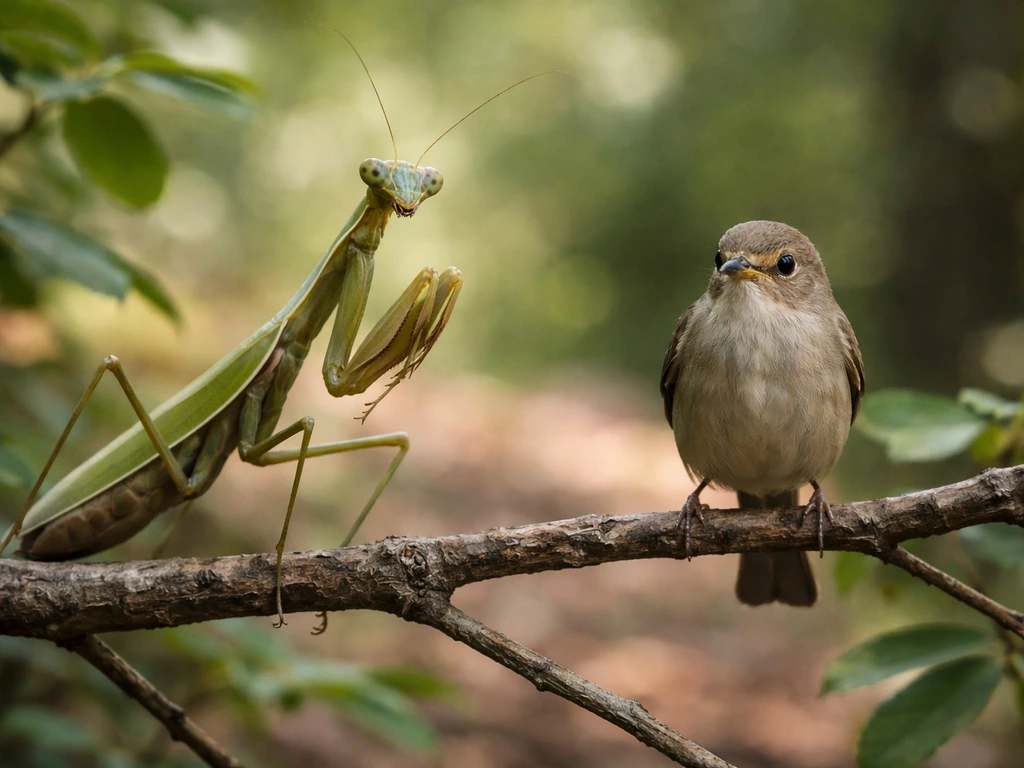
Even a large mantis (say, a Chinese mantis at around 10 cm) is smaller than most birds you are likely to encounter in a garden or woodland edge. The key postural difference is that a mantis holds its body roughly horizontal with the forelegs raised vertically in front, whereas a bird stands upright with its wings folded against its sides and its legs beneath the body. When a mantis moves its foreleg, you will see a hinged, jackknife-style motion where the tibia folds back against the femur. A bird moves its wings in broad, feathered arcs. The mantis's abdomen can also curve or tip upward when the insect is disturbed, something no bird does.
For anyone who wants to dig deeper into the broader category of insects being confused with birds, the mantis vs bird comparison covers additional species-level details worth reading alongside this guide.
Where you are likely to find each one
Mantises prefer open, heavily vegetated habitats where insect prey is abundant: gardens, old fields, pastures, thickets, and woodland borders are their home turf. In the United States you can find species spread across the country, from Brunner's mantis in the South to prairie-dwelling species like Yersiniops solitarius in mixed-grass shrublands of Arizona, New Mexico, and Colorado. If something is perched motionless on a garden plant, a tall grass stem, or a shrubby branch and appears green or brownish with its body blending into vegetation, mantis is a very reasonable first hypothesis.
Birds occupy every habitat from dense forest canopy to open water, and you will find them feeding on the ground, at feeders, in the mid-canopy, and at the tops of tall trees. Seeing something move along the ground with a pecking or probing motion, perched on a wire singing, or flying overhead all point firmly to bird territory. One useful mental frame: if the creature is smaller than your hand and completely still on a plant stem for several minutes, lean toward mantis. If it is moving around a feeder, pecking at bark, or has just flown in from another location, lean toward bird.
Diet and feeding mechanics: how each one captures food
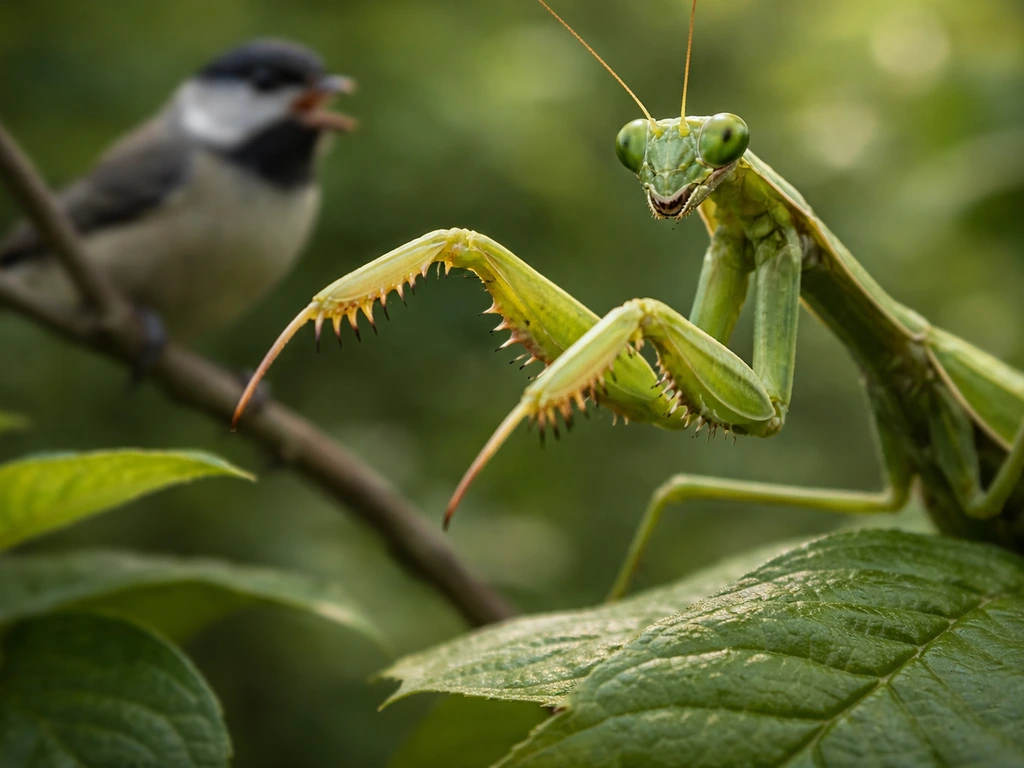
A praying mantis is a pure ambush predator. It waits, approaches slowly, and then extends its spined forelegs with extreme speed and accuracy to snare prey. The spines lock the prey in place while the mantis bites into the neck region to immobilize it. You will see the mantis actively holding and processing its meal with those raptorial legs while mouthparts work at the prey's head or thorax. This 'holding prey with forelegs while eating' behavior has no equivalent in birds.
Birds use beaks to capture and process food, and feeding strategies vary enormously by species. Some species watch from a perch and drop down on prey, which can look deceptively like 'ambush' behavior, so body-plan cues matter here. A kingfisher sitting motionless on a branch before diving is not doing what a mantis does, but from a distance the 'watchful waiting' posture could cause a moment of confusion. The moment you see a beak stab, peck, or probe, all doubt goes away. If you are curious how other arthropods compare in predatory role to birds, the spider vs bird article explores a similar set of predator comparison questions.
Red flags that lock in your ID
It is definitely a mantis if you see:
- A triangular head with bulging compound eyes at the top corners, sitting on a clearly elongated 'neck' segment
- Two forelegs folded vertically in front of the body in a prayer-like posture at rest
- Six legs total (the four walking legs beneath the body, plus the two raptorial forelegs)
- A slow, rocking or swaying approach to something nearby, followed by an explosive grab with the forelegs
- The creature holding a fly or other insect in its forelegs while chewing at the prey's head
- A flat, insect-style face with no beak at all
- Wings lying flat on the back (if present); adult females of some species have wings but fly only short distances of a few meters
It is definitely a bird if you see:
- A rounded head with a visible beak, any beak at all
- Feathered wings, even if they are folded tightly against the body
- Two legs with toes and visible claws built for perching, walking, or gripping
- Head-bobbing linked to walking or foraging movement
- Any vocalization: song, chip note, alarm call, or drumming
- Flight from one location to another with wing flapping or gliding
- Pecking, probing, or snatching food with the beak rather than with forelegs
One trap worth naming: some people see a large, dramatically colored insect and assume it must be something exotic. In reality, a common Chinese or European mantis in your vegetable garden is genuinely large enough to look surprising. On the other side of the confusion, very small birds like kinglets and wrens can be dismissed as 'just bugs' at first glance. Always check for a beak and feathers before concluding bird, and always check for the triangular head and folded raptorial legs before concluding mantis. For another interesting comparison involving large predatory arthropods sometimes mistaken for or compared to birds, it is worth checking out bird eating spider vs tarantula, which explores the 'bird-eating' label and what it actually means in size and predatory terms. Similarly, if you want to understand how other oversized arachnids factor into these size-scale comparisons, camel spider vs goliath bird eating spider puts those dimensions into a useful perspective.
What to do next: document it safely, then get help if needed
If you have spotted something and you are still not sure, your first move is to document from a distance without disturbing it. Use your phone's zoom or a pair of binoculars, and try to get photos from the side (to see the overall body plan), from the front (to see the head shape and eye placement), and from above if possible. Taking identification-helping photos from the side, front, and above can provide evidence for identification, and iNaturalist recommends focusing on key structures get photos from the side, front, and above. A clear photo of the head will almost always settle the question immediately. Do not approach closely, and absolutely do not try to handle the animal before you know what it is.
For mantises, handling is generally low-risk for an adult who takes basic precautions, since they cannot cause serious injury to humans. That said, there is no reason to pick one up unless you are moving it away from danger. If it is in a vegetable garden, leave it: mantises are valuable predators and will take care of themselves.
For birds, the guidance from wildlife professionals is clear: do not attempt to handle a bird unless it is in immediate danger and you have no other option. If you find a bird that appears sick, injured, or unable to fly after a window collision, keep your distance, note the exact location, and contact a licensed wildlife rehabilitator or your local wildlife agency. If you must move the bird to immediate safety, use gloves and a prepared cardboard box with ventilation holes. Handling wild birds without the proper permits is restricted under federal migratory bird law, and untrained handling can do more harm than good even when well-intentioned.
- Observe from at least 10 feet away and take photos before doing anything else
- Check the head: triangular with compound eyes (mantis) or rounded with a beak (bird)
- Check for feathers and wings in the folded position along the sides of the body (bird) or flat on the back (mantis, if winged adult)
- Listen for any vocalization, which confirms bird immediately
- Watch for 30 to 60 seconds: if it rocking-stalks and then grabs with forelegs, it is a mantis; if it hops, pecks, or flies, it is a bird
- If it is a bird that appears injured or sick, contact a licensed wildlife rehabilitator rather than attempting care yourself
- If you are still uncertain, share your clearest photo to a community ID platform like iNaturalist for a second opinion within hours
The bottom line: a praying mantis and a bird share almost no structural features, and once you have seen each one clearly, the confusion will not recur. Use the triangular compound-eyed head and folded raptorial forelegs as your mantis anchors, and the rounded head, beak, and feathered wings as your bird anchors. Everything else, habitat, movement style, and feeding method, reinforces whichever ID those structural cues point you toward.
FAQ
What if I only get a quick glance and can’t see the head clearly?
If you cannot see the head, prioritize the forelegs and stance. A mantis will present folded, “prayer” forelegs with visible spines and a hinged, jackknife-style leg motion when it shifts position. A bird will show legs beneath the body and, at most, wing or toe movement rather than forelegs extending like grasping arms.
How can I tell whether something is attacking like a mantis or hunting like a bird?
Look for a speed mismatch and a tool mismatch. Mantis strikes are extremely fast and end with the forelegs clamping the prey before feeding starts, while birds typically capture with a beak, claws, or wing-related movement, then chew, tear, or swallow. If you can observe the “capture tool” for even a second, ID becomes much more reliable.
Can baby mantises or tiny birds be especially hard to identify?
Yes, young mantises can look like thin twigs and small birds can freeze on branches, but the geometry still usually gives them away. A mantis nymph tends to keep its body angled low and shows the folded, grasping forelegs when not actively moving, while a bird’s rounded head and beak will be visible even when it is still.
How do I ID one that is motionless on a plant for a long time?
If the creature is perched and silent for several minutes, don’t rely on stillness alone. Instead, check for feeding indicators: mantises hold prey with the raptorial forelegs while working mouthparts at the head or thorax, and birds tend to peck, probe bark, or use a beak to eat. A beak “stab” or repeated pecking is a strong bird cue.
What should I do if the weather or lighting makes the movement cues unreliable?
Wet or windy conditions can blur movement cues, but body plan cues remain. In bad visibility, use binoculars or phone zoom to confirm either the mantis triangular, compound-eyed head and folded raptorial forelegs, or the bird’s domed head, beak, and feathered wing attachment. Avoid guessing solely from color.
Are there bird behaviors that look like mantis ambush from far away?
“Perching” can be misleading, especially with ambush-style birds. The deciding detail is structure: birds have feathered wings that move in broad arcs and a beak for capture, mantises have forelegs that extend in a jackknife motion and are held upright in front when at rest. If it uses forelegs like grasping arms, it is almost certainly a mantis.
How should I weigh habitat and size if my structural observations are uncertain?
Yes. If it has feathers, it is a bird, even if it looks insect-like. Conversely, if it has grasping forelegs and an angled, compound-eyed head, it is a mantis, even if it looks like a small brown “bug.” When unsure, make a “feathers vs raptorial forelegs” check before using habitat or size to decide.
What are common mistakes people make when they rely on color or camouflage?
Try to confirm one diagnostic feature from a safe distance: either the beak (bird) or the triangular compound-eyed head plus folded forelegs (mantis). If you only confirm “it is green” or “it looks twiggy,” that is too weak, because both insects and birds can share those camouflage patterns in gardens.
What’s the best way to photograph or observe without getting closer?
Do not keep waiting for a perfect moment. If you can photograph the head and forelegs from the side or front, you usually do not need additional observation. For best odds, take multiple shots as the creature shifts, because that is when the forelegs’ hinge motion or the bird’s beak orientation becomes obvious.
If I want to relocate a mantis safely, what is the lowest-risk approach?
For mantises, a practical rule is to avoid moving it if it is out of immediate danger, since they are beneficial predators. If it is truly in harm’s way (for example, about to be crushed), gently relocate it using a leaf or container rather than bare-hand handling.
What’s the safest first step if I think I found an injured bird after a window collision?
For birds, use distance and containment, not handling. Keep pets away, place a box nearby only if the bird is grounded and in immediate danger, and contact a licensed wildlife rehabilitator if it is injured, grounded, or behaving abnormally. Even “helpful” handling can be illegal or harmful without proper training and permits.
What signs would mean my initial ID might be wrong?
If a “mantis” suddenly flies away or a “bird” suddenly drops into a cling-like posture with folded raptorial forelegs, reassess immediately. Flight, feather movement, and beak-based probing are decisive for birds, while lack of wings, mantis head-rotation, and foreleg clamping indicate a mantis. Re-check the tool used to capture and eat, not just the starting posture.
Next Articles
Godzilla vs Kong Bird: Identify the Exact Bird Lookalike
Disambiguate and ID the exact bird behind searches like Godzilla vs Kong bird using field marks, habitat, range, behavio

Batman vs Bird: Identify the Animal and Tell Them Apart
Learn what Batman vs bird means and use field marks, behavior, and habitat to ID the right animal fast.
Nighthawk Bird vs Whippoorwill: Field ID Guide
Side-by-side field ID for nighthawk vs whippoorwill: size, silhouette, habitat, flight, calls, and quick checklists.