
The phoenix and the thunderbird are both legendary birds tied to immense natural forces, but they come from entirely separate cultural traditions and carry very different meanings. The phoenix is a Mediterranean and Near Eastern symbol of solar fire, death, and cyclical rebirth, rooted in Greek, Roman, and Egyptian sources. The thunderbird is a supernatural being from Indigenous North American traditions, controlling storms, rain, and the cosmic battle between sky and water. They are not different versions of the same myth. Once you know what to look for, they are unmistakable.
Phoenix Bird vs Thunderbird: Clear Mythical Bird Comparison

Marcus Hendricks
24 Jul 2026
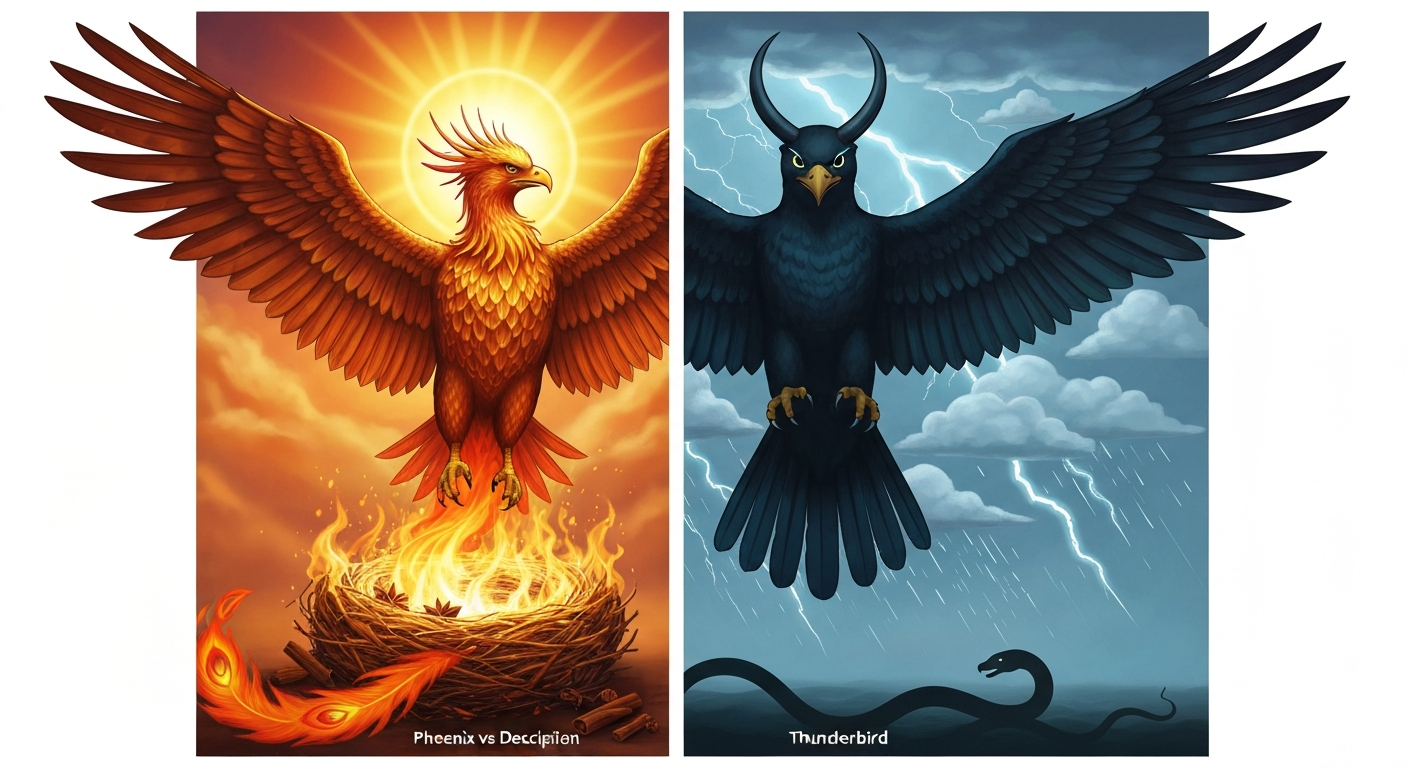
Phoenix vs Thunderbird at a glance
| Feature | Phoenix | Thunderbird |
|---|---|---|
| Cultural origin | Ancient Greece, Rome, Egypt (Heliopolis) | Indigenous North America (multiple nations) |
| Core element | Fire and sun | Thunder, lightning, and storms |
| Key power | Death and resurrection by fire | Controls weather; creates storms by wingbeats |
| Lifespan | Cyclical (commonly 500 years per classical sources) | Immortal or ageless in most traditions |
| Appearance | Eagle-like, radiant plumage, gold and red/purple | Enormous eagle or raptor, lightning bolts as eyes |
| Moral role | Symbol of renewal, eternity, imperial virtue | Protector, cosmic enforcer against water serpents |
| Main antagonist | None (internal cycle) | Underwater panther or great serpent |
| Primary sources | Herodotus, Pliny, Ovid, Egyptian Pyramid Texts | Ojibwe animikii traditions, Haida and Tlingit oral records, Northwest Coast totem art |
What the phoenix actually is
The phoenix is a mythological bird best documented in ancient Greek and Roman texts, though its roots reach back to Egyptian religious thought centered on Heliopolis. The clearest early classical account comes from Herodotus, who wrote in his Histories (Book II, §73) that Egyptian priests at Heliopolis described a sacred bird that arrived roughly every 500 years carrying the embalmed remains of its parent. Herodotus himself admitted he had never seen it and thought the story sounded incredible. Pliny the Elder gave a fuller Roman-era account in his Natural History (Book 10), describing a bird that builds a nest of aromatic spices, is consumed by fire, and regenerates from its own ashes. He also notes, with evident skepticism, that a supposed phoenix was exhibited during the reign of Emperor Claudius, though the Romans themselves regarded it as a fake.
Ovid wove the phoenix into Roman poetry, and by the medieval period Christian commentators had adopted it as a clear allegory for resurrection. This layering of Greek, Roman, and later Christian interpretation is why the phoenix feels so universal today. The Egyptian connection runs through the Bennu bird, a heron-like sacred creature tied to Ra and the benben stone at Heliopolis, referenced in the Pyramid Texts (the earliest Egyptian funerary corpus) and in papyri like the Book of the Dead. See bennu bird vs phoenix for a focused comparison. Egyptologists including Richard H. Wilkinson and Jan Assmann are careful to point out that the Bennu and the Greek phoenix are not identical: the Greek phoenix story was filtered and reshaped by Hellenistic authors, so treating them as the same being is an oversimplification. That comparison, and the phoenix's relationship to other eastern legendary birds like the vermilion bird of Chinese cosmology, is worth exploring separately. For a direct comparison, see vermilion bird vs phoenix.
What the thunderbird actually is
The thunderbird is not a single creature from a single tradition. It is a category of powerful supernatural being found across dozens of Indigenous North American nations, including Ojibwe (Anishinaabe), Blackfoot, Haida, Tlingit, and many Northwest Coast peoples. Each nation has its own specific oral traditions, names, and attributes. In Ojibwe and Anishinaabe tradition, the thunder-beings are called animikii (or animikeek in plural), and ethnographic scholarship published through academic repositories like UC eScholarship documents them as living, intentional spiritual beings tied to thunderstorm speech events, not just weather symbols. See the ethnographic study 'Calling the Thunder, Part One: Animikeek, the Thunderstorm as Speech Event in the Anishinaabe Lifeworld' (UC eScholarship) for detailed contemporary analysis of Ojibwe thunder names and ritual contexts. The Smithsonian's National Museum of the American Indian (NMAI) and classical ethnographies by Franz Boas and Herman Haeberlin, published in the Journal of American Folklore, remain central archival sources for Northwest Coast Thunderbird motifs.
In many traditions, the thunderbird's primary role is cosmic and protective: it exists in ongoing conflict with underwater beings, typically a great horned serpent or an underwater panther, representing the opposition between sky and water, upper world and lower world. Thunder is caused by the beating of its wings, and lightning by the flash of its eyes or the release of thunderbolts it carries. Thunderbird imagery appears in totem poles, regalia, and ceremonial art held in collections at museums including the Royal BC Museum, the Met, and the Cleveland Museum. It is a living, continuing part of Indigenous spiritual life, not purely historical mythology, which is an important distinction to keep in mind.
What a phoenix looks like
Classical texts describe the phoenix as resembling an eagle in overall body shape and scale, which is consistent across Greek and Roman sources. Herodotus compared its appearance to that of an eagle and noted its plumage was partly gold and partly red (sometimes described as purple in other sources). Pliny added the detail of a rose-colored neck and a tail of mixed blue and red feathers. Later artistic depictions, especially in medieval European manuscripts and Chinese adaptations (where the fenghuang absorbs some phoenix-like features), tend toward an elaborate, peacock-influenced bird blazing with gold, orange, and red tones. A crest of feathers is a common artistic addition. The key visual cue across all traditions is the association with fire and light: the bird either radiates light, is surrounded by flames, or emerges visually from fire. It is almost never shown in threatening posture and typically appears alone, serene, or in flight.
- Eagle-like body, large and upright
- Gold, red, orange, and sometimes purple plumage
- Radiant appearance, often shown glowing or surrounded by flames
- Feathered crest common in later artistic traditions
- Shown alone, not in conflict; rarely depicted aggressively
- Associated with the sun: typically depicted in daylight or at dawn
- Nest of aromatic spices (cinnamon, myrrh) is a recurring narrative prop
What a thunderbird looks like
Thunderbird representations vary significantly between nations, but a core set of visual features recurs across Northwest Coast and Plains traditions. In Northwest Coast art (Haida, Tlingit, and related peoples), the thunderbird is typically depicted as an enormous raptor, often resembling an eagle or osprey at base scale, with highly stylized curvilinear features characteristic of those artistic traditions. Curved horns or prominent ear-like projections on the head are a frequent distinguishing detail. The eyes are often shown as separate lightning bolts or are depicted with an intensity that signals supernatural power. In Plains traditions, the thunderbird is sometimes rendered more abstractly, its wings filling the whole sky.
- Massive eagle or raptor form, often depicted as larger than a human or even a whale
- Curved horns or projecting head features common in Northwest Coast art
- Eyes depicted as lightning bolts or with supernatural intensity
- Wings associated with thunder (their beating causes the sound)
- Often shown in dynamic, combative posture against serpents or sea creatures
- Highly stylized in Indigenous artistic traditions: bold lines, ovoid forms, split representation
- Color varies by tradition: not tied to fire tones; black, blue, and polychrome are all found
Side-by-side: origins, powers, and symbolism
| Category | Phoenix | Thunderbird |
|---|---|---|
| Geographic origin | Egypt (Heliopolis), Greece, Rome; later adapted in Chinese, Persian, and European traditions | North America: Algonquian, Ojibwe, Blackfoot, Haida, Tlingit, and many other Indigenous nations |
| Primary element | Fire and solar heat | Storm, thunder, lightning, and rain |
| Core ability | Self-immolation and resurrection from ashes | Generating storms; controlling weather; overpowering water beings |
| Lifespan model | Cyclic death and rebirth (500 years in Herodotus; other accounts vary) | Typically ageless or perpetually existing |
| Antagonist/conflict | None; its drama is internal and cyclical | Underwater panther, great horned serpent, cosmic water forces |
| Symbolic meaning | Rebirth, immortality, the sun, imperial power, resurrection | Cosmic protection, balance of sky and water, strength, authority over storms |
| Associated color | Gold, red, orange, purple | Variable; not fire-specific; black, white, blue, polychrome |
| Role toward humans | Passive, distant, awe-inspiring; an omen of rare good fortune | Active protector; intervenes in cosmic conflicts; can be dangerous to those who disrespect nature |
| Key texts/sources | Herodotus Histories II §73; Pliny Natural History Book 10; Ovid Metamorphoses; Egyptian Pyramid Texts (Bennu) | Ojibwe animikii traditions; Boas and Haeberlin ethnographies; NMAI collections; Northwest Coast totem and regalia records |
| Modern cultural presence | Global: heraldry, literature, fantasy, Chinese fenghuang influence | Pan-Indigenous North America: living spiritual tradition, also adopted into wider popular culture (sports logos, etc.) |
Powers and symbolism in detail
The phoenix: fire, death, and the loop of life
The phoenix's most famous power is its regeneration cycle. At the end of its long life (Herodotus puts it at roughly 500 years, though other sources vary), the phoenix builds a nest of aromatic spices, is consumed by fire, and then rises again, either from the ashes or from a worm or larva that forms in the ruins, depending on which account you follow. Pliny's version from Natural History Book 10 is among the most complete early Roman accounts, and he includes the idea that the bird carries the remains of its predecessor to the temple at Heliopolis. The core symbolic message is consistent across traditions: fire does not end the phoenix; it renews it. This made it an almost irresistible metaphor for resurrection in early Christian writing and for dynastic continuity in Chinese imperial symbolism, where the fenghuang absorbed similar renewal associations.
Beyond resurrection, the phoenix is a solar symbol. It is tied to Heliopolis, the city of the sun, and in Egyptian religious thought its precursor the Bennu was associated with Ra and the moment of creation at the benben stone. The Pyramid Texts, among the earliest religious corpora in the world, use solar and creation language around the Bennu figure. This solar dimension gives the phoenix a kind of cosmic authority: it is not merely a bird that comes back from the dead, it represents the sun's daily and annual cycle, the guarantee that light returns after darkness. In that context, its solitary nature makes sense. It does not fight; it simply endures and renews.
The thunderbird: storms, protection, and cosmic war
The thunderbird's powers are outward-facing and combative where the phoenix's are inward and cyclical. In Ojibwe and Anishinaabe tradition, the animikii are beings whose speech is the thunderstorm itself: each thunderclap is a word or action from these beings, and their presence is tied to rain, lightning, and the seasonal transition of storms. Peer-reviewed folklore scholarship in journals like the Journal of American Folklore situates the thunderbird across many traditions as an upper-world being in permanent opposition to underwater serpents or underwater panthers, representing the tension between sky forces and water forces that structures many North American Indigenous cosmologies. The thunderbird does not simply cause storms; it actively battles the forces that threaten balance in the world.
Its role toward humans is more complex and active than the phoenix's. In many traditions, the thunderbird is a protector, keeping dangerous underwater beings from threatening human communities. But it is also a being that commands respect: disrespecting the thunderbird, or the storms it governs, carries consequences. This gives it a moral and ethical dimension that the phoenix largely lacks. The phoenix is an omen; the thunderbird is an actor. In Northwest Coast traditions documented by Boas and Haeberlin, the thunderbird is often a central figure in origin stories, capable of transforming into human form and interacting directly with human characters.
Who is more powerful?
This question comes up often, and it is genuinely interesting to think about, even if it cannot have a definitive answer since the two beings come from completely separate mythological systems that never intersect. On raw destructive capacity, the thunderbird has a stronger case: it commands weather on a regional or cosmic scale, generates lightning and storms by its own movement, and actively defeats supernatural beings in combat. It is a warrior figure. The phoenix, by contrast, is not a combatant. Its power is existential rather than martial: it cannot be permanently destroyed and represents an unbreakable cycle. If the question is who would win in a fight, the thunderbird's combat role makes it the more straightforward answer. If the question is which is the more cosmically fundamental, the phoenix's solar and creation-linked symbolism (especially through the Bennu) gives it a case. The honest answer is that these are different kinds of power, designed to answer different questions for different cultures.
A similar power comparison applies when the phoenix is set against the dragon, which shares fire and elemental authority but typically represents more active, aggressive power than the phoenix does. For a focused comparison of the phoenix and the dragon, see phoenix bird vs dragon. The vermilion bird of Chinese cosmology is another close comparison point: it is a fire-associated, southern celestial being (one of the Four Symbols of Chinese astronomy) that is sometimes conflated with the fenghuang but is technically a distinct creature in scholarly sources like Lihui Yang and Deming An's Handbook of Chinese Mythology. For a focused comparison of the vermilion bird and the phoenix, including assessments of which might be considered more powerful, see vermilion bird vs phoenix who is more powerful. These distinctions between the phoenix, the vermilion bird, the fenghuang, the Bennu, and the griffon matter precisely because they each carry different symbolic weights and come from different cosmological frameworks.
Common confusions worth clearing up
The phoenix is frequently conflated with several other legendary birds and beings, and those confusions are worth addressing directly. The Bennu of ancient Egypt is the closest ancestral relative of the Greek phoenix in scholarly terms, but Egyptologists caution that they are not the same: the Bennu is a specifically Egyptian religious figure tied to Ra and the Pyramid Texts, while the phoenix as most people know it was shaped heavily by Greek and Roman literary tradition. The vermilion bird (Zhūquè) of Chinese cosmology is an astral and elemental fire bird, one of the Four Symbols, but it serves a calendrical and directional function in Chinese cosmology that the phoenix does not. The fenghuang is a broader Chinese 'king of birds' symbol with imperial and moral connotations. Treating all of these as interchangeable versions of 'the phoenix' flattens real and significant differences. See a focused comparison titled "liver bird vs phoenix" for an example of how related bird symbols can be mistaken across cultures.
The thunderbird is similarly prone to being lumped together with any large, powerful mythological bird from non-Western traditions. It is not a Native American phoenix. The two beings share very little beyond being large and supernatural. The thunderbird has no fire association, no death-and-rebirth cycle, and no solar symbolism. Its antagonist is water, not fire. Visually and symbolically, conflating them is like confusing a falcon with a cormorant because both are birds that catch prey.
Why this comparison matters for writers and designers
If you are writing a story, designing a tattoo, building a game, or creating any work that draws on these figures, the distinction between them is both practically and ethically important. The phoenix is a figure from ancient Mediterranean and Egyptian tradition that has been absorbed broadly into global culture, including heraldry, literature, and fantasy. Using it is generally unproblematic in creative contexts. The thunderbird is different: it belongs to living Indigenous North American spiritual traditions, and many nations consider it a sacred being rather than a historical mythology. Using it in commercial or creative work without understanding that context, or without appropriate engagement with those communities, is a real ethical consideration that the phoenix simply does not carry in the same way.
For game and tattoo designers specifically, the visual signatures are clear enough that mixing them produces incoherent imagery. A bird with gold and red feathers rising from flames reads as phoenix. For a related visual-comparison resource, see bearded dragon vs bird. A massive raptor with lightning-bolt eyes, horns, and a dynamic combative posture reads as thunderbird. Combining features from both without awareness of their origins produces something that communicates nothing clearly. Knowing these distinctions also helps when deciding which figure better fits your symbolic purpose: if the theme is renewal, survival through destruction, or solar cycles, the phoenix is the more directly relevant choice. If the theme is storm, protection, cosmic conflict, or Indigenous North American world-building, the thunderbird is.
FAQ
What primary sources should I consult to define and distinguish the phoenix and the thunderbird for an evidence‑based comparison?
Phoenix/Bennu: Herodotus (Histories II §73) for the Hellenic account linked to Heliopolis; Pliny the Elder (Natural History, Book 10) and Ovid (Metamorphoses) for Roman/Latin treatments; Egyptian corpora — Pyramid Texts and the Egyptian Book of the Dead (translations by R.O. Faulkner) for the Bennu material. Thunderbird: regionally appropriate primary ethnographic and oral sources — collected narratives and field notes in Northwest Coast, Great Lakes and Plains traditions (Boas; Haeberlin & Gunther; archived oral histories). For classical Chinese comparanda (fenghuang, Vermilion Bird), consult the Shan Hai Jing and early Han sources.
Which modern secondary sources and reference works are essential?
Egyptology and phoenix scholarship: Britannica (Bennu entry), standard Egyptological syntheses (Richard H. Wilkinson; Jan Assmann). Chinese birds: Lihui Yang & Deming An, Handbook of Chinese Mythology; scholarship on Four Symbols and fenghuang. Thunderbird studies: museum catalogs and peer‑reviewed folklore/anthropology journals (Journal of American Folklore); NMAI and university press ethnographies. Museum object records (Met, British Museum, Royal BC Museum) for verified images and provenance.
What specific research questions will produce the precise, ornithology‑style distinctions the article requires?
Core questions: 1) Origins/chronology — earliest textual/iconographic attestation for each bird and how the tradition developed over time. 2) Cultural context — religious, cosmological, funerary, meteorological roles (e.g., Bennu & sun cult; Thunderbird & weather/upper world). 3) Visual ID — consistent motifs (shape, plumage color, size, posture, associated objects) across reliable iconographic examples. 4) Powers/abilities and symbolism — documented attributes in primary texts and ethnographies. 5) Comparative criteria — how to operationalize “power” (ritual role, cosmological rank, supernatural feats, frequency in myth). 6) Cross‑cultural influence and conflations — where and why phoenix ↔ Bennu, fenghuang ↔ Vermilion Bird, or thunderbird ↔ other beings are conflated. 7) Variant forms and local names — track region/language variants to avoid overgeneralization. 8) Visual sources & dating — secure datable museum objects or illustrations to support ID cues.
What iconographic/visual‑ID checks should I perform when assembling images and captions?
1) Provenance & dating: prefer museum/object records with date, culture, material, and accession number. 2) Attribution: confirm curator description (e.g., labeled 'Bennu', 'fenghuang', 'Vermilion Bird', 'Thunderbird') and cross‑check scholarly catalog entries. 3) Visual features: note beak shape, crest, tail form, color scheme, recurring motifs (e.g., solar disk, flames, serpents). 4) Avoid anachronistic mixes: don’t use later European ‘phoenix’ stock art to illustrate Egyptian Bennu without noting differences. 5) File metadata & resolution: record image rights, resolution, and any restrictions in a usage log. 6) Captions: include object title, culture/period, museum or archive, accession number, and short ID cue (why it illustrates a point). 7) Alt text: concise descriptive phrase for accessibility.
What legal/image‑use checks and licensing steps are necessary before publishing images?
1) Rights metadata: consult the holding institution’s object page for rights/licensing (CC0/CC BY/All Rights Reserved). 2) Use policy: follow museum image‑use pages (e.g., The Met’s Open Access policy) and note exceptions. 3) Permissions: for non‑open images, request written permission and retain correspondence. 4) Commercial use: confirm whether the intended site use (educational vs commercial) affects licensing. 5) Attribution: comply with required credit lines exactly. 6) Reproduction quality: request high‑resolution images if needed and record any cropping/alteration policies. 7) Keep a usage log linking each image to its rights statement and permission.
How should I operationalize and research the article’s comparative “who is more powerful?” question without making unsupported claims?
1) Define 'power' categories to compare (cosmological rank, elemental control, mythic feats, ritual importance, frequency of dominion over other beings). 2) For each bird, extract only attested powers from primary/early secondary texts and ethnographies (e.g., Thunderbird’s control of storms; Bennu/phoenix associations with solar rebirth). 3) Avoid ranking by subjective aesthetics — present evidence side‑by‑side and discuss contexts where one is depicted as superior (e.g., Thunderbird vs underwater serpent). 4) Note cultural frame: some traditions do not use linear hierarchies; present comparative conclusions as conditional and evidence‑based (e.g., “Within Northwest Coast cosmology, Thunderbird is portrayed as upper‑worldly and warrior‑like; within Heliopolitan ritual vocabulary, Bennu is a solar creator emblem.”). 5) Cite sources for each claim.