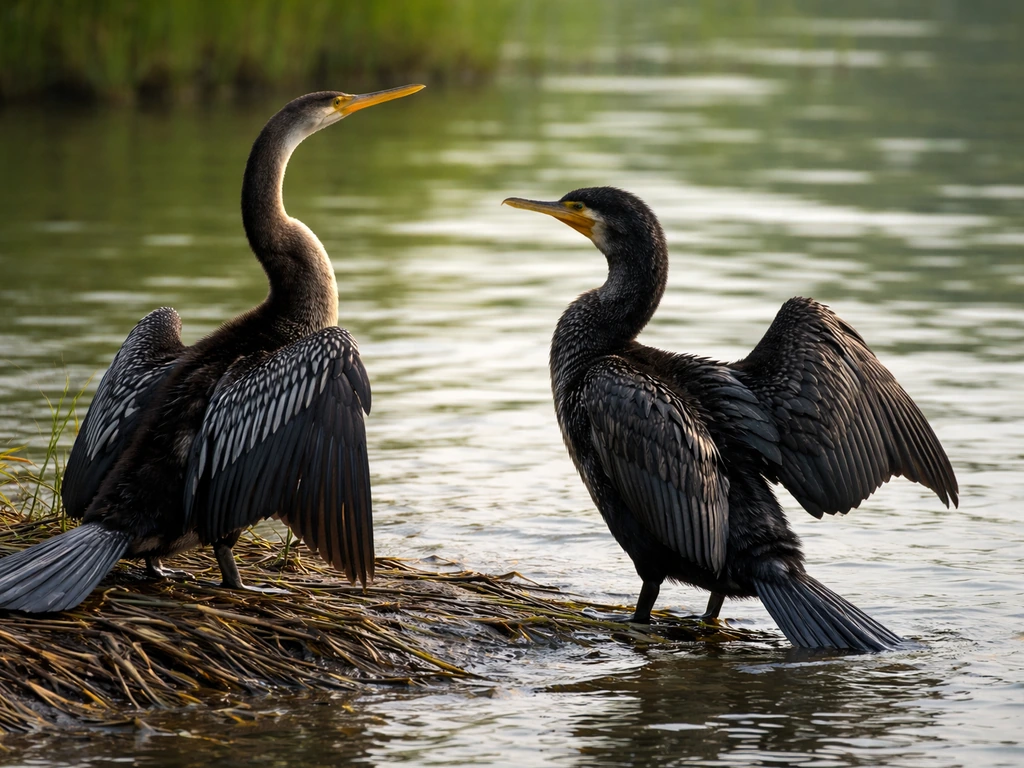
Yes, anhinga and cormorant look remarkably similar at first glance. Both are large, dark waterbirds that swim low in the water, dive for fish, and spread their wings to dry on a perch. But once you know what to look for, you can tell them apart in seconds. The single fastest check is the bill: anhinga has a long, straight, dagger-pointed bill, while cormorant has a hooked tip at the end of its bill. That one feature alone will resolve most sightings immediately.
Anhinga Bird vs Cormorant: Quick Field Guide to Differences

Marcus Hendricks
15 Apr 2026
Why people confuse anhinga and cormorant
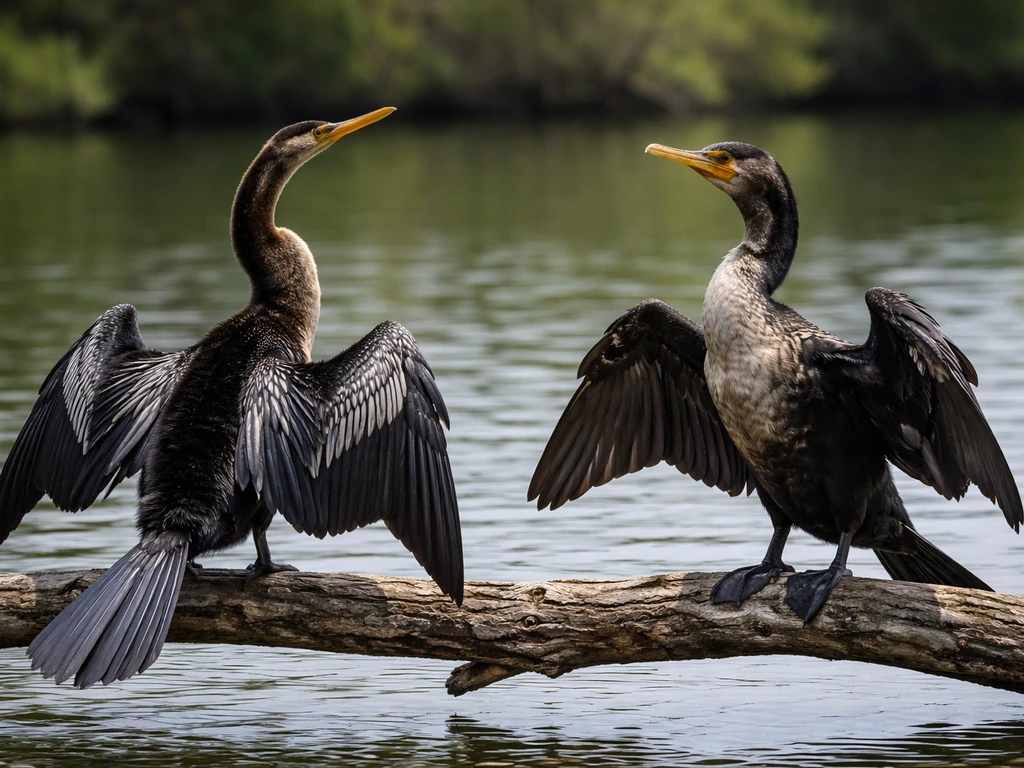
The confusion is completely understandable. Both birds are dark, roughly similar in size, found on the same lakes and rivers, and share the habit of perching with their wings spread open. When you see either one swimming, often only the long neck and small head are visible above the waterline. This "snakelike head poking above the surface" look is exactly what earns the anhinga its nickname, the snakebird, and it's also what makes a quick ID from shore so tricky. The overlap in habitat and behavior means you can genuinely see both species at the same wetland on the same morning, which compounds the confusion. People who are newer to birding often assume these two birds are basically the same species or very close relatives. They're actually not: the anhinga belongs to the family Anhingidae while cormorants belong to Phalacrocoracidae. They share a common ancestor and some convergent adaptations, but they're distinct lineages with measurable differences in anatomy and behavior.
The confusion also gets reinforced by habitat. As you'd know from comparing similar-looking waterbirds, like untangling an egret bird vs heron, the problem isn't usually a lack of differences. It's knowing which differences to look for first, and in what order. That's exactly what this guide addresses.
Best field marks to distinguish them
Bill: the fastest single ID feature
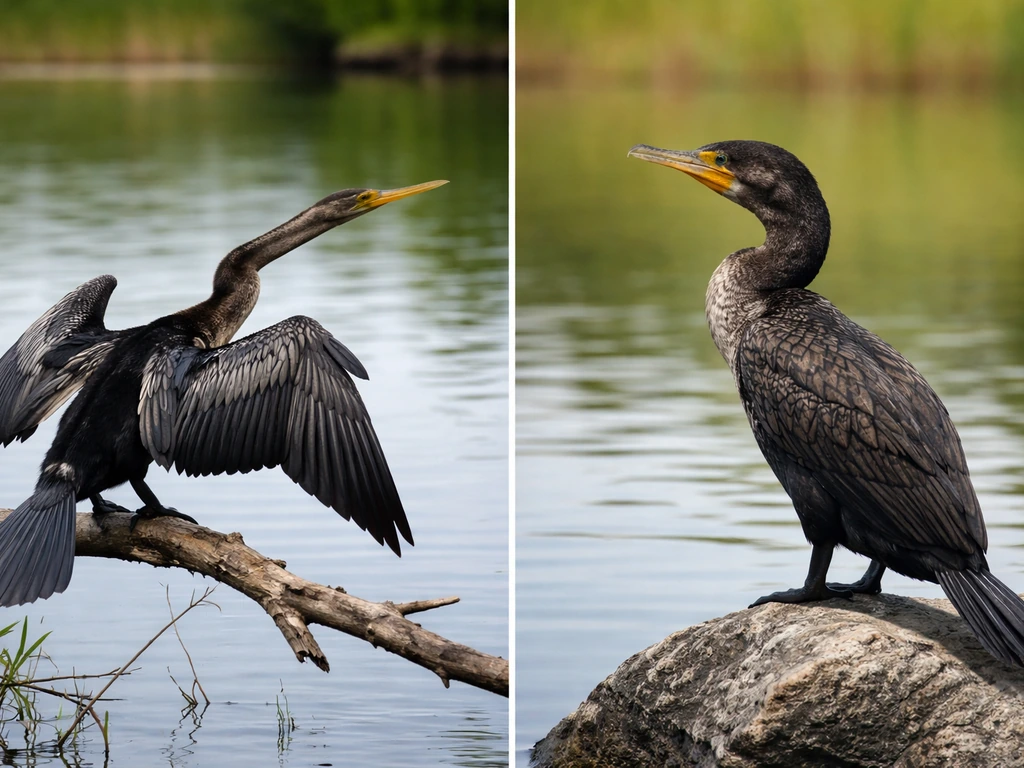
Start here every time. The anhinga has a long, narrow, dagger-pointed bill, straight from base to tip with no curve. The cormorant has a long bill too, but with a distinctly hooked tip, like a raptor's beak in miniature. This hook is visible from a reasonable distance, especially when the bird is actively looking around or eating. If you can see the bill tip and it curves downward, you're looking at a cormorant. If it's straight and sharp like a spike, it's an anhinga. This single trait resolves the ID more reliably than anything else.
Neck and tail: the silhouette check
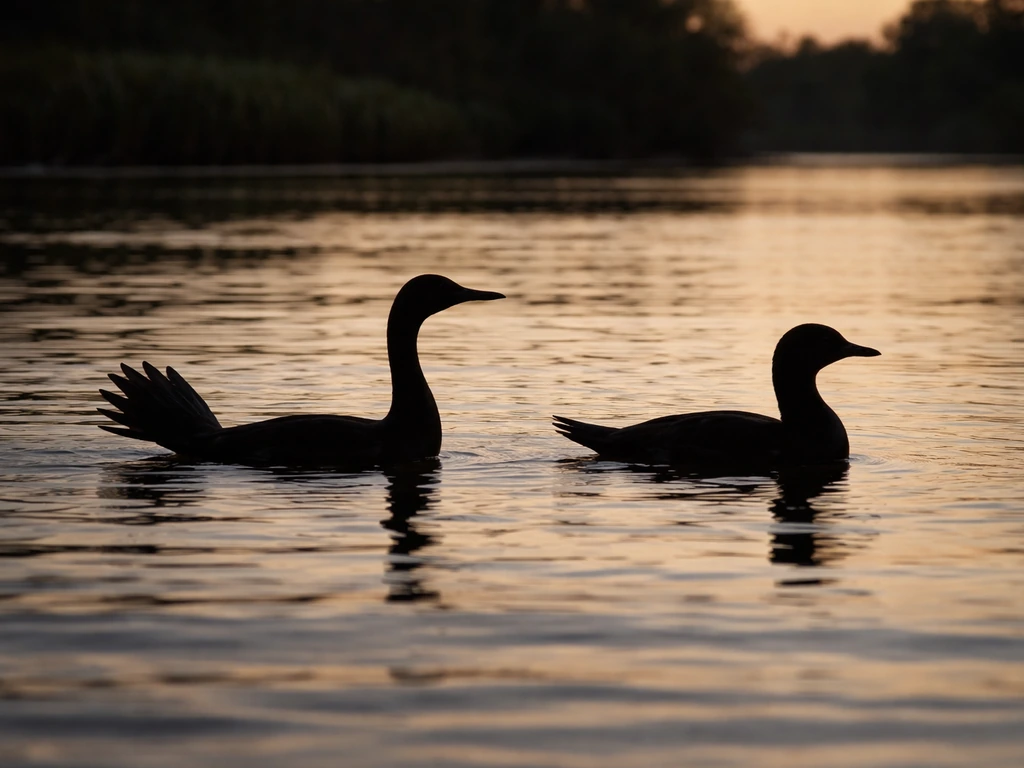
After the bill, look at overall proportions. Anhinga has a noticeably longer, thinner neck and a dramatically longer tail. The tail is fan-shaped, like an opened hand, and distinctly longer than what you'd see on a cormorant. Cormorants have shorter necks and shorter tails relative to body size, giving them a chunkier, more compact silhouette. If the bird looks lean and elongated from tip to tail, that's a strong anhinga signal. If it looks stout and rounded in the body with a relatively short tail, lean toward cormorant.
Head and wing markings
Adult anhingas have silver or whitish streaking and patches on their wings, sometimes described as silver-white plume edgings. These catch the light and give the wings a two-toned appearance that cormorants don't have. Cormorants are more uniformly dark. During breeding season, double-crested cormorants develop small tufts on the head (those are the "double crests") and have bright orange-yellow skin around the base of the bill and on the throat (the gular pouch). Juveniles show orange-yellow skin and have paler neck and breast. Adult anhingas in breeding condition develop a turquoise ring around the eye. Neither of these throat/eye features is easy to see from a distance, but in a photo they're confirmation-level detail.
| Feature | Anhinga | Cormorant (Double-crested) |
|---|---|---|
| Bill | Long, straight, pointed like a dagger | Long, with a hooked tip |
| Neck | Very long and thin | Shorter, thicker |
| Tail | Very long, fan-shaped | Shorter, stiffer |
| Wing markings | Silver/white patches and streaks | Uniformly dark |
| Throat skin | Not prominent; breeding eye ring is turquoise | Orange-yellow gular pouch, visible year-round |
| Overall silhouette | Elongated, slim, cross-shaped in flight | Stockier, more compact |
Behavior differences: how they hunt and move
How the anhinga hunts
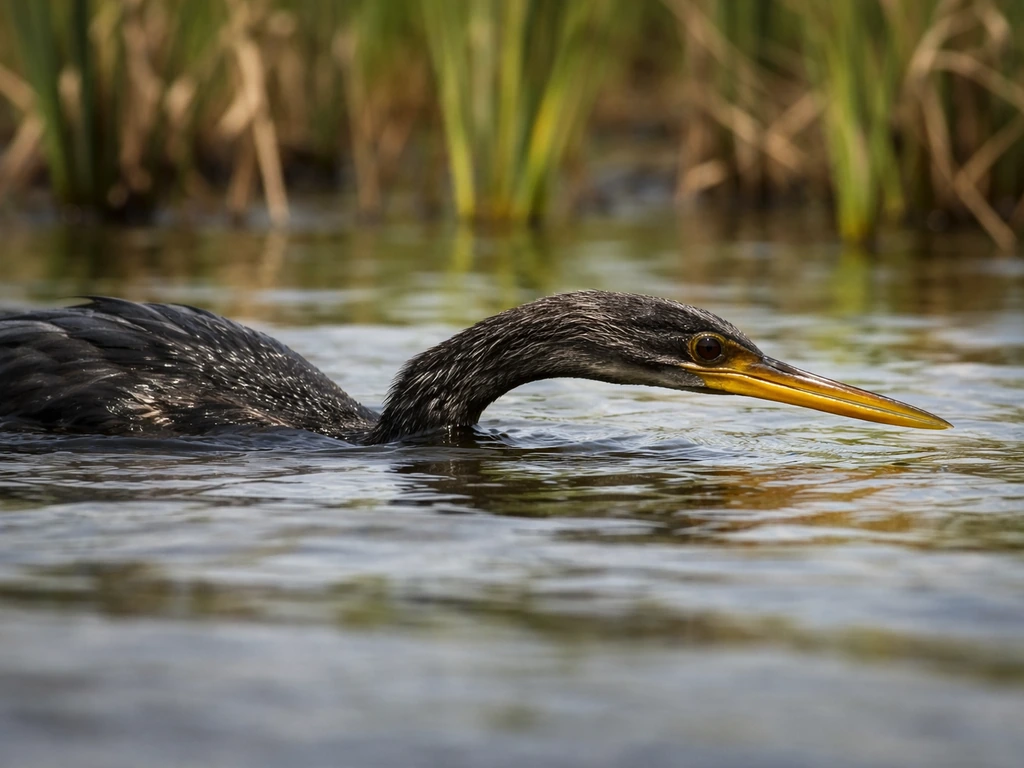
Anhinga hunting is genuinely one of the more striking things to watch in North American wetlands. The bird swims slowly just below or at the surface, stalking prey, and often you'll only see that snakelike neck and head above the waterline. When it spots a fish, it cocks its neck into an S-curve (Audubon describes this as "almost like a cobra's") and then fires it forward in a lightning-fast strike, impaling the fish on that pointed bill. After surfacing with the catch, the anhinga tosses the fish into the air, repositions it headfirst, and swallows it whole. This is the sequence to watch: stealthy surface glide, sudden dive or underwater stalk, then the toss-and-swallow on the surface. The anhinga's feathers are not waterproofed, which is what allows it to submerge easily rather than being buoyed up. That same lack of waterproofing is why it needs to dry off after fishing, which we'll get to in the next section.
How the cormorant hunts
Cormorants are more direct divers. They don't do the slow surface-stalk the way anhinga does. Instead, they plunge beneath the surface and chase fish actively with powerful propulsion from their webbed feet. The chase is fast and more athletic than the anhinga's spear-and-stab method. Cormorants grab fish with that hooked bill rather than spearing them. After surfacing, they typically manipulate the fish and swallow it, but without the dramatic mid-air toss that anhingas often perform. Watching the hunting technique from a kayak or from shore is one of the most reliable behavioral IDs you can make, because the two styles are genuinely distinct once you've seen them both.
Perching and wing-drying: how to read the posture
Both anhinga and cormorant spread their wings open after diving. This is the behavior most people photograph, and it's a reason people conflate the two species. But there are useful differences here too. Both birds spread wings because their feathers absorb water during diving rather than repelling it. Both anhinga and cormorant spread their wings because their blank" rel="noopener noreferrer">feathers absorb water during diving rather than repelling it, and this helps explain why cormorants can emerge differently after deep dives. The cormorant spreads wings primarily to dry feathers after fishing. The anhinga does this too, but research suggests anhingas also use the posture for thermoregulation, essentially using spread wings to absorb solar energy in addition to drying out. In practical terms, anhinga tends to stay in the wings-spread position for longer, and you'll often see it perched in full sun with wings extended for extended stretches even when it hasn't just been diving. The cormorant typically dries off and folds back up more quickly.
The perch choice is also a useful clue. Cormorants are highly gregarious and colonial. They often dry off in groups on exposed docks, channel markers, power lines over water, or rocky outcrops. You'll frequently see a row of cormorants all spread-winged together. Anhingas tend to be more solitary perchers, and they favor branches of trees or shrubs at the water's edge, often over swampy or slow-moving water. If you see a cluster of spread-winged dark birds on a dock piling, cormorant is the much more likely call. If it's one bird alone on a low branch overhanging a swampy creek, think anhinga first.
This kind of perch-posture reasoning is similar to the work involved in egret bird vs crane identification, where body posture and habitat context do as much work as plumage details.
Habitat, range, and where to expect each bird
Range is one of the most useful pre-filters you can apply before you even raise your binoculars. Anhinga in North America is largely a southern bird. It's common in Florida, coastal Texas, Louisiana, and the southeastern states generally. You'll find it in cypress swamps, slow-moving rivers, wooded ponds, and the sheltered shallow waters of places like the Everglades. It needs both calm water for hunting and nearby perches with good sun exposure for drying. If you're in the northern U.S. or Canada and you're seeing a spread-winged dark waterbird, it is almost certainly a cormorant, not an anhinga. Anhingas do move seasonally and can show up at the margins of their range, but they are not expected in, say, Minnesota or Ontario.
The double-crested cormorant, which is the species you're most likely to encounter in a freshwater context in North America, has the widest range and greatest adaptability of any North American cormorant. It occurs throughout the continent, from coastal Alaska down to Florida, and inland on lakes, rivers, reservoirs, and impoundments wherever fish are abundant. Interior and northern populations migrate south and southeast in winter, which expands the cormorant's footprint in the southeastern states during the months when anhinga is also present there. That seasonal overlap in the southeast is exactly when the "is that an anhinga or a cormorant?" question gets asked the most.
For context on how ocean-going birds compare to these freshwater diving specialists, frigate bird vs albatross covers the kind of large, soaring seabirds that inhabit a completely different ecological niche but are sometimes similarly confused by new observers at the coast.
It's also worth knowing that in some parts of the range, especially in Texas and Central America, the Neotropic cormorant overlaps with both the double-crested cormorant and the anhinga. The Neotropic is smaller than the double-crested, with a longer tail and a different gular pouch shape. If you want a deep dive into that three-way ID puzzle, the snake bird anhinga vs cormorant comparison specifically addresses the Neotropic overlap. For most of North America, though, double-crested cormorant is what you're dealing with.
Quick identification checklist and what to photograph
Here's the decision sequence I'd run through in real time when you spot a dark waterbird on a river or lake:
- Check the bill first. Straight and pointed like a spike? Anhinga. Hooked tip? Cormorant. This single check resolves most sightings.
- Look at the tail. Dramatically long and fan-shaped? Anhinga. Short and stiff? Cormorant.
- Assess the neck length and body proportions. Very long, thin neck and a lean overall silhouette? Anhinga. Stockier and more compact? Cormorant.
- Check for wing markings. Silver or white patches on dark wings? Anhinga. Uniformly dark wings? Cormorant.
- Look at the throat and face. Orange-yellow skin or pouch at the base of the bill? Cormorant. No prominent throat pouch? Lean anhinga.
- Observe the hunting behavior. Slow surface stalk with cobra-neck strike and impaled fish? Anhinga. Active underwater chase and hooked-bill grab? Cormorant.
- Note the perch context. Solitary bird on a low branch over a swampy creek? Anhinga more likely. Group of birds spread-winged on a dock or rock? Cormorant more likely.
- Check your location. Are you in the southeastern U.S. near slow-moving, sheltered water? Both are possible. Are you in the northern U.S. or Canada? Almost certainly cormorant.
What to photograph or record for confirmation
If you have a camera or a phone, focus your shots on these specific targets in order of priority: (1) the bill tip in profile, because bill shape is the decisive feature and a clear side-on shot of the bill settles the question definitively; (2) the full body in profile to show tail length and body proportions; (3) the upper wing surface to check for silver or white markings; (4) the throat and face area for the gular pouch color if the bird is cooperative. Video is especially useful if you can capture the hunting sequence, because the cobra-neck strike and fish-impaling behavior are unmistakable for anhinga. Just a few seconds of a bird actively hunting resolves the ID without needing to see bill detail clearly.
Once you have a photo, cross-check your sighting against eBird's species pages for anhinga and cormorant. eBird describes the anhinga as a "long-necked 'snake bird'" that "dives underwater and spears fish with dagger-like bill," which matches the bill-first field ID approach this guide recommends. Run a range check on eBird Status and Trends using the current season to see whether anhinga occurrence is expected in your location right now, since that platform estimates occurrence within each season using historical data and can tell you whether an anhinga report is plausible where you're standing. Similarly, All About Birds maintains detailed ID pages for both species with range maps that help you interpret marginal sightings.
For anyone interested in how other iridescent or brightly-colored waterbirds compare in terms of ID strategy, the neelkanth bird vs kingfisher article applies the same kind of bill-shape-first approach to a different but similarly colorful group of fish-eating birds. The principle is consistent: bill shape and hunting behavior together outperform color as ID tools in almost every waterbird comparison.
To summarize: the anhinga-cormorant confusion is real but solvable in seconds once you train your eye to check the bill first. Straight and pointed means anhinga. Hooked tip means cormorant. Back that up with tail length, neck length, wing markings, and perch context, and you'll be calling these birds correctly from shore without hesitation.
FAQ
What should I do if I cannot clearly see the bill tip in the field?
If you only get a distant, straight-on view where the bill tip is unclear, prioritize body shape and behavior. Anhinga look more elongated (especially the long, thin neck and longer tail), and their hunting often includes that S-curve neck and a fish-impaling strike rather than an immediate dive. Cormorants more often plunge and chase actively underwater without the slow stalking look.
How can I tell anhinga from cormorants when I’m looking at juveniles or immature birds?
Yes, juveniles can confuse you because some of the adult throat or face colors are less obvious. In photos, don’t rely on wing streaks alone, because lighting can hide them. Use the bill tip profile first, then check tail length and overall silhouette (anhinga look leaner with a longer tail).
Does the wings-spread drying behavior always identify which species it is?
Wing-spread behavior overlaps, so treat it as a supporting clue, not the main ID. If the bird stays with wings extended for a long time in full sun, especially after what looks like surface fishing or repeated short movements at the waterline, lean anhinga. If the bird dries briefly and folds back quickly, lean cormorant.
What’s the most reliable behavioral cue if both birds are perched with wings spread?
Where the bill is hard to judge, look for hunting style as your tiebreaker. Anhinga usually perform a visible neck cocking movement before the strike and may toss the fish on the surface. Cormorants are more likely to disappear quickly below the surface and reappear after actively pursuing, with the hooked bill doing the work.
Can range alone help, or is it risky to rely on it?
Season and location can prevent wasted effort. In North America, anhinga are expected mainly in the warmer southern range, and seeing one in places like the northern U.S. or Canada is uncommon. If you’re outside the typical anhinga region and you spot a spread-winged dark bird, it’s far more likely to be a cormorant.
How should I photograph from a kayak or moving boat to avoid the wrong ID due to angles?
Birding from a moving boat changes your angles. Try to get a side-on frame of the bill in profile, because bill shape is decisive when viewed from the correct angle. If the bird is angled away, shoot a short burst as it turns, since the hooked tip becomes obvious only in the right orientation.
What video length or content is enough to confirm anhinga vs cormorant?
Use real-time recording if you can. A 5 to 10 second clip that includes the hunting sequence is often more conclusive than a still photo. Anhinga’s cobra-like neck movement and fish-impaling strike are distinctive, while cormorants typically show a different dive-and-chase rhythm.
How much does group behavior (colonies vs solitary birds) matter for ID?
When you see a group of birds, default toward cormorant because they are often colonial at drying sites like docks, channel markers, or power lines over water. When you see a single bird drying on a low overhanging branch at the water’s edge, especially in swampy or slow-moving water, anhinga becomes the stronger candidate.
What should I watch for in areas where Neotropic cormorants overlap the anhinga range?
Yes, there are edge cases outside the double-crested context. In parts of Texas and Central America, Neotropic cormorants can overlap, and they are smaller with differences in tail and gular pouch shape. If your bird looks smaller than expected and you can see throat details in a clear photo, consider checking for that overlap.
What are common mistakes when people confirm an ID from a photo after the fact?
If your photo is blurry, don’t guess based on color. Prioritize whether the bill tip shows curvature or whether the bird’s outline shows the longer anhinga tail and thinner, elongated posture. Then use a seasonal range check to confirm plausibility, because a wrong range assumption leads to repeat misidentifications.
Next Article
Snake bird Anhinga vs Cormorant: Field Marks to Tell Apart
Anhinga vs cormorant: key field marks, neck posture, bill shape, wing-drying and diving cues to identify fast.