Once you know what to look for, a frigate bird and an albatross are actually pretty easy to separate. The single fastest clue is the tail: frigatebirds have a long, deeply forked tail that opens like scissors when they steer, while albatrosses have a short, blunt, wedge-shaped tail. Add to that the overall body proportions, the way each bird flies, and where in the world you are, and you can nail the ID in seconds. Here is exactly how to do it.
Frigate Bird vs Albatross: Key Field Marks to Tell Them Apart

Marcus Hendricks
30 Apr 2026
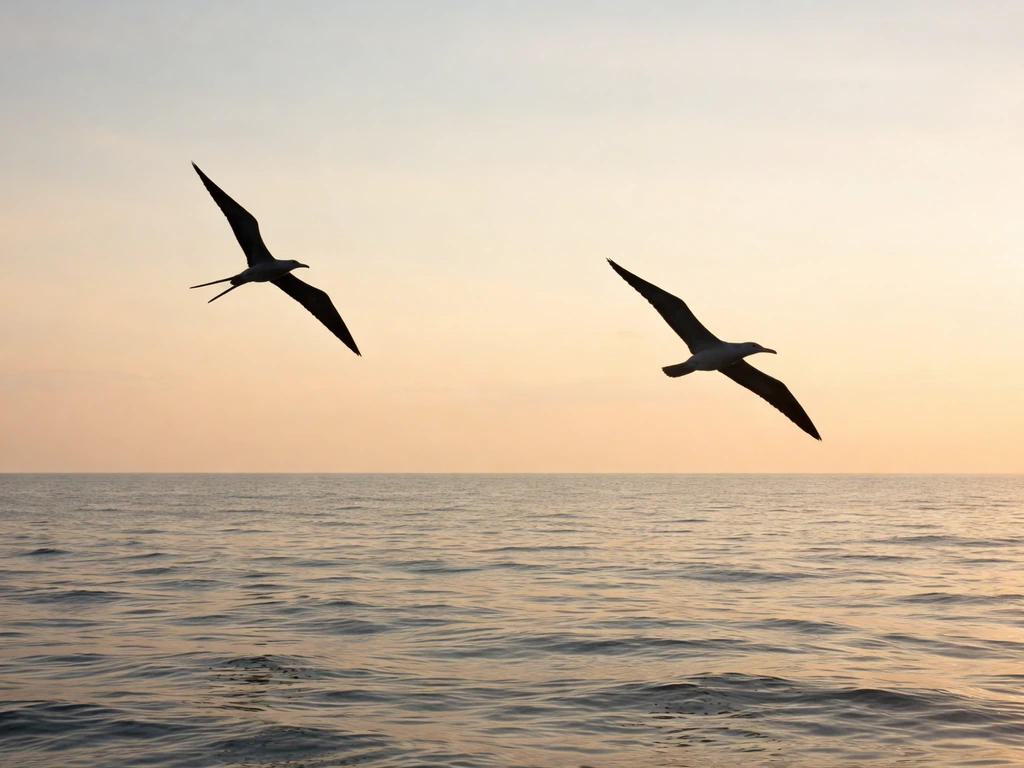
Quick ID check: size, shape, and overall silhouette
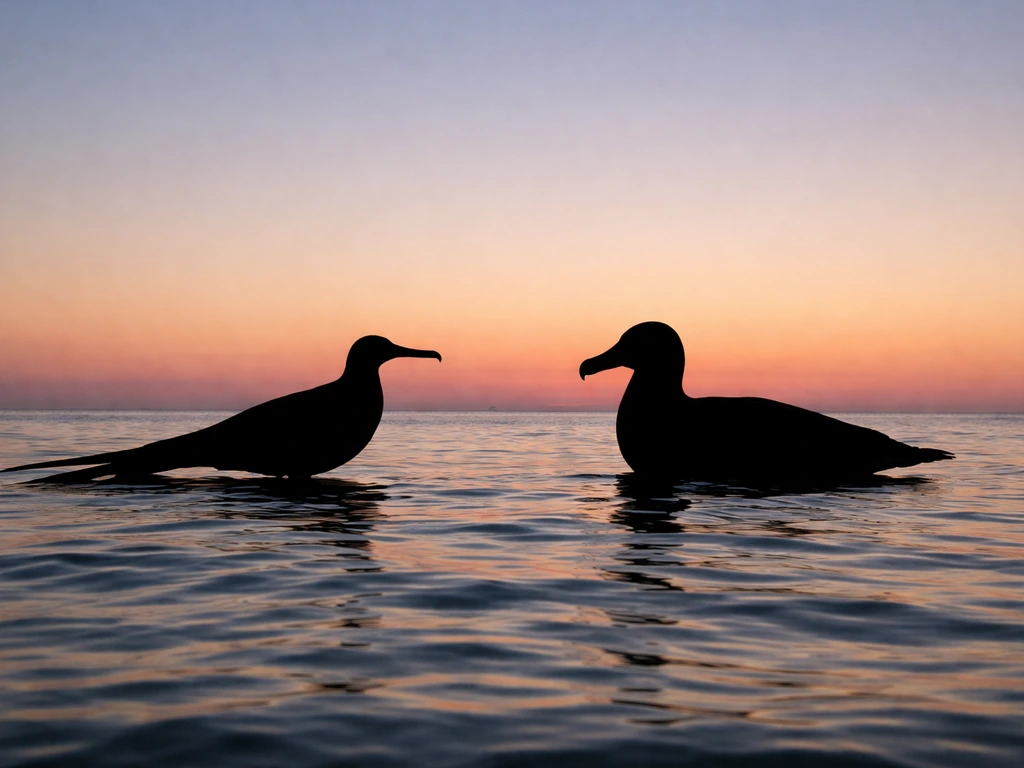
Both birds are large, dark, long-winged seabirds, which is exactly why people mix them up at a distance. But their body plans are very different once you slow down and look.
The Magnificent Frigatebird is long and lightly built, almost skeletal in profile. Its body length runs 89 cm or more, but most of that is a long neck, a long tail, and a long bill. It weighs surprisingly little for its size. The wings are long, narrow, and sharply angled at the wrist, giving the bird a distinctive bent-wing silhouette that looks almost like a flying letter M or a pterodactyl. The deeply forked tail is the clincher: when fanned, it opens into a dramatic V-shape. When closed, it looks like a single long spike.
Albatrosses are built completely differently. Take the Black-footed Albatross as a reference point for North Pacific observers: it measures about 64 to 74 cm in body length, which is actually shorter than a frigatebird, but it is far heavier and more solidly constructed. The head and neck are thick and heavy, the bill is massive and hooked, and the tail is short and rounded. Wandering Albatrosses push the wing-span to roughly 11 to 12 feet tip to tip, which is among the largest of any living bird. Even the smaller albatross species project a sense of heft and solidity that no frigatebird can match.
| Feature | Magnificent Frigatebird | Albatross (e.g. Black-footed) |
|---|---|---|
| Body length | ~89 cm (35 in) or more | ~64–74 cm (25–29 in), but heavier |
| Wingspan | Up to ~2.3 m (7.5 ft) | Up to ~3.5 m (11–12 ft) in largest species |
| Build | Lightly built, skeletal | Heavy, thick-necked, solidly built |
| Tail shape | Long, deeply forked (scissor-like) | Short, blunt, wedge-shaped |
| Wing angle | Sharply kinked at wrist, bent-wing look | Long, straight, held flat or slightly bowed |
| Overall impression | Angular, buoyant, 'paper airplane' | Massive, gliding, 'flying plank' |
Key field marks on wings and flight style
Flight style alone will separate these two birds almost every time, even at long range where color details wash out.
Frigatebirds are acrobatic and restless. They use strong, deep wingbeats punctuated by soaring, and they steer constantly with that forked tail, opening and closing it to bank and pivot. Their wings have a sharp angular kink at the wrist that makes them look perpetually bent. You will often see them circling high over coastal areas or swooping low to snatch something from the water's surface, all while looking impossibly light and maneuverable for their size.
Albatrosses do the opposite. They are the masters of dynamic soaring: they lock their wings nearly straight out, tilt into the wind, and use the speed gradient between the ocean surface and the air above it to gain and maintain altitude without flapping. For long stretches, they barely move their wings at all. The result is a gliding, arcing, almost mechanical flight pattern that hugs the wave contours. You will not see an albatross banking sharply or chasing another bird. They are built for endurance over open ocean, not agility.
Bill, head, and face pattern differences
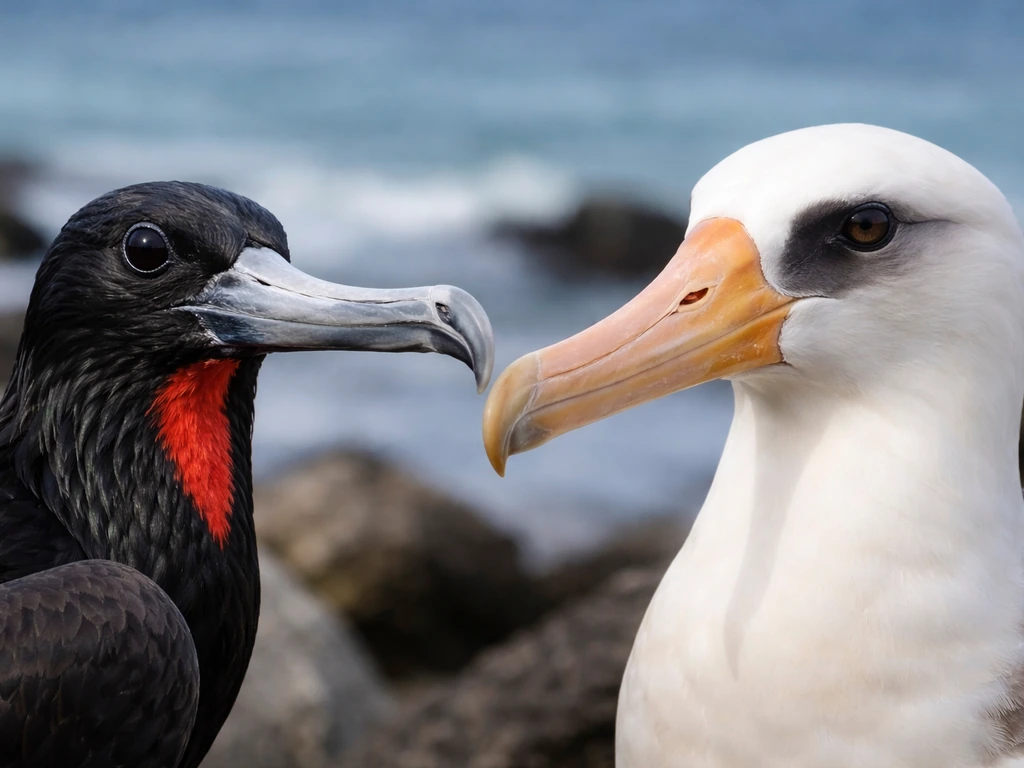
Both birds have long, hooked bills, so the bill shape alone will not save you. You need to look at the whole head.
The frigatebird's head is relatively small and sits on a long, slender neck. The bill is long with a strongly hooked tip. In adult males during breeding season, the most dramatic feature is the gular sac: a bare patch of bright scarlet or red throat skin that inflates like a balloon during courtship displays. Away from the breeding colony, that sac is deflated and far less obvious, but the skin patch is still visible if you are close enough. Females and immatures have a white belly and chest with a white head patch (in immatures), which is a useful mark when the bird is overhead.
Albatrosses have a completely different head profile: thick, heavy, and large, with a massive bill that has a distinctive tube-nose structure along the top and a pronounced hook at the tip. blank" rel="noopener noreferrer">The Black-footed Albatross shows a white ring around the base of its dark bill and white patches around the face. The overall impression is of a powerful, front-heavy bird rather than the sleek, elongated look of a frigatebird. If the bird you are watching has a tiny head on a long neck, it is a frigatebird. If it has a big, bulky head that looks almost too large for the body, you are looking at an albatross.
Habitat and range: where to find each bird
Geography is one of the most powerful quick-ID tools available, and it often resolves the question before you even raise your binoculars.
Magnificent Frigatebirds are tropical and subtropical birds. Their colonies are spread across the islands and coasts of tropical America, from the Caribbean through Central America and into the tropical Pacific. They are regularly seen along the coasts of Florida, Texas, and the Gulf of Mexico, and non-breeders and immatures wander widely, sometimes turning up far from any colony. If you are standing on a tropical beach watching a large black bird soaring overhead, a frigatebird is a very strong bet.
Albatrosses occupy completely different real estate. The Black-footed Albatross is the one most North American birders will encounter: it is essentially restricted to the North Pacific, ranging from Alaska and California across to Japan, and is the only albatross seen regularly off the North American coast. The Wandering and Black-browed Albatrosses are birds of the Southern Ocean, circling Antarctica on those enormous wings. The Black-browed Albatross has a tendency to push into the North Atlantic occasionally, which can create confusion. Bottom line: if you are on a pelagic trip in the North Pacific, far out to sea, an albatross is plausible. If you are near tropical coasts, it is almost certainly a frigatebird.
| Bird | Primary Range | Typical Habitat |
|---|---|---|
| Magnificent Frigatebird | Tropical Americas, Caribbean, Gulf of Mexico, tropical Pacific | Coastal, nearshore, over coral reefs and mangroves |
| Black-footed Albatross | North Pacific (Alaska to California, Japan) | Open ocean, far offshore pelagic waters |
| Wandering Albatross | Southern Ocean, circumpolar | Open ocean, far from land except when breeding |
| Black-browed Albatross | Southern Ocean, occasional North Atlantic | Open ocean, subantarctic islands for breeding |
Behavior and diet: foraging and breeding habits
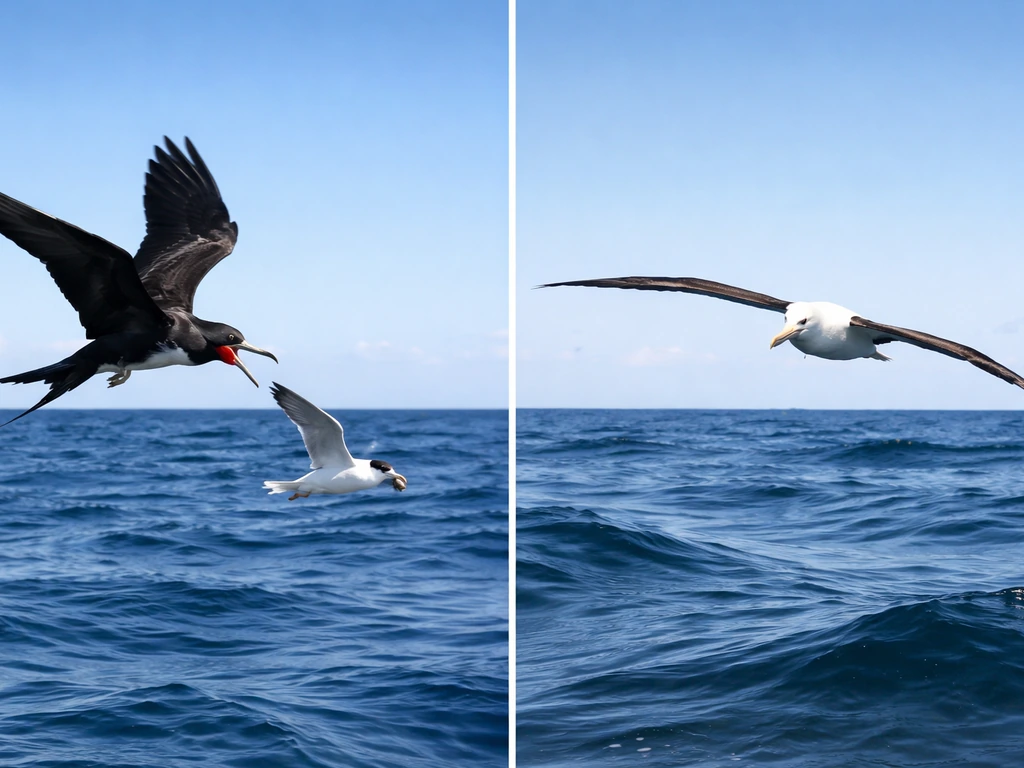
How a bird feeds is one of the most reliable behavioral ID cues in the field, and these two species could hardly be more different. If you are specifically comparing a neelkanth bird versus kingfisher, use the same kind of step-by-step checklist approach used here for seabirds neelkanth bird vs kingfisher. If you want a similar comparison approach, check anhinga bird vs cormorant next, since their field marks and behaviors also contrast well.
Frigatebirds are aerial predators and opportunists. If you are also trying to tell an anhinga from a cormorant, compare how the birds feed and perch, since those habits can be as telling as body shape snake bird anhinga vs cormorant. They snatch flying fish and squid from the ocean surface in flight, barely getting their feathers wet (they actually cannot land on the water safely because their feathers are not waterproofed the way a gull's are).
They are also notorious kleptoparasites: they will chase and harass boobies, terns, and other seabirds in flight, forcing them to drop or regurgitate their catch, then stealing it mid-air. Watching a frigatebird barrel-roll after a booby is one of the more spectacular things you will see on a tropical coast.
Albatrosses feed very differently. They scavenge and surface-seize: they settle on the water, scan for squid, fish, and carrion, and pick food from the surface or make shallow dives. They follow fishing vessels for offal and discarded bycatch, which is one of the reasons they are so vulnerable to longline fisheries. An albatross sitting on the water is a completely normal sight. A frigatebird sitting on the water is essentially never seen.
Nesting and lifecycle differences (breeding colony traits)
Both birds breed colonially, but their colonies look, sound, and feel completely different, and visiting one will make the ID second nature.
Frigatebird colonies are found in coastal trees, shrubs, and sometimes on the ground when vegetation is unavailable. The scene at a Magnificent Frigatebird colony during breeding season is unforgettable: males sit in the vegetation with their scarlet gular sacs fully inflated to the size of a small balloon, rattling and drumming to attract females flying overhead. Each pair raises a single white egg. The male sticks around for roughly three months after hatching to help guard the chick, then departs, leaving the female to raise the young bird alone for up to about a year.
Albatross colonies are found on remote, windswept offshore islands with little human access. The Short-tailed Albatross, for example, nests on just a handful of islands. Adults take turns on very long foraging trips, sometimes lasting two to three weeks, while their partner stays at the nest. Chicks are initially fed stomach oil, a rich energy source. Black-footed Albatrosses at Midway Atoll famously nest right on the grassy borders of the old airstrip and among introduced ironwood trees, making them unusually easy to observe at close range for an albatross.
Confusion traps and how to avoid misidentification
Even experienced birders get tripped up by a few specific situations. If you want a quick comparison, an egret bird versus heron is another common mix-up people run into when looking at long-legged waders mix them up. Here are the most common ones and how to work through them.
- Immature plumage: Young frigatebirds have white heads and white bellies, which can make them look pale and unfamiliar. They still have the forked tail and angular bent-wing silhouette, so focus on structure, not color, when dealing with immatures.
- Backlit or silhouetted birds: Strong overhead light or a bright sky can wash out all color and pattern. In this situation, the tail shape is your best friend. Look for the forked V of the frigatebird versus the short, blunt tail of the albatross before anything else.
- Distance: At long range, both birds look like big dark shapes. Check the flight style: is it banking and steering actively (frigatebird) or locked-wing gliding in arcs over the waves (albatross)?
- Wrong ocean: If you see what looks like a large dark soaring seabird in the tropics and think 'albatross,' pump the brakes. Albatrosses are almost never in tropical coastal waters. The tropical default is frigatebird. Similarly, if you are well offshore in the North Pacific in cold water and see a large, heavy, gliding bird, it is almost certainly not a frigatebird.
- Mixed flocks: Frigatebirds sometimes appear near areas where other large seabirds are foraging. Cormorants and anhingas can cause confusion at a distance in certain light conditions, in the same way that egrets and herons or cormorants and anhingas can fool observers scanning a mixed group. Focus on tail shape and wing angle as your first check.
- Deflated gular sac: Outside of breeding season, male frigatebirds have a flat, unremarkable throat patch. Do not expect the red balloon. Instead, rely on the structural marks that work year-round: forked tail, angular wings, and slender build.
A simple decision path for the field
- Where are you? Tropical coast or nearshore tropics: default to frigatebird. Cold open ocean far offshore (especially North Pacific or Southern Ocean): default to albatross.
- What does the tail look like? Deeply forked or spike-like: frigatebird. Short, blunt, wedge: albatross.
- How is it flying? Active banking, steering, acrobatic soaring: frigatebird. Long locked-wing glides arcing over the waves: albatross.
- What does the head and build look like? Small head on a slender neck with a long kinked body: frigatebird. Thick heavy head and neck, massive bill, stocky build: albatross.
- Is it on the water? If yes, it is almost certainly an albatross. Frigatebirds almost never land on water.
- Is it chasing or harassing another bird? That is kleptoparasitism, which is a frigatebird behavior. Albatrosses do not do this.
Run through those six checkpoints in order and you will have a confident ID in nearly every situation you are likely to encounter. The tail shape and flight style will close the case well before you get to step four in most sightings. Once you have watched a frigatebird work a colony or seen an albatross lock its wings and arc across the Southern Ocean swells, you will never mix them up again. If you want a quick way to compare, think egret bird vs crane and use the same kind of side-by-side field markings approach never mix them up again.
FAQ
What should I do if the tail is not clearly visible, for example when the bird is flying away from me?
Fall back to the flight mechanics. Frigatebirds repeatedly steer and pivot with noticeable wing kinks, and their wings often look sharply angled at the wrist. Albatrosses tend to hold wings nearly straight and produce long, efficient glides with minimal banking.
Can immature birds be confusing, and what field mark still works?
Yes. Non-breeding adults and immatures can lack the dramatic throat patch on frigatebirds, but the overall proportions and tail shape still hold. Also, albatrosses keep the bulky, front-heavy head and massive tube-nosed bill feel, even when they are not showing adult breeding features.
How can I tell them apart when both birds are perched on a boat or near fishing activity?
Use posture and feeding habit. Frigatebirds are rarely seen resting on the water and are more likely to hover or remain in the air before snatching prey, while albatrosses commonly sit on the water and surface-seize or scavenge, including around vessels for offal.
What if I am unsure about the location, for example a bird is far offshore from a tropical coast?
In that case, prioritize behavior plus tail. Geography helps most, but if the flight is acrobatic with frequent steering, think frigatebird. If it is a long, arcing, wave-hugging glide with little wing movement, think albatross, even outside the expected range.
Are there look-alikes within “frigatebird” that could throw off the ID versus “albatross” species?
Within frigatebirds, the key is the long, deeply forked tail that opens like scissors when maneuvering, plus the narrow, lightly built profile. Within albatrosses, the short, wedge-like tail and the heavy, tubular bill structure are usually more reliable than color because plumage can look similar in distance or low light.
Do weather and lighting change the ability to ID them by color or size?
Yes, and that is why you should not rely on darkness or silhouette size alone at range. Over rough water or backlit conditions, color details wash out, but tail shape and wing posture remain the fastest cues. If you can, track the bird for a few seconds until it banks, then reassess based on steering style.
How long should I watch before making a call if I only got a quick view?
If you saw a clear bank or turn, you can likely ID within a few seconds because frigatebirds show pronounced steering with the tail and angular wing posture. If you only saw straight-line gliding, wait for at least one maneuver or for a landing opportunity, since albatross behavior often gives away the difference.
What are common mistakes birders make when using “bill shape” as the main clue?
Overlooking that both groups have hooked bills, so bill alone can mislead. Instead, judge head profile as a whole, especially the relative head bulk (albatrosses look front-heavy with a large tube-nosed bill) versus the sleeker, smaller head on a long slender neck (frigatebirds).
How can I use feeding behavior without getting close to wildlife?
Watch from a safe distance and focus on how the bird interacts with the water. A frigatebird typically captures prey from the air and is associated with harassing other birds for their catch, while an albatross more often scans, settles on the surface, and follows for offal or makes shallow dives.