If you've spotted a dark, long-necked bird swimming or perching near the water and you're not sure whether it's an Anhinga (the "snake bird") or a cormorant, you're in good company. These two birds share enough visual overlap to fool even experienced birders at a glance. But once you know exactly where to look, the ID becomes straightforward. The short answer: check the bill first. An Anhinga has a straight, dagger-sharp bill. A cormorant has a hooked bill. That single detail will solve most of your confusion right there.
Snake bird Anhinga vs Cormorant: Field Marks to Tell Apart

Marcus Hendricks
6 Apr 2026
Quick ID: where the confusion comes from
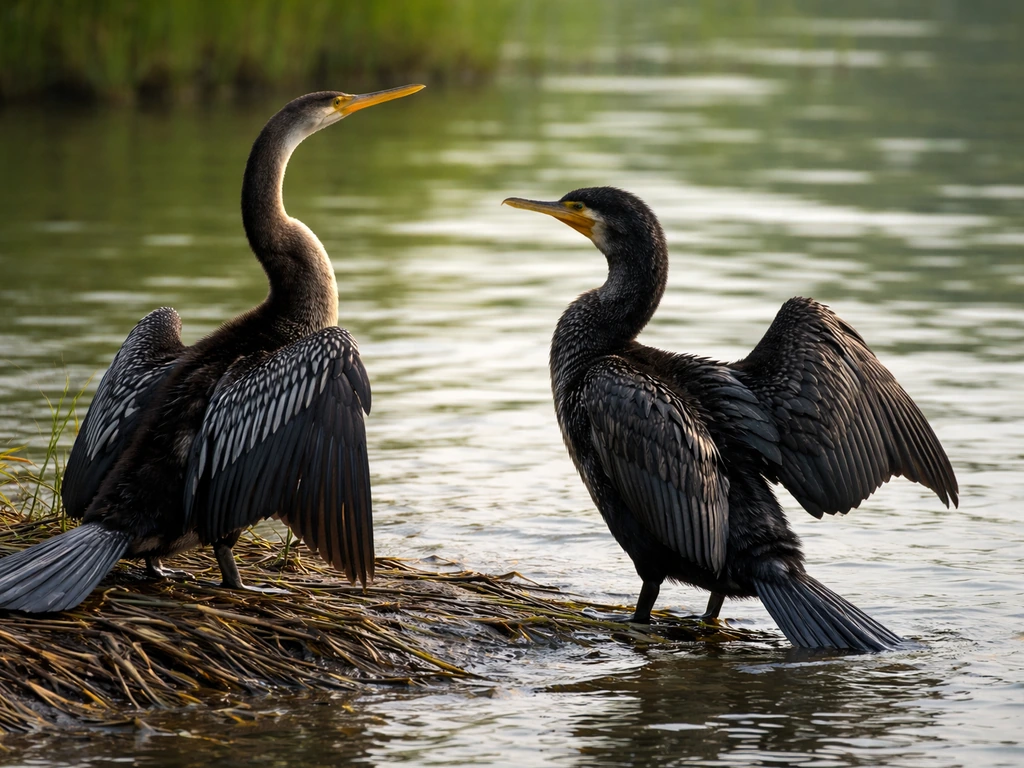
Both the Anhinga and the cormorant are dark-bodied, long-necked birds that dive underwater to catch fish and then perch with their wings spread out to dry. From a distance, especially on a glittery water surface, that general silhouette can look nearly identical. The problem is that most people rely on that broad impression ("dark bird, dives, spreads wings") and stop there. That's exactly the trap. Wing-drying, for example, is a behavior both birds share, so it's a supportive clue at best, not a reliable ID on its own.
The confusion is also partly a name problem. "Snake bird" is a well-established colloquial nickname specifically for the Anhinga, not for cormorants. The name comes from the Anhinga's habit of swimming with its body almost completely submerged, leaving only the long thin neck and head above the waterline. That periscope-style silhouette genuinely looks like a snake gliding across the surface. Cormorants swim higher and fuller in the water. So if you hear or read "snake bird," that's the Anhinga, full stop.
What is a snake bird (Anhinga) vs what is a cormorant
The Anhinga (Anhinga anhinga) is a large waterbird found primarily across the southeastern United States, Central America, and parts of South America. It belongs to its own distinct family and is not closely related to cormorants despite the superficial resemblance. It's built for slow, stealthy underwater hunting in sheltered freshwater environments. The "snake bird" nickname is official enough that you'll find it used by the U.S. National Park Service in their Everglades species profiles.
Cormorants are a different family entirely, with about 40 species worldwide. In most of North America, the bird you're most likely comparing to an Anhinga is the Double-crested Cormorant, which is the most broadly distributed cormorant on the continent and the one you'll encounter inland as well as on the coast. Cormorants are adaptable across aquatic habitats, from freshwater lakes and rivers to saltwater bays and shorelines, which means their range overlaps with the Anhinga's in a number of places, particularly in the Southeast.
For a deeper dive into the Anhinga-cormorant comparison covering plumage details and life history, the dedicated anhinga bird vs cormorant breakdown goes further into those specifics. This guide focuses on practical field ID you can apply right now.
Size, shape, and neck/bill field marks
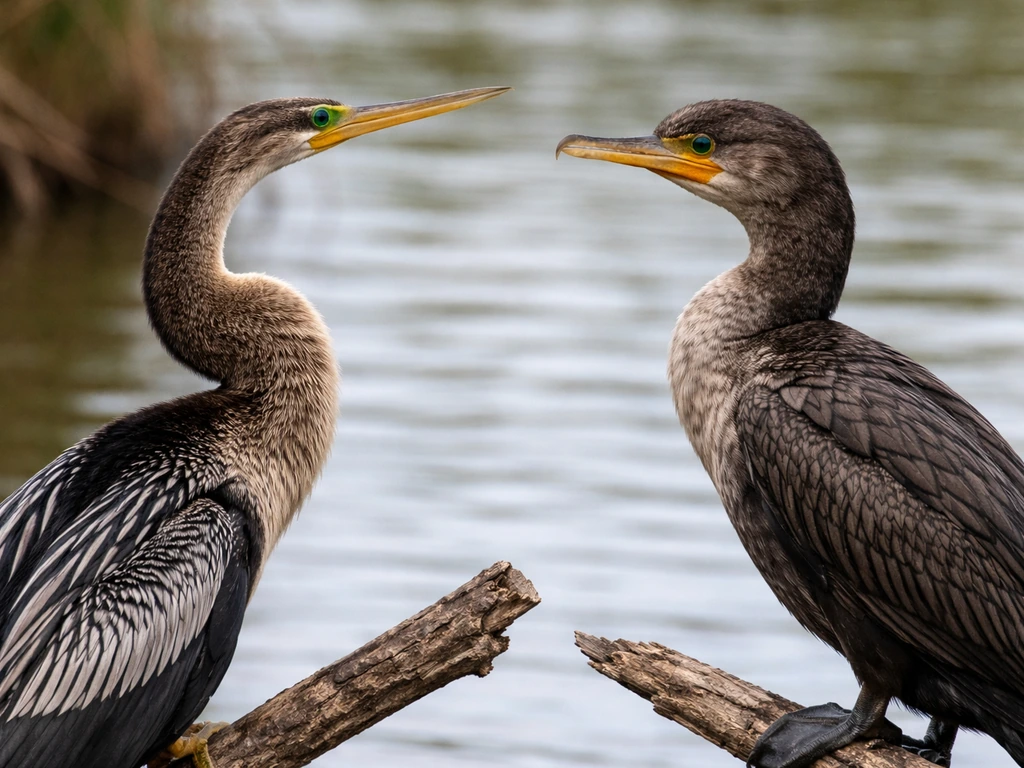
This is where the real separation happens. Line them up mentally and these differences jump out:
| Field Mark | Anhinga (Snake Bird) | Double-crested Cormorant |
|---|---|---|
| Bill shape | Long, straight, sharply pointed (dagger-like) | Shorter, hooked at the tip |
| Neck | Very long, thin, S-shaped curve | Long but thicker, less pronounced curve |
| Tail | Long, fan-shaped, clearly visible | Shorter, less prominent |
| Body in flight | Slender, cross-shaped silhouette | Chunkier, more torpedo-shaped |
| Overall size | Similar (roughly 32–36 inches) | Similar (roughly 28–35 inches) |
| Wing markings | Silver-white streaks/spots on upper wing | Mostly uniform dark |
The bill is your fastest confirmation. An Anhinga's bill is straight all the way to a sharp point, like a heron or egret, because it actually spears its prey rather than grabbing it. A cormorant's bill hooks downward at the tip, designed for gripping slippery fish. If you can see that hook, it's a cormorant. If it comes to a clean point, it's an Anhinga. In flight, the Anhinga looks almost cross-shaped, with its long tail and long neck both extending out, giving it a slender, almost prehistoric appearance. Cormorants in the air look noticeably stockier and more compact by comparison.
The tail length is another strong clue. The Anhinga's long, fan-shaped tail is distinctive enough that it sometimes gets compared to a turkey tail when spread. Cormorants have much shorter tails that rarely draw attention. This is especially useful when the bird is perched and you can't see the bill clearly.
Diving and hunting behavior on the water
Here's where the "snake bird" name really earns itself. When an Anhinga swims, it rides incredibly low in the water, often with just its neck and head visible above the surface. This is partly because Anhinga feathers are not as waterproof as those of most waterbirds, which actually helps them sink and pursue prey underwater with less effort. They dive and literally spear fish with that dagger bill, pinning the fish between both mandibles rather than grabbing it. They then surface, toss the fish into the air, and swallow it headfirst.
Cormorants, including the Double-crested, swim higher and fuller in the water. You'll see much more of their body at the surface. They dive too, but they pursue fish more like a chase rather than a spear strike, using their hooked bill to grip prey. If you're watching a bird on the water and only seeing a snake-like neck gliding across the surface, that's almost certainly an Anhinga. If you can see the bird's back and most of its body floating on the surface, think cormorant first.
Think of it like watching two different underwater styles: the Anhinga is a slow, stealthy ambush predator that barely breaks the surface, while the cormorant is more of a pursuit diver that rides higher between dives. This parallels the kind of behavioral distinctions you see between other water-foraging birds, much like what separates an egret bird vs heron in terms of hunting patience and technique.
Perching and wing-drying differences
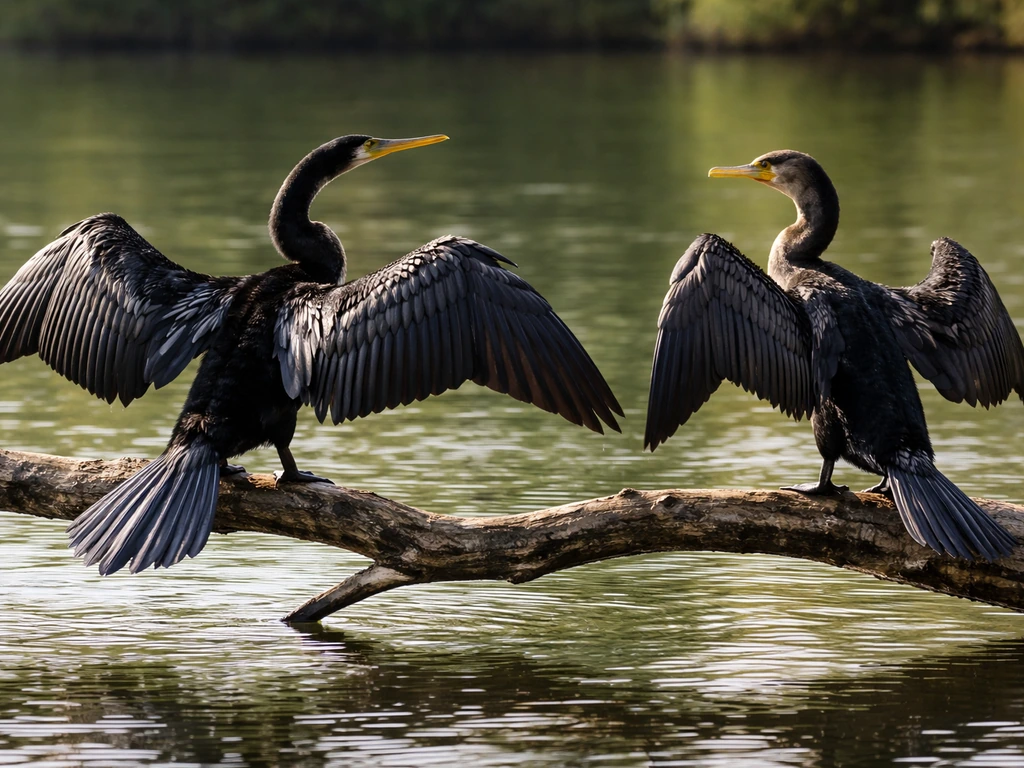
Both birds spread their wings after diving, and this is probably the single most common source of misidentification among new birders. Seeing a dark bird sitting on a branch with wings outstretched and thinking "Anhinga" without checking the bill is an easy mistake to make. But the wing-spread alone doesn't tell you which bird you're looking at.
That said, there are real differences in how they do it. An Anhinga typically spreads its wings very broadly and dramatically, often turning its back toward the sun to absorb solar warmth while drying water-logged feathers. The NPS describes this posture as the bird orienting its back to the sun specifically, with wings stretched wide. The long fan tail is usually visible beneath the perch. Anhingas also tend to hold this posture for extended periods, looking almost statue-like on a snag or low branch over the water.
Cormorants, particularly the Double-crested, typically perch more upright and hold their wings half-spread rather than fully open. The posture looks less theatrical and more hunched by comparison. The tail is short enough that it doesn't dangle notably below the perch. So if the bird looks like it's doing a full-on dramatic pose with wings completely fanned and a long tail hanging below, that points toward Anhinga. Wings half-open in a more compact, upright stance points toward cormorant.
Habitat and range cues to narrow the possibilities
Where you are matters a lot. If you're birding in a freshwater swamp, slow-moving river, cypress-lined pond, or sheltered marsh in the southeastern United States, an Anhinga is very much on the table. They prefer calm, shallow, freshwater environments with nearby perches like snags, low branches, or banks. You won't find them on open coasts, ocean shores, or large exposed reservoirs.
Cormorants are much more broadly distributed. The Double-crested Cormorant shows up in freshwater, brackish, and saltwater settings across most of North America. If you're on a coastal beach, a harbor, a large lake, or even a rooftop near water in a northern city, and you see a dark diving bird, it's almost certainly a cormorant. If you're standing knee-deep in a wooded Florida swamp, the odds of seeing an Anhinga go up significantly.
That said, habitat alone shouldn't close the ID. Both species can share the same Florida wetland. Use habitat as a probability tool, not a definitive answer. This same logic applies to other similar waterbird ID challenges: for instance, separating an egret bird vs crane also requires combining habitat clues with physical field marks rather than relying on one alone.
It's also worth remembering that some large, long-winged seabirds overlap in coastal zones where cormorants are common. If you're ever birding where ocean-going birds are present, the contrast between cormorant-style divers and something like a frigate bird vs albatross type of bird reinforces how much body shape and bill form vary across families that all fish over water.
A step-by-step field checklist + common mistakes to avoid
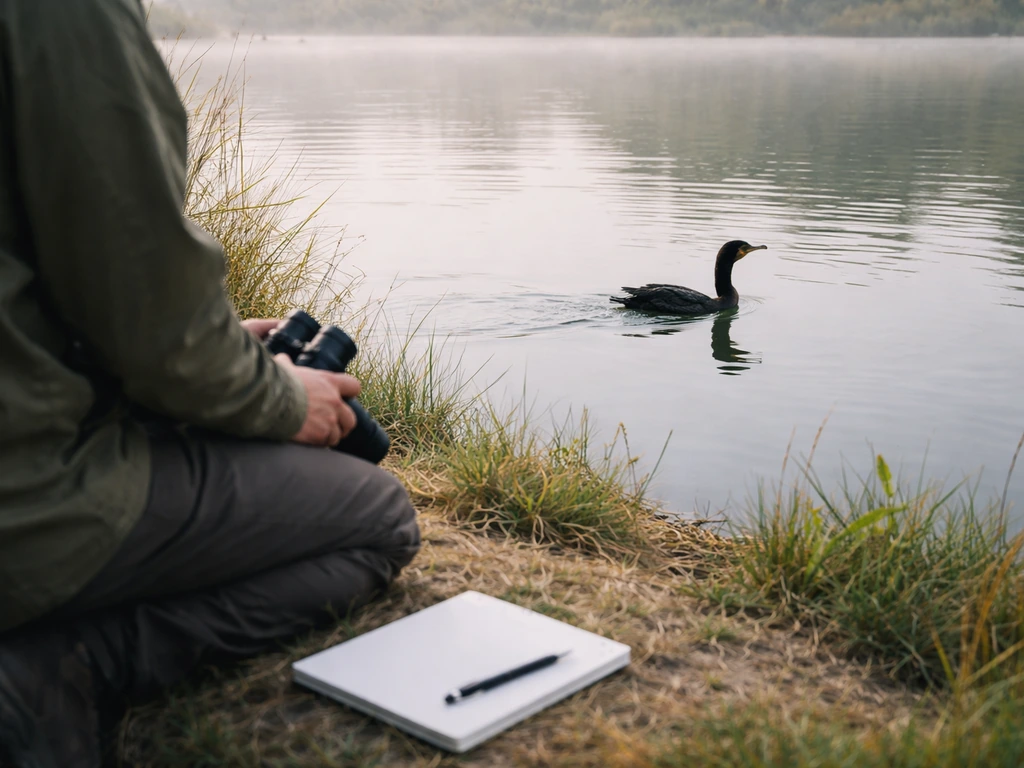
Here's a practical workflow you can run through when you spot a dark, long-necked waterbird. Work through these in order:
- Watch the swimming posture first. Is the bird riding very low with only its neck and head above water, like a periscope? That's a strong Anhinga indicator. Is it floating higher with most of its body visible? Lean toward cormorant.
- Get the bill in your binoculars. Straight to a sharp point = Anhinga. Hooked or curved downward at the tip = cormorant. This is your single most reliable field mark.
- Check the tail length. A long, fan-shaped tail visible in flight or when perched = Anhinga. Short, stubby tail = cormorant.
- Look at the neck shape in flight or when stretched. An Anhinga's neck is extremely long and visibly S-curved. A cormorant's neck is long too but thicker and less kinked.
- If the bird is perched drying wings, note the posture. Wings dramatically fully spread with back toward the sun and a long tail hanging below = Anhinga. Wings half-spread in a more upright, compact posture = cormorant.
- Factor in habitat and range as a probability check, not a final answer. Wooded freshwater swamp in the Southeast = higher Anhinga odds. Coast, large open lake, or northern location = almost certainly cormorant.
Common mistakes to avoid
- Don't stop at "dark diving bird that spreads wings." Both species do this. You need the bill and tail.
- Don't assume wing-drying means Anhinga. Cormorants dry their wings just as regularly. It's a shared behavior, not a species marker.
- Don't confuse the long neck alone as proof of Anhinga. Cormorants also have long necks. The S-curve, extreme thinness, and bill shape together make the case.
- Don't rely on size to separate them. Both species are similar in overall length, and size is hard to judge without a direct comparison in the field.
- Don't over-rely on coloration. Both are predominantly dark. Anhinga males have some iridescent green and silver-white wing streaks, but females and juveniles are browner and less distinctive.
- Don't assume you're looking at an Anhinga just because you're in Florida. Double-crested Cormorants are common throughout Florida too and share the same wetlands.
One more thing worth knowing: the wing-drying behavior in both birds is linked to feather structure, not just habit. Anhingas have particularly water-permeable feathers, which is why they sink so effectively for hunting but also why they need extended sun-drying time after every dive. Some birders liken them to a living wetsuit that soaks through completely. Cormorants also have less waterproofing than most waterfowl, which is why they too must dry their feathers, though their feathers aren't quite as saturating as an Anhinga's. Knowing the "why" behind the behavior helps you read it more accurately in the field.
If you're building out your waterbird ID skills more broadly, sharpening your eye for structural differences in related-looking species pays off across the board. The same attention to bill shape and neck length that separates Anhingas from cormorants also helps when sorting out something like a neelkanth bird vs kingfisher, where two brilliantly colored birds that both fish from perches require careful bill and body proportion checks to tell apart.
Bottom line: lead with the bill and swimming posture. Those two clues together will give you a confident ID the overwhelming majority of the time. Add tail length and wing-drying posture as confirmation, and fold in habitat as context. You'll be telling Anhingas from cormorants reliably every time you're out.
FAQ
What should I do if I cannot clearly see the bill tip on the waterbird?
Yes. In bright or backlit conditions, the hooked tip on a cormorant bill can be hard to see, especially at distance. If you cannot confirm the bill, prioritize (1) how high the bird rides while swimming (Anhinga stays low, cormorant rides higher) and (2) the tail length visible from a perch (Anhinga often shows a longer, fan-like tail).
How reliable is the wing-spread pose for snake bird Anhinga vs cormorant ID?
A wing-spread snapshot can mislead. Anhingas usually spread fully and show a long fan-shaped tail, while many cormorants hold wings more half-open in a more upright, compact posture. Use the combination of wing openness plus tail length, not wings alone.
What if the bird only shows up for a few seconds, then dives?
If the bird is only briefly visible and you did not see the bill, treat it like a probability check. Anhinga odds are higher when you repeatedly see the bird ride extremely low with only neck and head above the surface, and you later notice a long tail hanging beneath a perch. Cormorant odds rise if the bird’s back and much more of the body stay at the surface between dives.
Does habitat (ocean vs freshwater swamp) ever fail for these two birds?
Anhinga populations are centered in the southeastern United States and nearby regions, so a dark diving bird on an open ocean coast is more likely to be a cormorant. Still, do not use location alone, because sheltered lagoons or mangrove-adjacent areas can host both patterns. Always confirm with swimming height and bill shape when possible.
Are there variations among cormorants that make the ID harder?
Some species of cormorants can look slimmer or more compact than others, but the core structural differences remain. In general, cormorants have a hooked bill shape and a shorter tail relative to body, and they usually perch in a more upright stance with wings less dramatically fanned.
Can lighting or feather condition make Anhinga vs cormorant identification unreliable?
Yes, older or partially dried plumage can blur the typical “dark bird” look, but it usually does not change bill form. If you miss the bill during the drying session, wait for the next feeding bout. Swimming posture and the visible tail length during the next perch are often clearer than plumage color alone.
What flight cues help me confirm snake bird Anhinga vs cormorant when the bill is hidden?
Cormorants often look like strong, confident divers, and many will take off with a more stocky, compact silhouette. Anhingas in flight are typically more slender-looking because of the long neck and long tail extending together. Use flight only if you get a clear overhead or side view.
Can I identify Anhingas and cormorants by calls if I cannot see the bill?
If you hear the bird call but cannot see the bill or swim posture, do not rely on sound for confirmation. Calls overlap across waterbird species in many regions. Use your next visual opportunity to confirm bill shape or swimming height.
Does “snake bird” always mean the Anhinga in local guides or signage?
Be careful with “snake bird” as a generic phrase. In standard birding usage, “snake bird” refers to Anhinga. If you are reading a field label, map, or local guide that uses the nickname, double-check the accompanying description to ensure it is truly referring to an Anhinga, not a cormorant.
Is there a fast step-by-step checklist I can follow in the field?
A quick method for field use is, first check if the swimming bird rides extremely low (Anhinga) or higher with more body showing (cormorant). Then, when perched, check the tail length hanging below the perch. Finally, if you get a close view, verify bill form, straight dagger tip versus hooked downward tip.