Quick reality check: how birds and dinosaurs relate
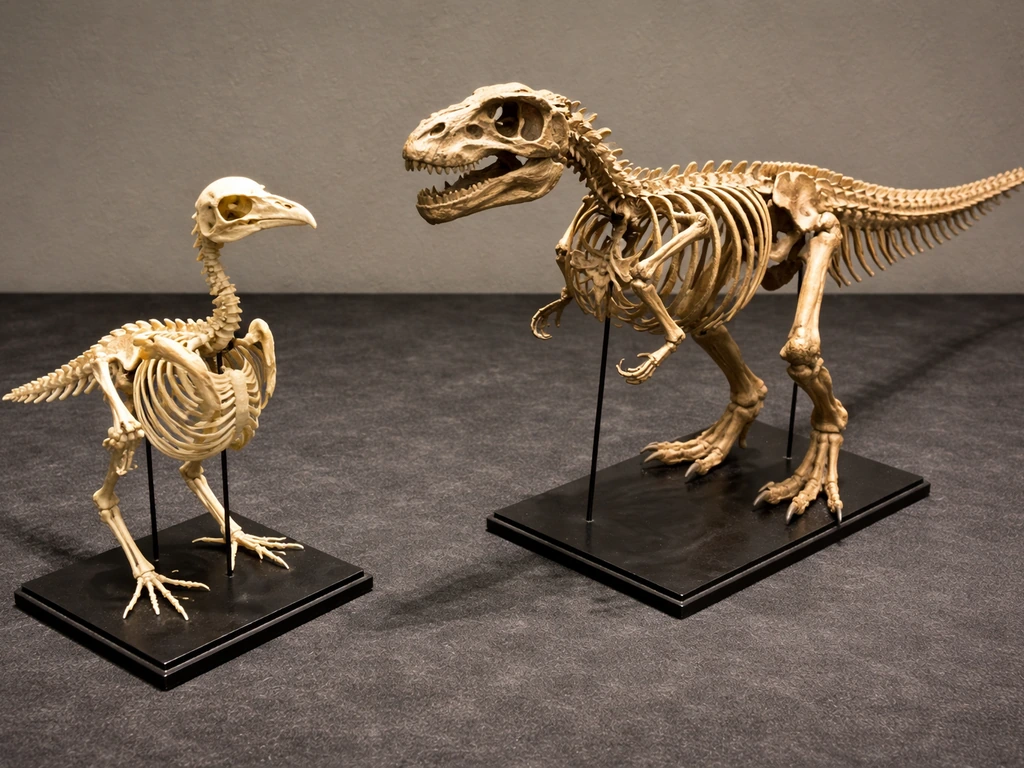
Here is the short answer that trips most people up: birds ARE dinosaurs. Not metaphorically, not loosely, but in a strict biological classification sense. Modern birds (class Aves) sit inside Theropoda, a major branch of dinosaurs that includes meat-eating giants like T. rex and Velociraptor. More specifically, birds evolved from maniraptoran theropods, a group within the even smaller clade called Paraves. This is mainstream paleontology, not a fringe theory. So when you ask "bird skeleton vs dinosaur skeleton," what you are really asking is: how does a bird skeleton compare to a NON-AVIAN dinosaur skeleton? That distinction matters enormously, because if you ignore it, every comparison you make will feel contradictory.
Think of it this way: all birds are dinosaurs, but not all dinosaurs are birds. A crow and a T. rex are both dinosaurs in the same way a bat and a blue whale are both mammals. They share a common ancestor and key skeletal features, but time, body size, and lifestyle have pushed their skeletons in very different directions. Keeping that mental model in place makes the anatomical comparison much easier to navigate. If you want a deeper look at how this plays out at the fossil level, a bird vs dinosaur skeleton breakdown is a great place to start building that foundation.
Bird vs dinosaur skeleton: the most reliable distinguishing landmarks
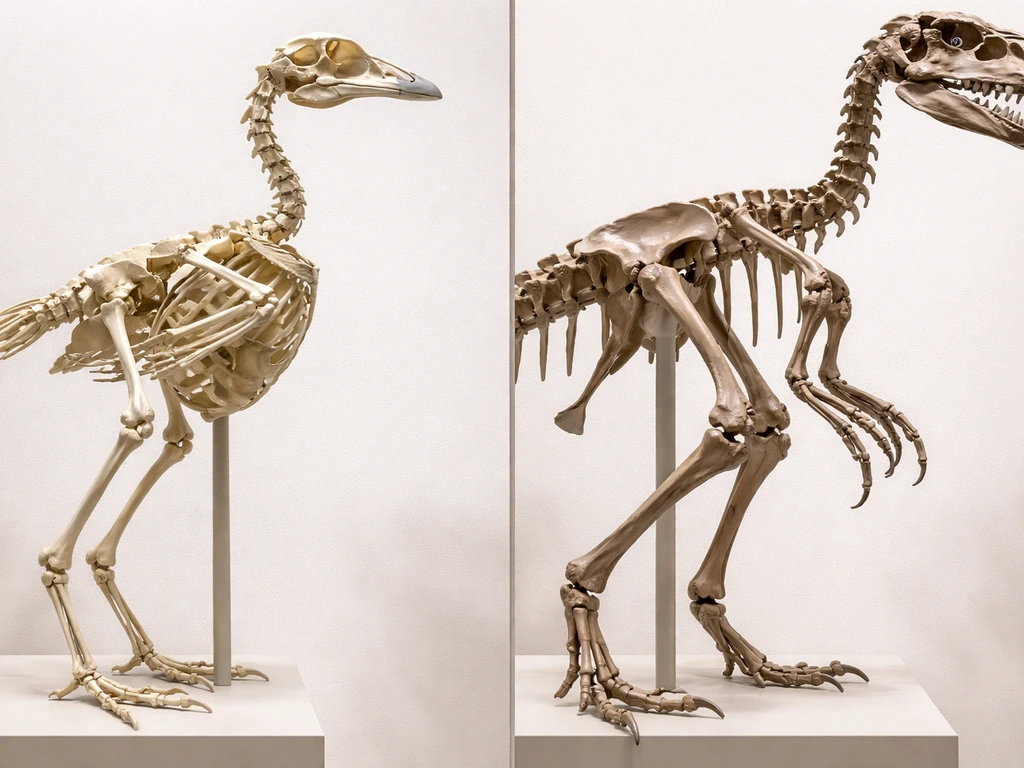
Even though birds and non-avian dinosaurs share a family tree, their skeletons diverged dramatically. The features below are the ones professionals, students, and museum visitors can actually look for in diagrams or specimens. They are not subtle micro-details reserved for specialists; most of them are visible at a glance once you know what you are looking for.
Bones that shrank, fused, or disappeared
Bird skeletons are radically reduced compared to non-avian dinosaurs. Over evolutionary time, many separate bones fused together to save weight and create rigid structures needed for flight. The most striking example is the pygostyle, the fused tail vertebrae that form the short bony nub supporting tail feathers. Non-avian dinosaurs had long, bony tails made of many separate vertebrae, sometimes dozens of them. In a bird skeleton, that long tail is completely gone, replaced by just a few fused elements. Another major fusion is the tarsometatarsus, the single elongated foot bone in birds that corresponds to several separate ankle and foot bones in a non-avian dinosaur.
The hand (manus) tells a similar story. Non-avian theropod dinosaurs had functional fingers with claws. In birds, the hand bones are highly fused and reduced into the carpometacarpus, a structure that supports flight feathers rather than grasping. The number of functional digits also dropped: most birds have only three fused, vestigial finger elements where their ancestors had more distinct digits.
The keeled sternum and wishbone
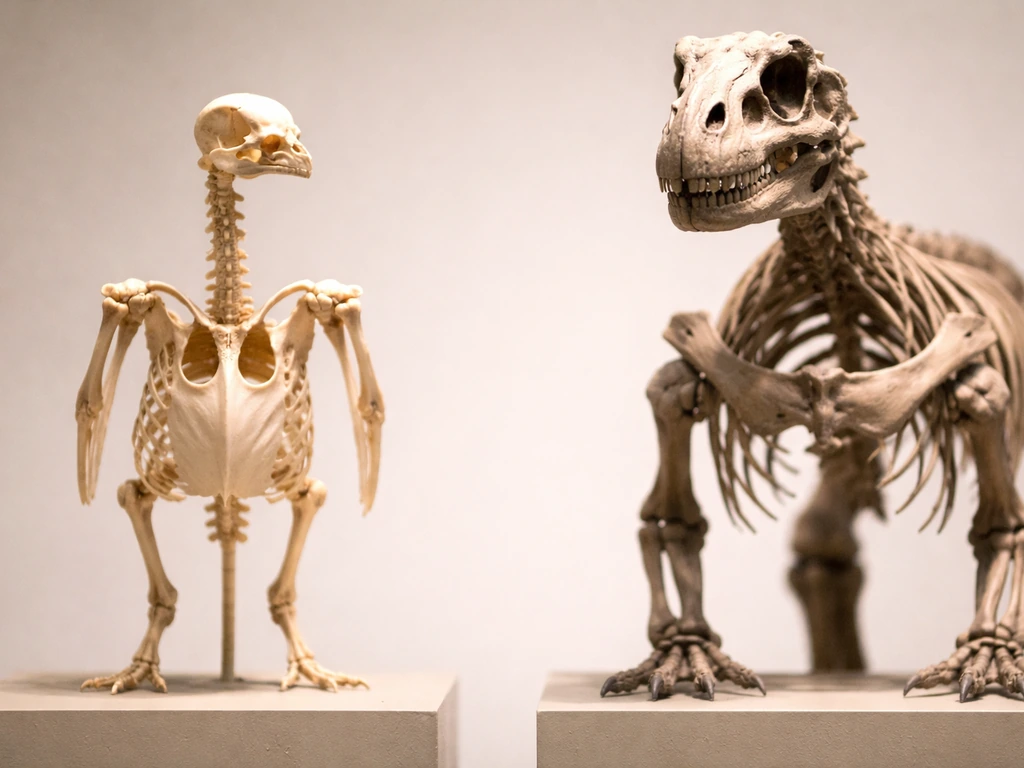
The sternum (breastbone) is one of the clearest identifiers. Flying birds have a dramatically enlarged sternum with a prominent central keel, called the carina, that provides the attachment surface for massive flight muscles. Non-avian dinosaurs had a much smaller, flatter sternum with no keel. Even flightless birds like ostriches retain a reduced sternum, but it lacks the pronounced keel of flying species. The furcula (wishbone) is another giveaway. Birds have a fused, V-shaped or U-shaped furcula that acts as a spring during the flight stroke. While some non-avian theropods (including Velociraptor and T. rex) actually had furculae too, the shape and function differ, and many other dinosaur groups lacked them entirely.
Hip orientation: a landmark worth knowing
Hip structure is another major split point. Birds have what is called an "open" acetabulum (hip socket) and a specific arrangement where the pubis bone points backward, parallel to the ischium. This backward-pointing pubis is actually a feature shared with a group called ornithischian (bird-hipped) dinosaurs, but the convergence is coincidental: birds evolved their pubis orientation independently from their theropod ancestors. This topic gets genuinely confusing fast, and a focused look at bird hip vs lizard hip anatomy helps clarify why hip bones are such a reliable landmark for separating bird skeletons from other animals.
| Feature | Modern Bird Skeleton | Non-Avian Dinosaur Skeleton |
|---|
| Tail | Short pygostyle (fused vertebrae) | Long tail of many separate vertebrae |
| Sternum | Large with prominent keel (carina) | Small, flat, no keel |
| Furcula (wishbone) | Fused, spring-like | Present in some theropods, absent in many others |
| Hand/fingers | Fused carpometacarpus, 3 reduced digits | Distinct fingers with claws (up to 5) |
| Foot bones | Fused tarsometatarsus | Separate ankle and metatarsal bones |
| Bone density | Hollow, pneumatized (very lightweight) | Denser, though some theropods had air sacs too |
| Pubis orientation | Points backward | Points forward (in most theropods) |
| Teeth | Absent (toothless beak) | Teeth present in most non-avian dinosaurs |
Bird vs dinosaur skull: key head/bone differences to look for
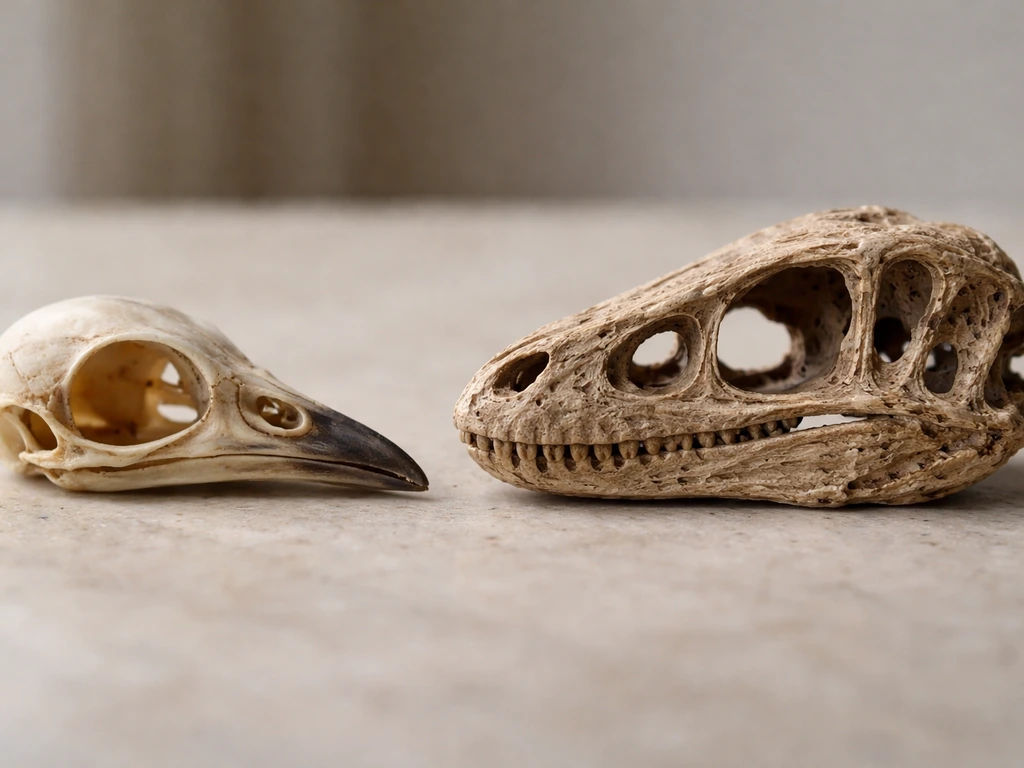
The skull is often the first thing people look at, and for good reason. It is packed with distinguishing features that are visible even in basic diagrams. The single most obvious difference is teeth vs no teeth. Almost all modern birds are completely toothless and instead have a keratinous beak (the rhamphotheca) that leaves no bony trace on the skull itself. The jawbones (premaxilla, maxilla, and dentary) are present but elongated and toothless. Non-avian dinosaurs, including the theropods most closely related to birds, had teeth in most cases, though the exact tooth shape varied widely from serrated blade-like teeth in carnivores to leaf-shaped teeth in herbivores.
Eye socket size is another quick visual clue. Birds have enormous orbits (eye sockets) relative to skull size, sometimes taking up more than half the skull's lateral profile. This is a flight and behavioral adaptation: large eyes provide the visual acuity birds need. Many non-avian dinosaurs had proportionally smaller orbits, with the skull dominated more by jaw muscles and snout structure. Birds also have a unique feature called the kinetic skull, meaning the upper beak can actually move independently from the braincase. This cranial kinesis involves a series of moveable joints in the skull that most non-avian dinosaurs did not have.
The braincase is another giveaway. Bird braincases are rounded and enlarged relative to total skull size, reflecting a large brain. The cerebellum and visual cortex are especially well-developed. In non-avian theropods the braincase is present and reasonably complex, but the overall skull is far more elongated and snout-dominated. The occipital condyle, the ball-joint at the back of the skull connecting to the spine, faces more downward in birds (reflecting a more upright posture with the beak pointing forward) compared to the more rearward-facing condyle in many dinosaurs.
Flight-linked anatomy vs non-flight dinosaur traits
Many of the most dramatic differences between bird skeletons and non-avian dinosaur skeletons exist because birds are built around flight (or, in flightless birds, descended from flighted ancestors). Non-avian dinosaurs were built for terrestrial locomotion, predation, or herbivory, and their bones reflect that completely different set of demands.
Flight demands extreme weight reduction, which is why bird bones are pneumatized: they contain air-filled cavities connected to the respiratory system, making them hollow and lightweight without sacrificing structural strength. While some large theropods like T. rex also had vertebral air sacs (postcranial pneumaticity), the degree of pneumatization in birds is far more extensive and systematic. Every major bone in a flying bird's body is optimized for minimum weight. Non-avian dinosaur bones are denser overall, suited for supporting larger body masses and absorbing the forces of running and hunting.
The pectoral girdle (shoulder region) shows this flight specialization clearly. Birds have a coracoid bone that is strut-like and elongated, bracing the shoulder against the sternum during the powerful downstroke of flight. In non-avian theropods, the coracoid is shorter and more plate-like. The scapula (shoulder blade) in birds is long and blade-shaped, lying parallel to the spine rather than fanning outward. The entire shoulder mechanism in birds is essentially a force-transmission machine optimized for flapping. For a more focused look at how this plays out in one of the most famous non-avian theropods, the T-rex skeleton vs bird skeleton comparison is particularly illuminating, since T. rex represents the extreme "heavy terrestrial predator" end of the theropod spectrum.
Leg anatomy also divides the two groups clearly. Birds walk on their toes (digitigrade posture) with a reversed hallux (the first toe pointing backward) that enables perching. The tibia is elongated and the femur is held nearly horizontal and close to the body, which is unusual compared to the more upright, parasagittal limb posture of many large theropods. This crouched, forward-leaning hip and knee posture in birds shifts the center of mass and is a direct adaptation for bipedal locomotion tied to a body plan dominated by a large, heavy chest.
Common confusion and how to avoid misidentifying skeletons
The biggest source of confusion is the statement "birds are dinosaurs." People hear this, and then when they try to compare skeletons, they expect everything to look the same. It does not. Saying birds are dinosaurs is a statement about evolutionary lineage, not about body plan similarity. A bird skeleton and a Triceratops skeleton are both dinosaur skeletons, but they look almost nothing alike.
A second common mistake is assuming that because some theropods (like Velociraptor or Deinonychus) were relatively bird-like, all non-avian dinosaur skeletons will look somewhat bird-like. They do not. Ornithischian dinosaurs (the other major dinosaur group, including Stegosaurus, Iguanodon, and Triceratops) have hip anatomy that superficially resembles birds (that is actually where the name "bird-hipped" comes from), but their overall skeleton is completely different from any bird. This misleads beginners into thinking hip shape alone is enough to sort the groups. It is not.
A third confusion comes from early fossil birds like Archaeopteryx, which had teeth, clawed wings, and a long bony tail, looking much more like a small feathered dinosaur than a modern bird. Archaeopteryx sits right at the transition zone and has features of both groups. If you are looking at a diagram and the specimen has teeth plus a bony tail but also appears to have flight feathers, you are likely looking at an early avian or a close non-avian relative, not a modern bird. A bird dinosaur skeleton comparison that includes transitional forms like Archaeopteryx makes this boundary much clearer.
Here is a quick list of the most common misidentification traps and how to avoid them:
- Trap: Assuming "bird-hipped" ornithischians are closely related to birds. Fix: Check the rest of the skeleton. If it has a long bony tail, no keeled sternum, and no fused foot bones, it is not a bird.
- Trap: Thinking small theropods (like Velociraptor) are basically birds. Fix: Look for teeth, a long separate-vertebrae tail, and unfused hand bones. Those point to non-avian status.
- Trap: Confusing Archaeopteryx or similar early birds with modern bird skeletons. Fix: Modern birds have no teeth, a pygostyle (not a long tail), and a full carpometacarpus. Early avians lack some of these.
- Trap: Assuming all dinosaur skeletons are large. Fix: Many non-avian theropods were small, chicken-sized or smaller. Size alone tells you nothing.
- Trap: Using feathers as a skeleton identifier. Fix: Feathers are not preserved in most fossils and are not part of the skeleton. Use bone structure only.
How to compare using diagrams: a practical checklist and next steps
When you are looking at a skeleton diagram and need to identify whether it is a bird or a non-avian dinosaur, work through this checklist in order. Each step narrows down the answer quickly.
- Check the tail first. Does it end in a short fused pygostyle, or does it extend as a long series of individual vertebrae? A long bony tail almost always means non-avian dinosaur (or an early transitional bird like Archaeopteryx).
- Look at the skull for teeth. A toothless beak strongly indicates a modern bird. Teeth in the jaws mean non-avian dinosaur or a very early avian.
- Examine the sternum. Is it large with a central keel? That keel is a bird hallmark, especially for flying species.
- Count and check the hand bones. A fused carpometacarpus with reduced digits is a bird. Separate, distinct fingers with claws point to non-avian dinosaur.
- Look at the foot. One long fused tarsometatarsus is a bird. Separate ankle and metatarsal bones are non-avian.
- Check the eye sockets. Very large orbits relative to skull length are a strong bird indicator.
- Look for a furcula (wishbone). Its presence in a specific fused V or U shape supports bird identification; its shape in theropods differs.
- Assess bone proportions overall. Is the chest region dominant with a reduced tail and lightweight build? Bird. Is the tail heavy, the chest relatively smaller, and limbs more robustly built? Non-avian dinosaur.
For finding reliable diagrams to practice with, museum websites are your best resource. The American Museum of Natural History (AMNH), the Smithsonian National Museum of Natural History, and the Natural History Museum in London all have free online collections with labeled skeletal diagrams. Search specifically for "skeletal diagram" alongside the species name to get anatomically labeled images rather than reconstructions. For non-avian dinosaurs, the Palaeontological Research Institution and university paleontology department pages often have high-quality, labeled skeletal drawings.
A practical exercise that works well: pick a familiar modern bird (a chicken skeleton is ideal because they are well-documented and easy to find images of) and put it side by side with a labeled theropod diagram such as Velociraptor or Coelophysis. Work through the checklist above on both. Once you can spot the differences on a familiar pair, you will be able to apply the same logic to unfamiliar specimens much faster. The more you practice with real labeled diagrams, the faster your eye for these landmarks will develop, and the less likely you are to fall into the common confusion traps outlined above.