The dodo and the shoebill are not closely related, do not share a habitat, and don't even live in the same era. The dodo went extinct around 1681 on the island of Mauritius, while the shoebill is a very much alive wading bird stalking papyrus swamps across central Africa today. People compare them because both birds look genuinely bizarre, have prominent bills, and carry a kind of prehistoric energy that makes you do a double-take. But once you know what to look for, telling them apart in photos or descriptions takes about ten seconds.
Dodo Bird vs Shoebill: Key Differences in Appearance, Ecology

Marcus Hendricks
28 May 2026
Fast identification: what to look for first

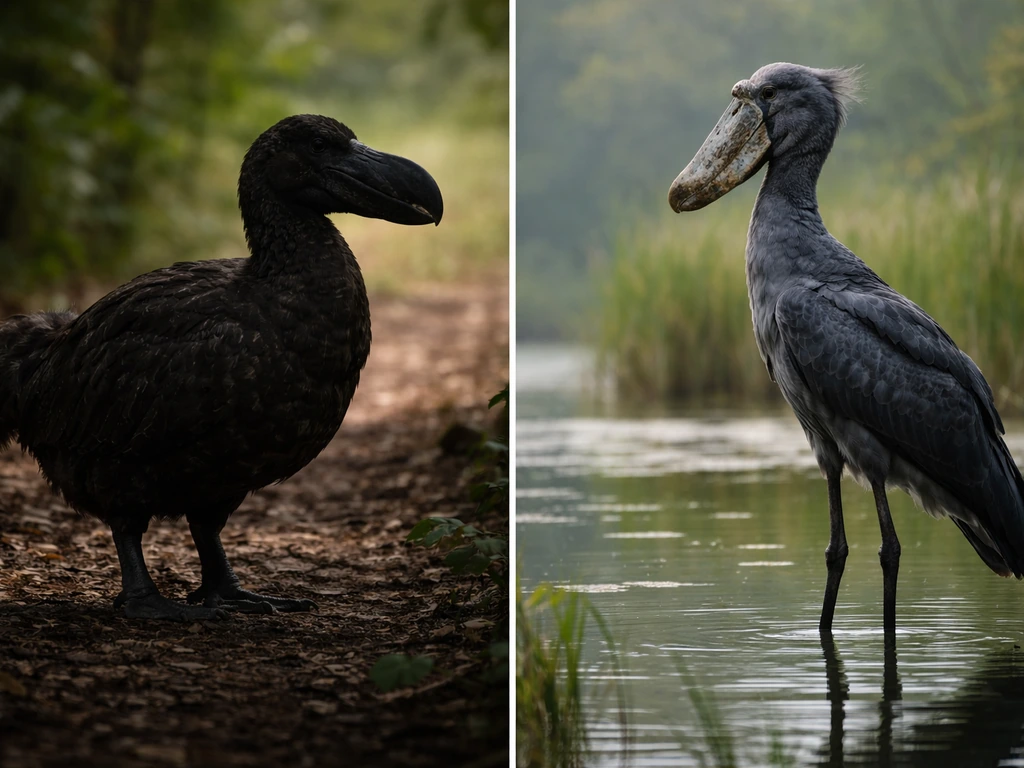
Before you get into taxonomy or habitat, just look at two things: the legs and the setting. If you see a tall, stilt-legged bird standing statue-still on floating vegetation over water, that is a shoebill. Full stop. The dodo was a squat, heavy ground bird that lived in forests on a small Indian Ocean island and never waded through a swamp in its life. Many people also wonder what it would mean to imagine a dodo bird facing a human, especially given how quickly it disappeared after people arrived on Mauritius. If the image shows a rounded, pigeon-like body sitting low to the ground with small useless wings and a hooked beak, you are looking at a dodo reconstruction. These two physical profiles are genuinely hard to confuse once you have seen them side by side.
Appearance comparison: body shape, size, and color
The size difference alone is significant. Shoebills stand roughly 110 to 140 cm tall, with some individuals reportedly reaching around 152 cm. They are tall, narrow-bodied waders with long legs, an upright posture, and a silhouette that reads as angular and imposing. The dodo, by contrast, was much shorter and far heavier for its height. Subfossil estimates place dodo height at around 62 to 75 cm, but its body mass was substantial, somewhere between 10.6 and 17.5 kg. That is a lot of weight packed into a compact frame. Think of the difference between a great blue heron and a bowling ball with feathers.
Coloration is trickier for the dodo because we are working from limited 17th-century illustrations and subfossil remains rather than direct observation. The most widely accepted reconstructions show blue-gray plumage with a large head and a tuft of curly feathers at the rear end. The shoebill, by comparison, is a living bird with well-documented plumage: slate gray overall with a slightly darker back and pale underparts. You can find hundreds of high-resolution field photographs confirming exactly what a shoebill looks like. Dodo coloration, honestly, involves some educated guesswork.
| Feature | Shoebill | Dodo |
|---|---|---|
| Status | Living (extant) | Extinct (c. 1681) |
| Height | 110–152 cm | ~63–75 cm |
| Body mass | ~4–7 kg | ~10.6–17.5 kg |
| Body shape | Tall, narrow, long-legged wader | Stout, rounded, ground-adapted |
| Plumage color | Slate gray (well-documented) | Blue-gray (reconstruction-based) |
| Wings | Functional, broad | Small, vestigial, flightless |
Beak and head details that separate them instantly
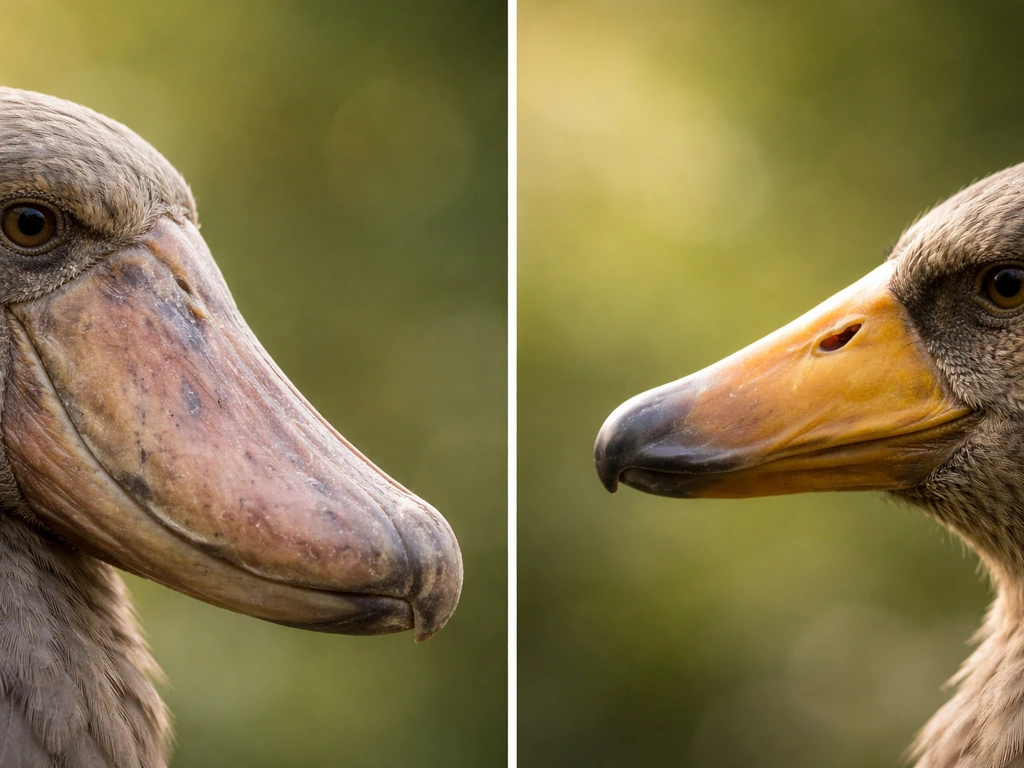
This is the most reliable single feature to check in a photo. The shoebill's bill is extraordinary: a huge, broad, shoe-shaped structure (hence the name) that is bulbous, deeply hooked at the tip, and gives the bird an almost mechanical, prehistoric look. The bill and head together dominate the bird's silhouette. In profile, the bill reads as wide and boat-shaped, and the face around it has a bare, structured appearance. It is unmistakable once you have seen it.
The dodo's bill was about 23 cm long, described in authoritative sources as blackish with a reddish sheath forming a hooked tip. The dodo skull was robust, with a dome-shaped frontal bone sitting above the rear of the eye sockets and a relatively short cranium compared to the jaw length. It was a hooked, curved bill, but it was not the wide, shoe-shaped, frontal-dominated structure of the shoebill. The dodo's head also sat on a bulky, rounded torso without any of the extended neck-and-stilt wader profile that makes the shoebill's head look like it is perched on a tower.
- Shoebill bill: wide, bulbous, shoe-shaped profile with a prominent hook at the tip; dominates the bird's head silhouette
- Dodo bill: narrower, blackish with a reddish hooked tip, sitting on a large rounded head atop a stout body
- Shoebill face: bare, structured, almost helmet-like appearance around the bill base
- Dodo face: uniformly feathered, more pigeon-like facial structure (think a very large, strange pigeon)
Habitat and geographic context: where each belongs
The geographic and ecological separation between these two birds could not be more complete. The dodo was endemic to Mauritius, a single island in the Indian Ocean east of Madagascar. It lived in forest habitat, not shorelines or swamps, and it was adapted to ground-level life in a terrestrial environment that had no mammalian predators before humans arrived. Its entire existence was tied to that one island, which is part of why hunting and habitat disruption wiped it out so quickly.
The shoebill occupies a completely different world. Its range spans freshwater swamps across central tropical Africa: from southern Sudan and South Sudan, through parts of the Democratic Republic of Congo, Uganda, Rwanda, western Tanzania, and into northern Zambia. Its favorite habitat is dense papyrus swampland, and the vast Sudd wetlands in East Africa are considered a core stronghold. Shoebills need floating vegetation and deep-water edges to hunt effectively. If a photo shows a big, strange bird standing in a papyrus swamp, the dodo is not even a candidate.
Feeding behavior and lifestyle differences
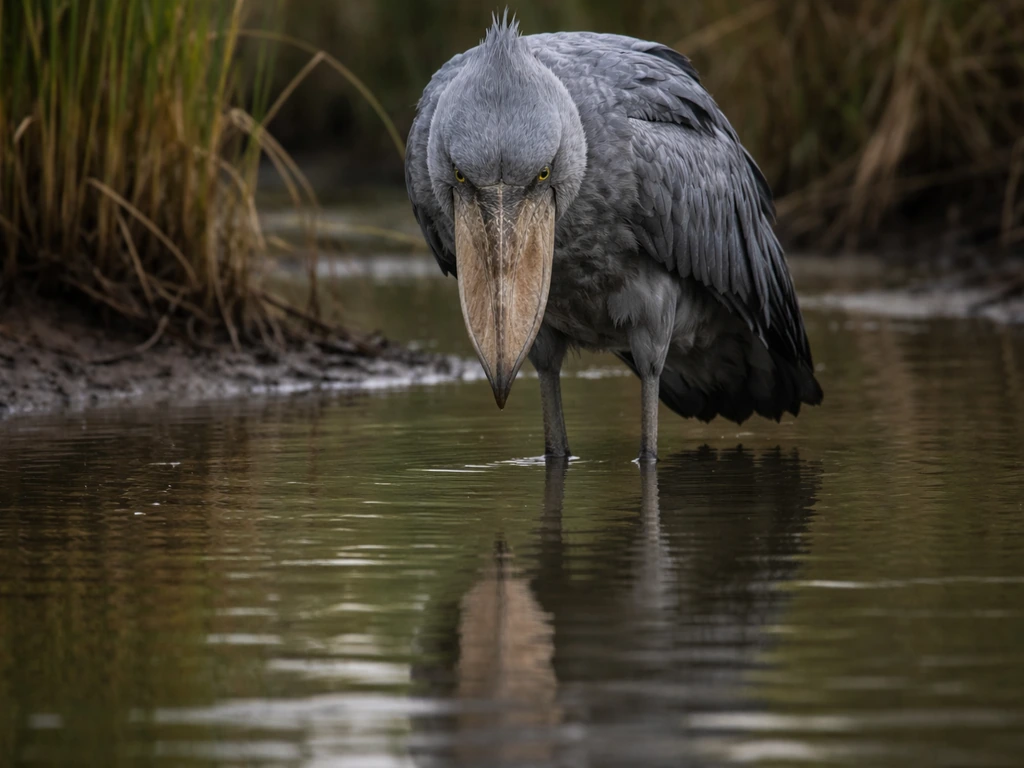
The shoebill is one of the most patient ambush predators in the bird world. It stands completely motionless for long stretches, sometimes appearing more like a garden ornament than a living animal, then collapses forward in a rapid strike to engulf prey with that enormous bill. According to the shoebill’s profile, it often stands motionless for long periods and can look statue-like when perched or standing on floating vegetation It stands completely motionless for long stretches, sometimes appearing more like a garden ornament than a living animal, then collapses forward in a rapid strike. Its targets are genuinely impressive: lungfish, bichirs, catfish, tilapia, and other large slippery aquatic animals. The bill absorbs the force of impact, and the bird frequently scoops up vegetation along with the prey before sorting it out. This hunting style is why so many photos show the shoebill in a statue-still pose, often on floating aquatic plants.
The dodo's diet is, to be honest, mostly speculation. Because the bird has been extinct for over 340 years and left limited evidence, researchers have had to work with interpretive inference rather than direct observation. What we do know is that the dodo was a terrestrial forest forager, probably eating fallen fruit, seeds, and roots based on its habitat and bill morphology. It did not wade, ambush aquatic prey, or stand motionless on wetland vegetation. Animal Diversity Web describes dodo locomotion as clumsy running and even belly-dragging when fleeing. These were slow, ground-bound birds living in a forest, nothing like the disciplined stillness of a shoebill working a swamp.
Extinct vs. living: why this matters for identification
Here is something worth keeping in mind when you are looking at comparison images online: everything you see of the dodo is a reconstruction. The surviving physical evidence includes a handful of preserved heads, a foot, and scattered skeletal remains held in museums including places like the Senckenberg Museum. Museum notes that the head and bill details of dodos are constrained by the small number of surviving illustrations, reports, and physical remains, rather than direct observation Senckenberg Museum. The visual record comes from a small number of 17th-century logbook illustrations and early drawings, many of which were not made by trained naturalists. That means dodo posture, exact coloring, and proportional details in popular artwork and side-by-side comparison images may be extrapolated or artistically interpreted rather than directly observed.
The shoebill, by contrast, has been photographed thousands of times in the wild by researchers, conservationists, and birders. Its anatomy, posture, behavior, and coloring are exceptionally well-documented. So when you are assessing a comparison, hold shoebill information to a high standard of photographic and field evidence, and treat dodo details as well-informed estimates grounded in skeletal analysis and limited historical accounts. Any image claiming to show precise dodo coloration or exact posture should be traced back to a named museum reconstruction or a specific historical drawing.
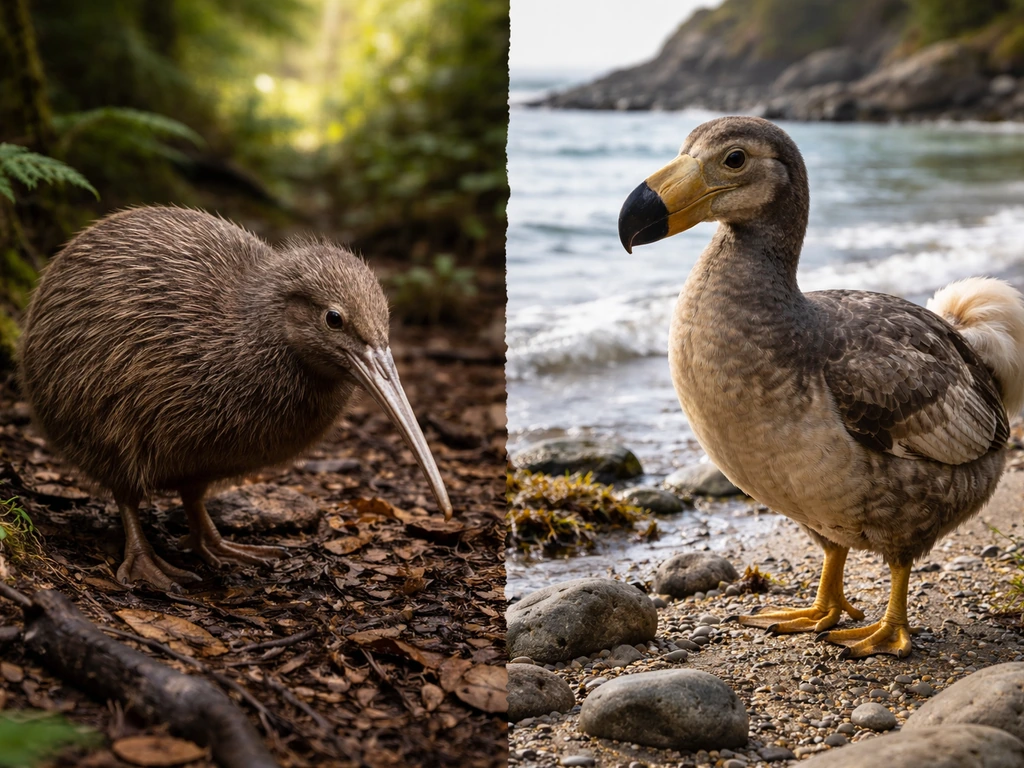
Taxonomically, these birds are also in completely different corners of the avian family tree. The dodo belongs in the family Raphidae (or within Columbidae as tribe Raphini, depending on which classification you use), making it a relative of pigeons and doves. The shoebill is Balaeniceps rex, the only member of the family Balaenicipitidae, a monotypic family with no close living relatives in an obvious sense. They share no meaningful taxonomic proximity. Comparing a dodo to a shoebill is a bit like comparing a kiwi to an ostrich: both are birds, both are unusual, but that's about where the overlap ends. Speaking of kiwis, this same logic applies to comparisons like kiwi bird vs dodo, where the shared quality is more about strangeness and flightlessness than any real evolutionary connection.
Photo checklist and common mix-ups to avoid
When someone shows you an image and asks which bird it is, here is how to work through it quickly and confidently. Use the photo checklist alongside the toucan vs dodo bird comparison so you do not mix up unrelated birds that look “bizarre” in the same way. If you want a fast answer to dodo bird vs t rex-style matchups, focus first on the legs and the habitat. If you keep the key traits in mind, the comparison in kiwi bird vs ostrich style articles will make it easier to avoid common mix-ups.
- Check the setting first. Water, floating vegetation, papyrus swamp? You are looking at a shoebill. Forest floor, island terrain, no aquatic context? More likely a dodo reconstruction.
- Look at the legs. Long, stilt-like legs with the bird standing upright and tall? Shoebill. Short, thick legs under a heavy rounded body sitting low? Dodo.
- Examine the bill profile. Wide, shoe-shaped, bulbous bill that dominates the head silhouette? Shoebill. Narrower hooked bill with a reddish tip on a more uniformly feathered head? Dodo.
- Check the body proportions. Tall and narrow with a forward-held head and extended neck? Shoebill. Barrel-chested, round, with tiny vestigial wings? Dodo.
- Ask about the source. Is this a field photograph or a painting/digital reconstruction? Shoebill photos can be verified against thousands of real images. Dodo images should cite a specific museum reconstruction or historical illustration, not generic artwork.
- Do not rely on bill size alone. Both birds have notable bills, but the shape is entirely different. 'Big bill' is not a reliable differentiator without looking at the specific profile.
- Ignore the 'prehistoric feel' comparison. Both birds evoke that reaction in people, which is exactly why the confusion exists in the first place. That shared vibe tells you nothing about actual appearance.
The most common mix-up happens when someone sees a reconstructed dodo illustration with an exaggerated head and bill, then puts it next to a shoebill photo where the bill is enormous and angular, and concludes they look similar. They really don't, once you separate the body shapes and leg proportions. The shoebill is a tall, deliberate, aquatic predator. The dodo was a stocky, ground-walking forest bird on a remote island. If you are trying to compare unrelated “small bird” stories online, double-check the source, since mix-ups can spread fast, including claims like dugast small bird vs typhoon remote island. Treat any image source that blurs those distinctions as unreliable, and prioritize museum-backed reconstructions for the dodo and field-verified photographs for the shoebill.
FAQ
What should I check first if I only have a blurry photo of dodo bird vs shoebill?
Look at leg length and the ground cover in the scene. Shoebills show long stilt-like legs and an aquatic setting with floating or wetland vegetation. Dodos appear squat with short legs and a terrestrial forest or ground-level pose, not a swamp ambush posture.
Can a dodo ever be confused with a large wading bird besides the shoebill?
Yes, especially in stylized illustrations, but the decisive clue is context. If the image shows an obvious swamp, floating plants, or a long-necked stilt wader stance, treat it as a living wetland bird. A dodo reconstruction should never be presented as “in the wild,” because every reliable dodo look comes from limited drawings and skeletal remains.
How can I tell whether I’m looking at a reconstructed dodo image or a real bird photo?
Check for whether the source provides provenance, like a named museum reconstruction or a specific historical illustration. If the image claims precise coloring, exact proportions, or exact behavior without citing a particular drawing or specimen-based reconstruction, it is likely an artist’s extrapolation.
Are there any stance clues besides legs that separate them quickly?
Yes. Shoebills often appear upright and angular, with a head and bill that dominate the silhouette, usually shown in a still, ambush-like posture. Dodos look low to the ground with a rounded, heavy body and small wings, giving a pigeon-like bulk rather than an elongated wader profile.
Why do some dodo reconstructions look more “upright” than others?
Because posture and proportions are not directly observed. Artists adjust how the torso sits, how the wings rest, and how the head is carried based on limited artwork plus skeletal interpretation, so different reconstructions can vary even if the core anatomy is consistent.
If I see a bird with a hooked bill, how do I avoid overconfidence?
A hooked bill alone is not enough. Many birds have hooked bills, but the shoebill’s bill is unusually broad, shoe-shaped, and frontal-dominated. Pair that with the right setting (papyrus swamp with floating vegetation) and the upright stilt-legged stance.
What does it mean if an image claims the dodo hunted aquatic prey?
That claim conflicts with what’s inferred from its terrestrial forest life. The dodo is best treated as a ground-level forager, with diet largely inferred from habitat and bill form, not an ambush aquatic predator like the shoebill.
How should I interpret “size” comparisons online, especially with dodo vs shoebill?
Treat them cautiously unless the article or image specifies scaling. Dodos were much smaller in height than shoebills and also much heavier for their height. Without a scale reference, artists may exaggerate dodo size to make it “match” the frame next to a shoebill photo.
Is it possible to identify them by bill shape alone in side profile?
Often, yes. The shoebill’s bill reads as wide and boat-shaped with a bulbous, deeply hooked tip, and the head/bill area dominates the face. The dodo’s bill is hooked, but it is not the huge frontal, shoe-like structure and the overall head sits on a bulkier, rounded torso.
What’s the fastest decision tree for dodo bird vs shoebill?
Step 1: Is the setting a papyrus swamp or floating vegetation over water? If yes, it is a shoebill candidate. Step 2: Are the legs long and stilt-like with an upright, statue-still posture? If yes, lean shoebill. Step 3: If the bird looks squat, low, forest-grounded, with a reconstruction-style appearance, it is likely a dodo illustration.
Next Article
Kiwi Bird vs Dodo: Key Differences and Spotting Tips
Kiwi vs dodo comparison with easy spotting tips on looks, flightless traits, habitat, diet, and why dodo went extinct