The toucan and the dodo are two of the most recognizable birds in popular culture, but they have almost nothing in common biologically. The toucan is a living, brightly colored Neotropical bird famous for its oversized bill, while the dodo is an extinct, flightless pigeon relative that disappeared from Mauritius in the late 17th century. They belong to completely different orders, lived on opposite sides of the world, and occupied entirely different ecological roles. The comparison matters precisely because both birds carry outsized cultural weight relative to what most people actually know about them, and setting them side by side is one of the clearest ways to understand what makes each one extraordinary.
Toucan vs Dodo Bird: Differences, Origins, and Facts

Marcus Hendricks
12 Jul 2026
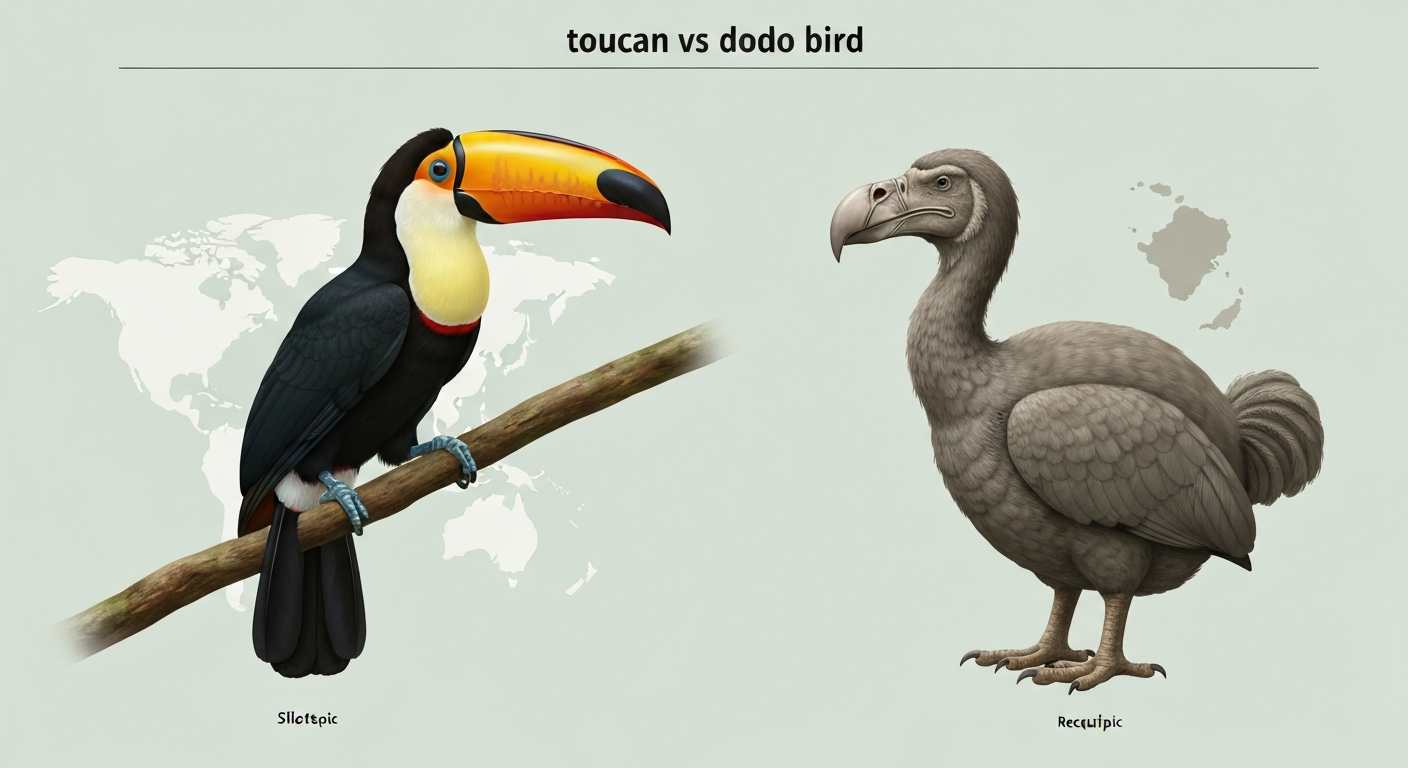
At a glance: toucan vs dodo
| Trait | Toco Toucan (Ramphastos toco) | Dodo (Raphus cucullatus) |
|---|---|---|
| Order | Piciformes | Columbiformes |
| Family | Ramphastidae | Columbidae / Raphidae |
| Size (length) | 50–61 cm | Estimated ~65–75 cm tall |
| Body mass | 500–860 g (approx.) | ~10.6–14.3 kg (live-mass estimate) |
| Beak | Very large, lightweight, colorful bill (158–215 mm) | Stout, hooked, grey beak |
| Plumage | Vivid black, white, red, yellow, blue | Grey-brown with pale wing plumes; modest coloration |
| Flight ability | Capable flier | Flightless (secondary flightlessness) |
| Diet | Mainly fruit; also insects, small vertebrates, eggs | Ground-foraging frugivore/omnivore |
| Habitat | Tropical forest, woodland, savanna edges | Lowland forest and seasonal wetlands, Mauritius |
| Range | Amazonia, Cerrado, Pantanal, N. Argentina (Neotropical) | Mauritius only (Indian Ocean, Mascarene Islands) |
| Life history | Cavity nester; pair bonds; lifespan ~20 years in captivity | Inferred ground nester; slow reproduction (island ecology) |
| Conservation status | Least Concern (IUCN/BirdLife) | Extinct (EX) — last reliable records late 1600s |
The toucan: a quick overview
When most people picture a toucan, they are picturing the toco toucan (Ramphastos toco), the largest and most widely recognized member of the family Ramphastidae. It belongs to Order Piciformes, the same broad grouping as woodpeckers and barbets, and phylogenomic work using ultraconserved elements and mitogenomes (Ostrow et al., 2023) confirms that Ramphastidae is a well-supported monophyletic family nested within the Piciformes radiation. There are over 40 toucan species in total, distributed across Central and South America from Mexico down to northern Argentina, but the toco toucan holds the widest range, spanning Amazonia, the Cerrado, the Pantanal, and open woodlands well into the Southern Cone.
In terms of appearance, the toco toucan is unmistakable. The body is mostly glossy black with a large white bib on the throat and upper breast, a vivid red patch under the tail, and bright blue skin around each eye. The bill itself can measure 158–215 mm and is a striking orange-yellow with a black base and a red tip. The bird's total length runs 50–61 cm, and adults typically weigh somewhere between 500 and 860 grams. Despite its enormous bill, the toucan is a reasonably agile flier, moving through forest canopy in bounding, flap-and-glide sequences. It nests in tree cavities (often repurposed woodpecker holes), raises small clutches, and shows pair-bond behavior. Toucans are primarily frugivores but will opportunistically take insects, lizards, small frogs, and the eggs or nestlings of other birds.
Conservationally, the toco toucan is assessed as Least Concern by IUCN and BirdLife International. See World Bird Names / species facts (IOC) and IUCN/BirdLife assessments (see linked checklist entries) for detailed range maps and the IUCN/BirdLife assessment listing the toco toucan as Least Concern across Amazonia, the Cerrado, the Pantanal and into northern Argentina. Its broad range and adaptability to forest edges, gallery forest, and even suburban trees with mature fruiting species give it a buffer that many Neotropical birds lack. That said, like all forest-dependent species, it faces pressure from deforestation and trapping for the pet trade.
The dodo: a quick overview
The dodo (Raphus cucullatus) is one of the most famous extinct animals in history, and also one of the most misrepresented. It was not a primitive, isolated relict of ancient bird evolution. Ancient-DNA phylogenetic analysis (Shapiro et al., 2002, Science) placed the dodo and the Rodrigues solitaire firmly within Columbidae, most closely related to Southeast Asian pigeons including the Nicobar pigeon. In plain terms, the dodo was a highly derived pigeon that colonized Mauritius in the Indian Ocean and, over evolutionary time, lost the ability to fly. Its taxonomic placement is most often listed as Raphus cucullatus, Order Columbiformes, with family designation varying between Columbidae and the subfamily/family Raphidae depending on the authority used. The IOC World Bird List treats it as extinct (EX).
The dodo was a large, stocky bird. CT-based volumetric reconstructions (Brassey et al., PeerJ 2016) produced live-mass estimates of roughly 10.6–14.3 kg, replacing the inflated estimates of earlier literature. A morphometric study using 174 dodo femora from the Mare aux Songes subfossil bone-bed in southeast Mauritius (van Heteren et al., PeerJ 2017) refined this further, providing the most sample-robust body-mass inference yet available. The dodo stood roughly 65–75 cm tall, with grey-brown plumage, a small tuft of curly feathers at the tail, stubby vestigial wings, and a large, hooked, grey beak. Osteological studies confirm that the pectoral girdle and wing bones were markedly reduced compared to volant pigeons, consistent with secondary flightlessness, but no elements were entirely lost.
The dodo's habitat, inferred from the Mare aux Songes assemblage and associated plant microfossils and sediment data, included lowland forest and seasonal freshwater wetlands. Eyewitness accounts from 17th-century Dutch sailors and naturalists like Clusius (1605) describe a ground-dwelling bird feeding on fallen fruits, and modern paleoecological synthesis supports a reconstruction as a ground-foraging frugivore and opportunistic omnivore within Mauritius' lowland forest mosaic. The dodo went extinct by the late 17th century, primarily due to the combined pressures of introduced invasive mammals (rats, pigs, macaques, cats), direct hunting by sailors and settlers, and forest clearance. There was no single cause; it was cumulative anthropogenic impact concentrated on an island animal with no prior exposure to mammalian predators.
Size and taxonomy: how different are they really?
The size gap between these two birds is significant. A toco toucan weighing up to around 860 grams sits comfortably in one hand. A dodo, at a live mass of roughly 10.6–14.3 kg based on the most current CT-based and morphometric analyses, was closer in heft to a large domestic turkey. In body length, the dodo was probably slightly taller in standing posture, but its bulk was far greater. The toucan has a characteristically elongated bill that can make it look larger than it is; the dodo was genuinely massive for a pigeon relative.
Taxonomically, these birds are about as distantly related as two birds can be. The toucan belongs to Order Piciformes, which also includes woodpeckers, puffbirds, and jacamars. The dodo belonged to Order Columbiformes, which today includes all pigeons and doves. Modern molecular and phylogenomic work places these two orders in quite different parts of the avian tree, with no close common ancestry within the scope of any meaningful comparison. There is no shared evolutionary history worth noting beyond the fact that both are birds.
One misconception worth addressing directly: the toucan and the dodo never coexisted in the wild. Toucans are restricted to the Neotropics (the Americas), while the dodo was endemic to Mauritius in the Indian Ocean. They lived on different continents and different geological epochs of human history, and their ecologies never overlapped.
Bill structure and function: two very different tools
The toucan bill is one of the most studied structures in avian biology, and for good reason. It looks unwieldy but is actually a marvel of lightweight engineering. High-resolution structural studies (Seki, Schneider and Meyers, Acta Materialia 2005, and follow-up materials science work) show the bill is a sandwich composite: a thin outer shell of keratin (the rhamphotheca) enclosing a mineralized collagen trabecular core with a closed-cell foam architecture. Micro-CT and nanoindentation measurements put the keratin shell's Young's modulus at roughly 1–7 GPa depending on measurement direction and hydration, with the mineralized trabeculae stiffer still. This sandwich design gives the bill exceptional stiffness-to-weight ratio and good fracture tolerance, it resists cracking under the loads of manipulating large, hard fruits or fending off competitors.
The bill also serves a physiological function that has nothing to do with feeding. Live-animal thermography by Tattersall et al. (PNAS 2009) demonstrated that the toucan actively regulates blood flow to the bill surface, using it as a controllable vascular thermal radiator. The bird can dissipate a substantial fraction of its metabolic heat through the bill, making it a kind of built-in cooling system. This is particularly relevant for a bird living in humid tropical environments where overheating is a genuine risk. The bill's large surface area, which might seem like a liability, turns out to be an advantage for thermoregulation.
The dodo's beak was something else entirely. It was stout, heavily built relative to body size, strongly hooked at the tip, and grey in coloration. It was not designed for the kind of precise fruit manipulation a toucan performs. The dodo's beak morphology is consistent with a bird processing hard fruits, seeds, and perhaps roots or other ground-level food items in the absence of competition from the kinds of mammals that typically fill those niches on continental landmasses. There is no sandwich foam architecture here; the dodo beak shows the robust, mineralized construction typical of large columbid-style bills scaled up considerably. The two bills are functionally and structurally in entirely different categories.
Bill comparison at a glance
| Feature | Toco Toucan Bill | Dodo Beak |
|---|---|---|
| Length | 158–215 mm | Proportionally shorter but stout and deep |
| Structure | Keratin shell over closed-cell foam trabeculae | Solid, heavily mineralized columbid-type bill |
| Shape | Long, slightly curved, blunt tip with serrations | Shorter, deeply hooked at tip |
| Color | Vivid orange-yellow, black base, red tip | Grey with pale tip regions |
| Primary function | Fruit manipulation, thermoregulation, display | Crushing and processing hard food items |
| Weight | Extremely light relative to size | Proportionally heavier |
| Thermal role | Active vascular radiator (confirmed experimentally) | No evidence of thermal radiator function |
Plumage, coloration and external appearance
The contrast in plumage between these two birds could not be more dramatic. The toco toucan is a high-contrast, vividly colored bird. The body is largely glossy black, relieved by a broad white bib, a crimson undertail region, bright blue orbital skin, and the spectacular multicolored bill. The coloration is thought to function in species recognition, social signaling, and possibly sexual selection, though the toucan is not strongly sexually dimorphic: males and females look similar, with males averaging slightly larger. The bill patterning is consistent within the species and serves as an identification marker both for other toucans and for human observers.
The dodo, by contrast, was a subdued bird in terms of color. Historical illustrations and accounts, including those derived from live specimens brought to Europe in the early 1600s, consistently describe grey-brown body plumage with paler, somewhat fluffy or disheveled feathering on the wings and a small tuft of curly feathers at the tail. The face had bare, pale skin around the bill, and the legs were yellowish. It is worth noting that many of the early European paintings of the dodo were made from captive birds that may have been overfed and in poor feather condition, so some depictions may overstate the bird's rotundity. The plumage itself was not highly structured for display; given the island ecology with few predators and no close competitors requiring visual signaling, there would have been limited selective pressure for elaborate coloration.
Wing structure tells an important story too. Toucan wings are fully developed and functional, with a wing chord of roughly 220–260 mm in the toco toucan, supporting competent powered flight. Dodo wings, as documented in osteological analyses, were proportionally tiny: the pectoral girdle was reduced, the carina (keel) was small, and the wing bones were gracile and vestigial. The flight muscles that attach to those bones would have been minimal. This is a textbook example of secondary flightlessness, the same process seen in kiwis, ostriches, and other island or niche-specialist birds that traded flight for increased body mass and ground-feeding efficiency once the evolutionary pressure to escape predators was removed.
Ecological roles and diet
Toucans are important seed dispersers in Neotropical forest ecosystems. Their large bills allow them to swallow whole fruits that smaller birds cannot handle, and they move through the canopy across considerable distances, depositing seeds far from parent trees. This makes them what ecologists call keystone frugivores in some forest systems. They supplement their fruit diet with insects, small reptiles, frogs, and the eggs or nestlings of cavity-nesting birds, which sometimes brings them into conflict with other species at nest sites.
The dodo's ecological role on Mauritius was analogous in some respects: it was almost certainly an important disperser of large-seeded fruits in the island's lowland forest. The most famous ecological hypothesis links the dodo to the tambalacoque tree (Sideroxylon grandiflorum), whose seeds were once thought to require dodo gut passage to germinate. That specific claim has been questioned and largely refuted in subsequent botanical work, but the broader principle, that the dodo played a seed-dispersal role for large-seeded Mauritian plants, is well-supported by its frugivore ecology. The loss of the dodo almost certainly disrupted plant community dynamics on Mauritius in ways that are difficult to fully reconstruct.
Flight, flightlessness and wing morphology
Flight capacity is one of the starkest biological divides between these two birds. The toco toucan is a capable, if not especially graceful, flier. It moves between fruiting trees, crosses rivers and forest gaps, and can travel several kilometers. The dodo was completely flightless. Osteological work makes clear that the skeletal elements for flight were present but heavily reduced: no bones were entirely lost, but the pectoral girdle and wing bones were so diminished that flight would have been physically impossible. This is not unusual among island birds. The kiwi shows a similar pattern of wing reduction, and comparing the dodo to the kiwi in this respect makes for a useful parallel. For a direct comparison of the dodo and the kiwi, see kiwi bird vs dodo (internal link id ab83acf3-740d-43c0-a01a-807ba562f9f2). For another perspective on flightlessness and body-size evolution, see our comparison of kiwi bird vs ostrich. See kiwi bird vs egg for a focused comparison of kiwi flightlessness and reproductive biology.
Secondary flightlessness evolves on islands when there are no terrestrial predators to escape, when food resources are concentrated on the ground, and when the energetic cost of maintaining large flight muscles outweighs any benefit. Mauritius before human arrival had no native land mammals and no mammalian predators whatsoever. Under those conditions, a large ground-dwelling bird could thrive without wings. When European sailors arrived in the late 1500s and early 1600s, they brought rats, pigs, macaques, and cats, all of which could prey on dodo eggs and chicks. The dodo had no behavioral or morphological adaptations to cope with mammalian predation, which is a major reason the extinction was so rapid.
Why the dodo went extinct (and the toucan hasn't)
The dodo's extinction by the late 17th century (the last widely accepted reliable sighting dates to 1662, though some accounts push slightly later) was driven by a combination of factors that modern synthesis work (Cheke and Hume, Lost Land of the Dodo, 2008) summarizes as cumulative anthropogenic impact. Direct hunting by sailors was a factor, particularly in the earliest contact period when dodos had no fear of humans and were easy to approach. But hunting alone was probably not the primary driver. The introduction of invasive mammals, especially rats (which preyed on eggs and chicks), pigs (which destroyed ground nests and consumed vegetation), and macaques (agile, opportunistic nest predators), was likely the decisive pressure. Habitat clearance for early Dutch colonial agriculture compounded everything.
The toucan avoids this fate for several reasons. It is a volant species capable of escaping predators by flight. It occupies a large geographic range across multiple countries and biomes. It nests in tree cavities above ground level, reducing egg and chick predation risk. And it has co-evolved with a full complement of Neotropical predators, so it retains behavioral wariness. None of these factors applied to the dodo. The extinction of the dodo is not a story of a stupid or slow bird; it is a story of an animal perfectly adapted to one environment that was annihilated when that environment was abruptly transformed by human arrival.
Common misconceptions
- The dodo was not a primitive bird — it was a derived, specialized member of Columbiformes, closely related to Southeast Asian pigeons like the Nicobar pigeon, as confirmed by ancient-DNA analysis.
- The toucan's bill is not heavy — its sandwich composite structure (keratin shell over foam trabeculae) makes it extremely lightweight relative to its size.
- The dodo did not go extinct purely because it was slow or dumb — it went extinct because introduced mammals destroyed its nests and it had no evolved defenses against ground-level mammalian predators.
- Toucans and dodos never met in the wild — they lived on different continents and there was no geographic or ecological overlap.
- The dodo was not as round as many famous paintings suggest — early captive specimens were probably overfed, and modern mass estimates based on CT scanning place it at 10.6–14.3 kg, not the morbidly obese figure some illustrations imply.
- The toucan bill is not used primarily for combat — its main roles are fruit manipulation, thermoregulation, and social display.
Cultural significance: two birds the world knows by silhouette
Both birds have achieved a level of cultural recognition far beyond what their biological status might predict. The toucan is a global brand icon, particularly associated with tropical fruit and cereal marketing, and its image is used to signal abundance, color, and the exotic tropics. The dodo has become the universal symbol of extinction, carelessness, and biological loss, so much so that 'dead as a dodo' entered the English language as a phrase for irreversible obsolescence. For more on comparisons that place the dodo in the context of human impacts and responsibility, see the dodo bird vs human discussion. Neither bird's cultural image is entirely accurate: the toucan is not just a decorative tropical curiosity but a functionally sophisticated species with remarkable bill biomechanics, and the dodo was not an inherently doomed evolutionary failure but a victim of rapid, human-caused ecological disruption.
For educators and communicators, the dodo's extinction offers one of the clearest and most documentable case studies in anthropogenic extinction. The sequence of events, first contact, hunting, introduction of invasive species, habitat clearance, local population collapse, and final disappearance within roughly 80 years of initial European contact, is unusually well-dated by historical records and subfossil chronology. The Mare aux Songes bone-bed, with radiocarbon dates clustering around 4,235–4,100 calibrated years BP, gives us pre-extinction population context that few other extinct island birds can match.
Evolutionary context and the fossil record
The dodo's fossil and subfossil record is primarily sourced from Mauritius, with the Mare aux Songes site providing the largest and most contextually rich collection of dodo bones known. Those bones have enabled morphometric studies at meaningful sample sizes, culminating in the van Heteren et al. (2017) analysis of 174 femora, the most statistically robust body-mass estimation to date. Earlier literature had a wide range of mass estimates for the dodo because it relied on small, biased samples; the subfossil record has steadily corrected this.
For the toucan, the fossil record is much thinner, as expected for a Neotropical forest bird whose bones rarely preserve. The modern phylogenomic framework (Ostrow et al., 2023) places Ramphastidae within Piciformes with strong support and resolves internal relationships among toucan genera, but divergence-time estimates for when toucans split from other Piciformes lineages remain approximate. What is clear is that by the time humans encountered both the toucan and the dodo, both birds had been on their respective evolutionary trajectories long enough to become highly specialized for their particular ecological niches.
Toucan vs dodo: which comparison is actually useful?
Honestly, the toucan and the dodo are not species that a birder would normally compare for identification purposes, because one is alive and one is not. What makes this comparison genuinely useful is the contrast it draws between two very different evolutionary strategies, one involving flight, canopy life, vivid coloration, and a sophisticated multifunction bill, and the other involving ground life, flightlessness, island specialization, and a body plan that worked perfectly until the world it was adapted to ceased to exist. For anyone interested in bird biology, extinction science, or comparative anatomy, the side-by-side view is instructive precisely because these two birds are so different.
If you want to go deeper on the dodo side of this comparison, the kiwi vs dodo comparison covers two flightless birds with quite different evolutionary backstories, and the dodo vs shoebill comparison examines two large, distinctive birds with very different ecological contexts. For a focused comparison, see the dodo bird vs shoebill comparison (internal resource 5d6c1c96-d09c-44af-bcfd-629a28a0c5e9) which examines similarities and contrasts between these two large, distinctive birds. The dodo vs terror bird angle takes things in a more paleontological direction, while dodo vs T. rex explores the dodo's place in the full arc of extinction science. For a broader perspective on the dodo's place in extinction narratives, see our dodo bird vs t rex comparison. On the toucan side, the anatomical detail of the bill covered here connects naturally to broader discussions of avian beak evolution across any number of comparison pairs on this site. For a focused comparison of small-bird morphology and aerodynamic trade-offs, see dugast small bird vs typhoon.
FAQ
What is a good SEO‑friendly title and meta description for an article comparing the toucan and the dodo?
Title: Toucan vs Dodo Bird — Side‑by‑Side Comparison of Taxonomy, Anatomy, Ecology & Extinction Meta description (≤160 chars): Toucan vs Dodo: compare taxonomy, beaks, size, ecology, extinction causes and conservation lessons in an authoritative side‑by‑side guide.
Quick answer: how do the toucan and the dodo differ in a sentence?
The toucan (Ramphastos toco) is a living Neotropical, arboreal, volant frugivore with a large vascularized bill, while the dodo (Raphus cucullatus) was a flightless, now‑extinct ground‑foraging columbid endemic to Mauritius with reduced wings and robust body adapted to island life.
How do the toucan and dodo compare taxonomically?
Toucan: Order Piciformes, Family Ramphastidae, genus Ramphastos, species example Ramphastos toco (IOC/World Bird List). Dodo: Order Columbiformes, genus Raphus, species Raphus cucullatus (treated as extinct). Ancient DNA places the dodo firmly within Columbidae, closely related to pigeons such as the Nicobar pigeon (Shapiro et al., 2002). Provide checklist citations (IOC, World Bird Names) and phylogenomic studies for authoritative sourcing.
What are the key anatomical differences (size, wings, beak, plumage)?
Size: Toco toucan total length ≈50–61 cm; dodo live‑mass estimates ~10–14 kg (CT/convex‑hull and morphometric studies). Wings: toucans are fully volant with well‑developed flight apparatus; dodos show reduced pectoral girdle and wing bones (reduced carina) consistent with secondary flightlessness. Beak: toucan bill is a lightweight keratinized sandwich of thin rhamphotheca over porous bone—large, vascular and used also for thermoregulation; dodo had a stout hooked bill for handling fruits/food. Plumage: toucans have colorful bare bill and contrasting plumage; dodos had dense feathers and a downy body in contemporary descriptions and reconstructions. Cite Seki et al. for toucan bill structure, Livezey and van Heteren/Brassey for dodo osteology and mass.
How do toucan and dodo diets and feeding behaviors compare?
Toucan: primarily frugivorous but opportunistically omnivorous (fruits, insects, small vertebrates), foraging in trees and using bill to reach fruit; documented in field accounts/species accounts. Dodo: reconstructed as a ground‑foraging frugivore/omnivore in Mauritius lowland forest mosaic—ate fallen fruit, seeds and possibly invertebrates; historical accounts support this, but specific dietary items and gastrolith evidence require specimen‑level evaluation. Use paleoecological data (Mare aux Songes) and historical accounts plus modern syntheses (Cheke & Hume).
What did the dodo’s extinction involve — causes and timeline?
The dodo became extinct in the late 17th century due to multiple anthropogenic drivers: habitat loss from human clearance, introduced mammals (rats, pigs, macaques, cats) predating eggs and chicks and competing for food, and direct hunting/collecting by sailors. Radiocarbon and historical records constrain the timeline; Cheke & Hume (2008) and paleoecological syntheses summarize these drivers. Extinction was rapid after human colonization of Mauritius.