Bearded dragons and birds are not closely related at all. A bearded dragon (Pogona vitticeps) is a squamate reptile in the family Agamidae, while birds belong to the class Aves and are, technically, a living lineage of theropod dinosaurs. They share a distant common ancestor hundreds of millions of years ago, but everything from their body temperature regulation and lung design to how they communicate and what they need from a home enclosure is fundamentally different. If you're deciding between one and the other as a pet, the honest answer is: bearded dragons suit hands-on reptile keepers who can commit to precise heat and UV lighting management, while birds suit owners who want vocal, socially interactive companions. Neither is a starter pet, and they should never share an enclosure.
Bearded Dragon vs Bird: Key Differences, Care & Choice

Which one is actually right for you?
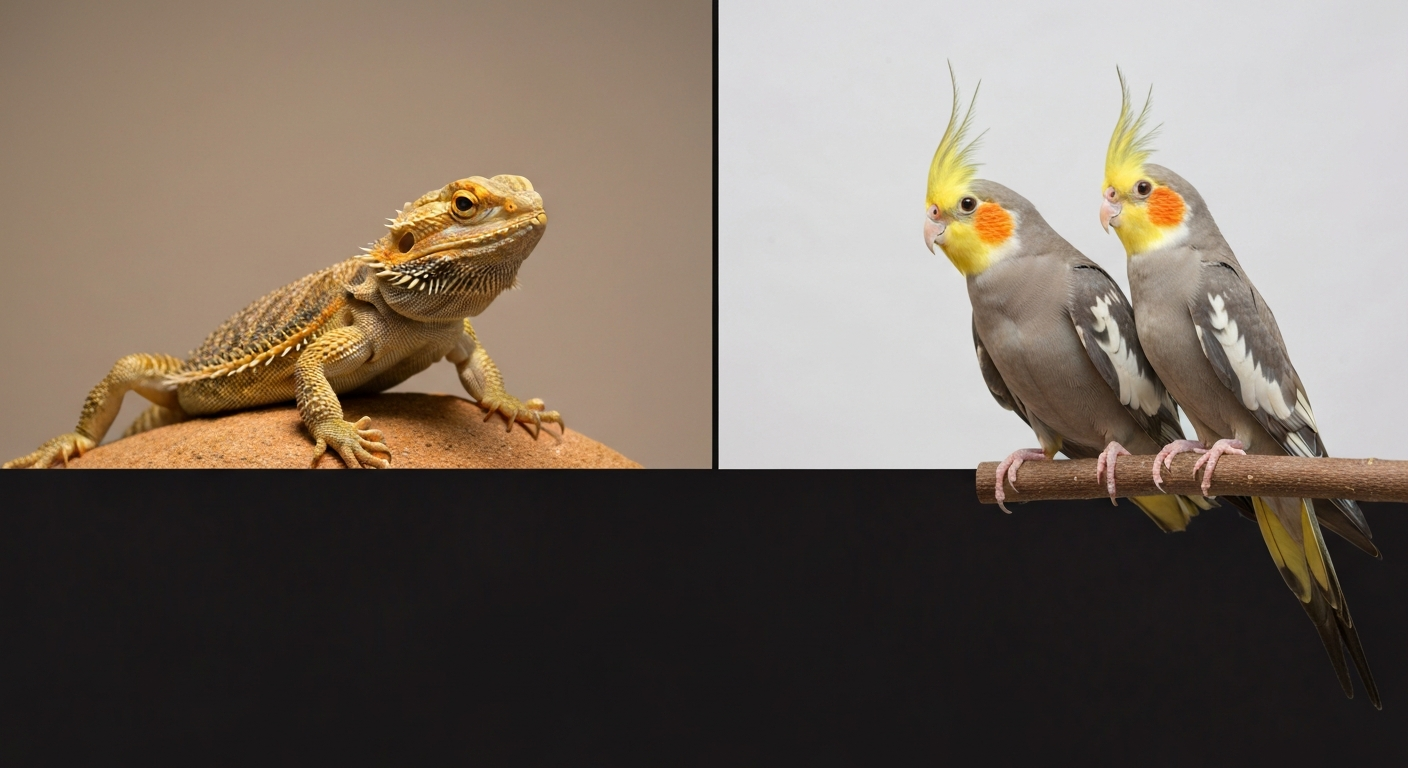
Both animals can thrive in captivity when given proper care, but they demand very different things from their owners. Bearded dragons are quiet, individually focused, and highly dependent on a carefully engineered environment (basking spots, UVB lamps, live feeder insects). Birds, depending on species, can be loud, intensely social, and emotionally demanding in ways that surprise first-time owners. A cockatiel will vocalize daily and need hours of out-of-cage interaction. A bearded dragon will bask contentedly on a rock and study you with one lateral eye. Neither description is better than the other, but they map onto very different lifestyles.
Go with a bearded dragon if you enjoy observational care, have the budget and discipline for structured lighting and temperature gradients, and prefer a pet that doesn't make noise. Go with a bird if you want vocal interaction, training, and a companion that actively seeks your attention. If you're drawn to the mythological overlap between these creatures, you'll find that fascinating territory explored on this site in comparisons like the phoenix bird vs dragon and related mythical-creature pages, but the animals covered here are very much real.
Side-by-side comparison: bearded dragon vs bird
The table below covers the most biologically important categories. 'Bird' here refers to commonly kept pet species (parrots, cockatiels, budgerigars, canaries, finches) unless otherwise specified. Wild bird biology is noted where it differs meaningfully from pet-species norms.
| Category | Bearded Dragon (Pogona vitticeps) | Bird (Aves — typical pet species) |
|---|---|---|
| Taxonomy | Kingdom Animalia; Class Reptilia; Order Squamata; Family Agamidae; Genus Pogona; Species P. vitticeps (NCBI Taxonomy ID 103695) | Kingdom Animalia; Class Aves; varies by species (e.g., Order Psittaciformes for parrots, Passeriformes for canaries/finches); IOC World Bird List is the standard checklist authority |
| Appearance | Stocky lizard body, 40–60 cm total length; overlapping keratinous scales; expandable gular pouch (the 'beard'); four limbs with clawed toes; no wings; laterally placed eyes | Feathered body; forelimbs modified into wings; toothless beak/bill; scaly legs and feet; most species 10–100 cm; plumage coloration varies enormously by species and sex |
| Respiration & Thermoregulation | Simple saccular lungs; bidirectional airflow; ectothermic (cold-blooded); relies on behavioral thermoregulation — basking, microhabitat selection, posture — to reach preferred body temperature (38–42 °C active range) | Rigid parabronchial lungs coupled with compliant air sacs produce near-unidirectional airflow for high oxygen extraction; endothermic (warm-blooded); maintains constant core body temperature metabolically; highly sensitive to airborne toxins (Teflon fumes, etc.) |
| Locomotion | Quadrupedal; walks and runs on four limbs; can rear up briefly on hind legs; no aerial locomotion | Bipedal on ground; primary locomotion is flight in most species; forelimbs fully committed to wings; perching feet with anisodactyl or zygodactyl toe arrangement |
| Senses | Lateral-facing eyes with good color vision including UV; parietal eye (pineal photoreceptor) on top of skull; vomeronasal (Jacobson's) organ used via tongue-flicking for chemical detection; hearing adequate but less acute than birds | Forward-facing or lateral eyes depending on species; exceptional visual acuity and color vision (tetrachromacy, including UV in many species); hearing highly developed, especially for frequency discrimination; no vomeronasal organ; some species (parrots) capable of vocal mimicry |
| Reproduction | Oviparous; lays clutches of roughly 8–30 eggs; incubation 55–75 days at ~28–32 °C; ZZ/ZW sex-determination system, but high temperatures (above ~32 °C) can cause sex reversal in genetic males | Oviparous; clutch size varies from 1 egg (large raptors) to 12+ (small passerines); incubation 11–80 days depending on species; most species show temperature-independent sex determination (ZW/ZZ in most); many show biparental care |
| Diet | Omnivorous; juveniles primarily insectivorous (60–70% live insects); adults shift toward leafy greens and vegetables (~70–80% plant material); calcium supplementation essential; live prey triggers strong feeding responses | Highly variable: seed-eaters (canaries, budgies), fruit/nectar specialists (lorikeets), omnivores (crows, parrots), carnivores (raptors); commercial pellet diets now recommended as the base diet for most pet parrots over seed-only diets |
| Social Behavior & Communication | Largely solitary in the wild; communicate via arm-waving, head-bobbing, beard darkening, and color changes; capable of social learning and gaze-following in experimental settings; not vocal; no territorial songs | Highly variable: many species are intensely social (flock birds like budgies, cockatiels); communication via vocalizations (songs, calls, alarm cries); parrots and some passerines demonstrate vocal production learning; parrots show advanced problem-solving and emotional bonding |
Behavior, temperament, and what they're like to live with
Bearded dragon temperament
Bearded dragons have a well-earned reputation as one of the calmest, most handleable lizard species. They rarely bite once tame, and adults often seem genuinely relaxed when sitting on a warm arm or shoulder. That said, 'calm' doesn't mean 'simple.' They communicate constantly through body language: arm-waving signals submission or greeting; rapid head-bobbing in males signals dominance; a darkened, puffed beard indicates stress, threat display, or thermoregulatory signaling. Squamate reptiles also possess a vomeronasal (Jacobson’s) organ and use tongue-flicking to sample chemicals for prey, conspecific, and environmental detection (Chemical Communication in Lizards and a Potential Role for Vasotocin in Modulating Social Interactions, Integrative and Comparative Biology, 2021) Chemical Communication in Lizards and a Potential Role for Vasotocin in Modulating Social Interactions (Integrative and Comparative Biology, 2021). Experimental work has demonstrated that Pogona vitticeps can follow gaze, learn by watching conspecifics, and solve novel tasks, so they're cognitively more active than their still, basking posture suggests. They are solitary by nature and do best housed alone. Two males will fight. A male and female kept together will result in continuous, often stressful breeding attempts.
Bird temperament
Bird temperament varies more dramatically across species than bearded dragon temperament does. A canary is a hands-off, visually beautiful companion that sings but doesn't want to be handled. A hand-raised cockatiel is affectionate and vocal. A large parrot (macaw, African grey, cockatoo) is intensely bonded, emotionally complex, extremely loud, and capable of destructive behavior if bored or neglected. Many pet birds are flock animals by nature and suffer psychologically from isolation, leading to feather-destructive behavior and screaming. The Association of Avian Veterinarians stresses that bird owners must understand species-specific social needs before acquiring a bird. Vocal production learning in parrots is well-documented and makes them uniquely interactive, but that same intelligence makes under-stimulated birds genuinely difficult to manage.
Practical care: what each animal actually needs day to day
Housing
Adult bearded dragons require a minimum 120 x 60 x 60 cm (4 x 2 x 2 ft) enclosure, ideally larger. Screen-top glass terrariums or PVC reptile enclosures work well. Substrate options include reptile carpet, ceramic tile, or topsoil-sand mixes for adults. Loose particle substrates carry impaction risk for juveniles. The enclosure needs structured décor: a basking rock or branch under the heat lamp, hides at the cool end, and food and water stations. Cleaning involves spot-cleaning daily and full substrate changes regularly.
Pet birds need species-appropriate cages: a budgerigar or cockatiel needs a cage wide enough to fully extend and flap wings (minimum 60 cm wide for small species, much larger for parrots). Bar spacing matters, as wide gaps cause injury. Cage position is important too: birds are sensitive to drafts, kitchen fumes, and Teflon (PTFE) off-gassing from non-stick cookware, which is acutely lethal at low concentrations due to their highly efficient respiratory system. Bird lungs are structurally unique: a rigid lung of parabronchi coupled with compliant air sacs produces near‑unidirectional airflow and high respiratory efficiency (Perspectives on the Structure and Function of the Avian Respiratory System: Functional Efficiency Built on Structural Complexity, J. N. Maina, Frontiers in Animal Science, 2022). Daily out-of-cage supervised time is essential for most parrot species.
Temperature and UV lighting
This is where bearded dragon care is uniquely demanding. Per UC Davis veterinary guidance, the enclosure should maintain a thermal gradient: a basking spot at 100–110 °F (38–43 °C), a warm ambient side at 80–85 °F (27–29 °C), and a cool side around 75–80 °F (24–27 °C). Night temperatures should not drop below 65 °F (18 °C). Critically, bearded dragons require UVB radiation (UV index 3–6 in the basking zone) to synthesize vitamin D3 and metabolize calcium. Research on Pogona vitticeps confirms that UVB exposure directly affects plasma vitamin D3 metabolite concentrations, and deficiency leads to metabolic bone disease. UVB bulbs degrade before they visibly dim, so they must be replaced every 6–12 months regardless of apparent brightness. Lighting cycles of 12–14 hours of light in summer and 10–12 hours in winter support natural circadian rhythms, which are modulated by multiple photoreceptive pathways including the parietal eye.
Birds are endothermic and regulate their own body temperature, so they don't need external heat gradients for thermoregulation. Most pet bird species are comfortable at typical home temperatures of 65–85 °F (18–29 °C). However, they are sensitive to rapid temperature drops and cold drafts. Full-spectrum lighting is beneficial for many bird species (particularly for seasonal breeders and UV-dependent color perception) but is not as physiologically critical as it is for bearded dragons.
Diet
Juvenile bearded dragons eat 60–70% live insects (crickets, dubia roaches, black soldier fly larvae) and 30–40% leafy greens. Adults flip that ratio: roughly 70–80% leafy greens and vegetables, with insects as a supplement. Calcium powder should be dusted on insects at almost every feeding for juveniles; adults need it several times per week. Avoid iceberg lettuce (low nutrition), spinach and oxalates in excess, avocado (toxic), and wild-caught insects (pesticide and parasite risk). Water can be offered in a shallow dish and via light misting.
Bird diets depend entirely on species. The old 'seed-only' approach for parrots is now considered inadequate by most avian vets; formulated pellets supplemented with fresh vegetables, fruits, and limited seeds provide better nutritional balance. Canaries and finches do well on quality seed mixes with fresh greens. Never feed birds avocado, onion, garlic, chocolate, or caffeine, as these are toxic. Fresh water daily is non-negotiable.
Handling and enrichment
Bearded dragons generally tolerate regular, gentle handling once acclimated. Support the full body when lifting. Avoid handling for 1–2 hours after feeding to reduce regurgitation risk. Enrichment includes foraging opportunities (hiding insects in salad, puzzle feeders), novel objects, and controlled outdoor time in warm weather for natural UVB and environmental stimulation. Their demonstrated social learning ability suggests they benefit more from environmental complexity than their reputation implies.
Birds require daily out-of-cage time, social interaction, and cognitive challenges. Foraging toys, shredding toys, and training sessions (target training, trick training) keep parrot species mentally occupied and reduce problem behaviors. Canaries and finches are hands-off birds that don't want handling but benefit from visual interest, cage enrichment, and same-species companionship.
Veterinary care and health issues to know about
Bearded dragon health
Bearded dragons should see an ARAV-member reptile vet for a baseline exam within the first few weeks of acquisition, and annually thereafter. The most common health problems in captive bearded dragons are metabolic bone disease (MBD) from inadequate UVB or calcium supplementation, infectious stomatitis (mouth rot), respiratory infections (often triggered by suboptimal temperatures or humidity), parasitic infections (pinworms, coccidia, which are common even in captive-bred animals), and impaction from swallowing substrate or oversized food items. Adenovirus (atadenovirus) is a significant pathogen in bearded dragon collections, causing neurological signs and high mortality in juveniles. Signs requiring urgent vet attention include: inability to lift the body, swollen limbs or jaw, open-mouth breathing, mucus around the nose or mouth, prolonged lethargy (beyond normal brumation), paralysis, or a soft/rubbery jaw.
Bird health
Birds require avian-specialist vets (AAV-member veterinarians are a reliable starting point) because their physiology is genuinely different from mammals and general practice vets may lack avian training. Annual wellness exams with blood work are recommended for most pet birds. Common conditions include psittacosis (Chlamydia psittaci infection, a zoonotic disease covered below), feather destructive behavior, Proventricular Dilatation Disease (PDD, caused by Avian Bornavirus), Psittacine Beak and Feather Disease (PBFD, a circovirus), aspergillosis (fungal respiratory infection), and nutritional disease from poor diets. Birds mask illness instinctively, a survival behavior that means by the time a bird looks obviously sick, the illness is often advanced. Early signs to watch for: fluffed feathers at non-sleeping times, decreased vocalization, tail bobbing, discharge from nares or eyes, or loose/discolored droppings.
Lifespan, upfront costs, and what you'll spend each year
| Cost Category | Bearded Dragon | Pet Bird (small to medium parrot/cockatiel) |
|---|---|---|
| Animal purchase price | $50–$100 (standard morphs); $200–$600+ (designer morphs) | $20–$100 (budgie, canary); $100–$400 (cockatiel); $1,000–$4,000+ (larger parrots like African grey, macaw) |
| Initial setup (enclosure, lighting, accessories) | $300–$700 (quality UVB fixture, thermostat, décor, basking lamp, substrate) | $150–$600 (cage, perches, food dishes, initial toys) |
| Ongoing food costs (annual) | $300–$600 (feeder insects, greens, calcium supplements) | $150–$500 (pellets, fresh food, seeds) |
| Electricity (heating/lighting) | $100–$300/year (multiple lamps running 12+ hours daily) | $30–$80/year (standard room lighting, minimal extra heating) |
| Veterinary care (annual wellness) | $100–$300/year (reptile-specialist exam, fecal parasite test) | $150–$400/year (avian vet exam, blood panel) |
| Unexpected vet costs | MBD, respiratory infections, impaction: $200–$1,500+ | Illness, surgery, PBFD testing: $300–$2,500+ |
| Typical lifespan | 10–15 years in captivity (well-cared-for adults) | Budgie: 5–10 years; cockatiel: 15–25 years; large parrots: 30–80+ years |
Lifespan is a serious planning factor. A macaw or cockatoo can outlive its owner. Even a cockatiel at 20+ years is a multi-decade commitment. A bearded dragon at 10–15 years is substantial but manageable within a typical decade of life planning. Budget realistically: the animal purchase price is usually the smallest expense. It's the enclosure setup, ongoing UVB bulb replacements, feeder insect colonies, and vet bills that add up.
Safety, compatibility, and zoonotic risks
Can bearded dragons and birds share a space?
Do not house bearded dragons and birds in the same enclosure. Ever. From a predator-prey standpoint, a bearded dragon's instinct is to investigate and potentially eat smaller animals, and a bird's instinct is to perceive a large lizard as a threat. Beyond behavior, bacteria from reptile oral cavities (including Salmonella and other gram-negative organisms) are highly dangerous to birds, whose respiratory and immune systems are vulnerable to unfamiliar pathogens. Even in the same room, free-flying birds and free-roaming lizards are a safety risk. If you keep both species, they should be in separate rooms or at minimum strictly supervised with no possibility of physical contact.
Zoonotic disease risks
Bearded dragons are well-documented Salmonella carriers. Shedding is intermittent and the animal may appear completely healthy. Transmission to humans occurs via direct contact or contaminated surfaces. The solution is consistent hand hygiene: wash hands thoroughly after every handling session and after any enclosure maintenance. This is especially important in households with young children, elderly individuals, pregnant people, or immunocompromised individuals. Don't kiss your bearded dragon or allow it near food preparation areas.
The primary zoonotic concern with pet birds is psittacosis, caused by Chlamydia psittaci. It is transmissible to humans via inhalation of dried fecal particles or respiratory secretions and can cause a flu-like illness that occasionally progresses to severe pneumonia. It is treatable with antibiotics in both birds and humans when caught early. New birds should be tested and quarantined. Routine cage cleaning with good ventilation reduces exposure risk significantly.
Legal considerations and permit requirements
Bearded dragons (Pogona vitticeps) are captive-bred extensively in the United States and much of Europe, making them legal to own in most jurisdictions without a special permit. However, importation of wild-caught specimens from Australia is prohibited under Australian law, and purchasing wild-caught animals or importing without proper documentation violates both the Convention on International Trade in Endangered Species (CITES) and national laws. Some U.S. states have additional restrictions: Hawaii prohibits bearded dragons entirely, as it does with most non-native reptiles, due to invasive species concerns. Always verify local and state/county regulations before acquiring any reptile.
Birds have a more complex legal landscape. Many parrot species are CITES Appendix I (most restricted) or Appendix II listed. CITES Appendix I species (including hyacinth macaws, spix's macaws, and numerous others) cannot be commercially traded internationally. In the United States, the Wild Bird Conservation Act of 1992 bans the import of most CITES-listed bird species for commercial purposes. Most legally sold pet birds in the U.S. and EU are captive-bred, but documentation (closed leg bands, hatch certificates) matters. Migratory native birds are protected under the Migratory Bird Treaty Act in the United States and cannot be kept as pets regardless of how they were obtained. Always purchase birds from USDA-licensed breeders or reputable avian rescues, and request documentation.
What to look for in photos and enclosure setups
When evaluating care images or setting up your own space, knowing what correct looks like helps. For bearded dragons, a properly equipped enclosure will show a basking lamp and a separate UVB tube (linear T5 HO or T8 UVB fixture running most of the enclosure length), a temperature gradient visible through the décor layout (basking rock on one end, cooler hide on the opposite end), and substrate appropriate for the animal's age. A digital thermometer with a probe at basking level should read 100–110 °F. Photos of healthy bearded dragons show bright, alert eyes, a round (not sunken) abdomen, smooth limbs without bumps or deformities, and a full, firm tail base.
For birds, a correctly sized cage shows no crowding, ample horizontal space for flight or wing extension, multiple perch diameters (to exercise foot muscles and prevent pressure sores), foraging toys, and a feeding station away from perches (to prevent fecal contamination of food). Feather condition is a key health indicator: tight, glossy, intact feathers indicate good health. Broken, missing, or barbered feathers suggest stress, poor nutrition, or feather destructive behavior.
When comparing scale versus feather microstructure, the distinction is visible even at modest magnification. Reptile scales are epidermal folds of cornified tissue with no central shaft or branching barbs. Bird feathers are complex hierarchical structures with a central rachis, lateral barbs, and interlocking barbules that create the vane. Feathers provide insulation, enable flight, and contribute to visual signaling in ways that scales simply cannot. This structural difference reflects the fundamental divergence in the thermal and locomotory biology of these two groups.
Decision guide: which animal fits your life?
Work through the following checklist honestly before committing to either animal. There are no wrong answers, only mismatches that lead to rehomed pets.
- Noise tolerance: Can you handle daily vocalizations, including loud calls and screaming? If no, a bird (especially a parrot) is a poor fit. A bearded dragon makes no noise beyond light scratching.
- Space and environment: Do you have a room that can accommodate a large terrarium with multiple lamps running 12+ hours daily? Bearded dragons need consistent electricity for heat and UV. Birds need a cage in a draft-free, Teflon-free zone.
- Interaction style: Do you want a pet that actively seeks your attention and can learn vocal tricks? That's a parrot. Do you prefer an animal you can handle calmly but that doesn't demand interaction? That leans toward a bearded dragon.
- Time commitment: Can you provide daily supervised out-of-cage time and social interaction? Birds (especially parrots) require this. Bearded dragons are lower-maintenance socially but need daily feeding and habitat monitoring.
- Household composition: Are there young children, elderly people, or immunocompromised individuals in the home? Both animals carry zoonotic risk (Salmonella for bearded dragons, psittacosis for birds). Follow strict hygiene protocols regardless.
- Lifespan commitment: Are you prepared for 15 years (bearded dragon) or potentially 20–50+ years (large parrots)? Consider what your life looks like that far ahead.
- Budget: Can you spend $400–$700 upfront on a properly equipped enclosure plus ongoing food, electricity, and annual vet costs? Both animals are more expensive than they first appear.
- Local regulations: Have you confirmed that the species you want is legal in your state, county, and rental agreement? Check before you buy.
Scenario-based recommendations
- First-time exotic pet owner, apartment, low noise tolerance: A single bearded dragon is a reasonable starting point. Their calm temperament and quietness suit apartment living, but budget and research the enclosure requirements thoroughly.
- Family with children (ages 8+): A bearded dragon handled regularly from a young age is a good family reptile. Teach hand-washing as non-negotiable. A cockatiel is a reasonable bird choice for families, but expect noise and require supervised child-bird interactions.
- Experienced keeper wanting long-term bonding: A hand-raised parrot (African grey, cockatoo, macaw) offers extraordinary companionship but is a multi-decade commitment with significant emotional and financial demands.
- Owner interested in low-maintenance observation: Canaries or finches provide visual and auditory pleasure with minimal handling requirements, similar in management intensity to a well-set-up bearded dragon enclosure.
- Already own a bird, considering adding a reptile: Keep them in separate rooms, maintain separate hygiene routines, and do not allow free-contact interaction. Both can thrive in the same household with proper separation.
Related comparisons worth exploring
If you arrived here with a broader curiosity about how birds and dragons relate in culture and mythology, this site covers a range of fascinating comparisons in that space. The phoenix bird vs dragon comparison examines how these two iconic mythological creatures are portrayed and contrasted across cultures. For a focused comparison on the Vermilion Bird versus the Phoenix and which is depicted as more powerful, see Vermilion Bird vs Phoenix, who is more powerful Vermilion Bird vs Phoenix — who is more powerful. For a look at how the phoenix contrasts with another legendary avian-hybrid, see our phoenix bird vs griffin comparison. Related mythical-bird content includes the vermilion bird vs phoenix, the bennu bird vs phoenix, the liver bird vs phoenix, the phoenix bird vs griffin, and the phoenix bird vs thunderbird comparisons, each unpacking different traditions and symbolic frameworks. For anyone curious about power hierarchies in mythological creatures, the vermilion bird vs phoenix (who is more powerful) piece tackles that directly. These topics sit in a different register from the biological comparison in this article, but they're part of the same broad territory of birds-versus-other-creatures comparisons that this site explores. For a related mythological comparison, see phoenix bird vs thunderbird for contrasts between two legendary avian symbols. For a focused comparison of similar mythological birds, see our liver bird vs phoenix discussion.
FAQ
Quick answer: How do bearded dragons differ from pet birds in one paragraph?
Bearded dragons (Pogona spp., chiefly P. vitticeps) are diurnal, oviparous agamid lizards: ectothermic, scale‑covered, tongue‑flicking chemosensory reptiles that thermoregulate behaviorally, require UVB for vitamin D3 synthesis, and have simpler bidirectional lungs. Pet birds (Aves) are endothermic, feathered, mostly oviparous vertebrates with complex unidirectional/parabronchial lungs plus air sacs, frequently show advanced vocal learning and flight adaptations, and have different husbandry needs (perch/flight space, diet, social stimulation). These fundamental differences affect anatomy, physiology, daily care, veterinary needs, zoonosis risks and suitability for different owners.
Annotated side‑by‑side comparison: taxonomy and appearance—what are the key differences?
Taxonomy: Bearded dragon = Pogona vitticeps (Agamidae, Squamata, Reptilia); Birds = Class Aves (multiple orders/families; use IOC World Bird List for classification). Appearance: Bearded dragons have scales, a ‘beard’ of throat spines, stout limbs and a long tail; most pet birds have feathers, beaks, wings and variable foot types (anisodactyl, zygodactyl). Size ranges overlap but body plan, integument (scales vs feathers) and appendage specialization (claws/tail vs wings/feathers) are diagnostic.
Respiration and thermoregulation—how do they differ physiologically?
Birds: endothermic with high metabolic rates, rigid parabronchial lungs + air sacs that support near‑unidirectional airflow and efficient gas exchange. Bearded dragons: ectothermic heliotherms relying on behavior (basking, posture, microhabitat) to reach preferred body temperatures; lungs are simpler and ventilated bidirectionally. Consequently birds maintain internal temperature metabolically; bearded dragons need controlled external temperatures and UVB to support calcium/vitamin D physiology.
Locomotion and senses—what contrasts should owners know?
Locomotion: Birds are adapted for flight to variable degrees (many pet species fly or require clipped/managed flight); bearded dragons are terrestrial climbers and runners with claws and tails for balance. Senses: Birds often have acute vision, color perception and (in many taxa) advanced vocal learning; bearded dragons have good vision including wavelength sensitivity and extra‑ocular photoreceptors, plus a vomeronasal organ/tongue‑flicking chemosensory system important for prey and social cues.
Reproduction differences useful for prospective owners?
Birds: oviparous with species‑specific clutch sizes, parental incubation or brood care behaviors; sex determination varies by species (ZW/ZZ in many birds). Bearded dragons: oviparous with clutch sizes typically ~8–30 eggs (varies), genetic sex (ZZ/ZW) but high incubation temperatures can cause sex reversal in P. vitticeps; incubation duration and temperature strongly affect development and hatchling phenotype.
Diet and feeding—how do requirements compare?
Bearded dragons: omnivorous but proportions change with age (juveniles more insectivorous, adults more herbivorous); require gut‑loaded insects, fresh greens, and attention to calcium/vitamin D3 (UVB or dietary D3) to prevent metabolic bone disease. Birds: diet depends on species (seed/nectar/frugivore/insectivore/carnivore); many companion birds need formulated pellets plus fresh produce; nutritional imbalances differ by species and are common if diet is inappropriate.
Phoenix Bird vs Thunderbird: Clear Mythical Bird Comparison
Compare phoenix vs thunderbird: origins, ID features, powers, symbolism, visuals, FAQ and sources.