Cranes and swans look nothing alike once you know what to check, but at a distance or in a quick glance they can genuinely fool you. The fastest way to tell them apart: look at the neck and bill. Swans have long, often curved necks and short, broad bills suited for dabbling and upending in shallow water. Cranes have long, straight necks, straight dagger-like bills longer than their head, and extremely long legs that lift their body high off the ground. If the bird is standing tall with legs visible and probing the ground or marsh edge, it's almost certainly a crane. If it's gliding on the water with a graceful S-curved neck, it's a swan.
Crane Bird vs Swan: Key Differences for Easy ID

Marcus Hendricks
16 Jun 2026
Fast visual ID at a glance
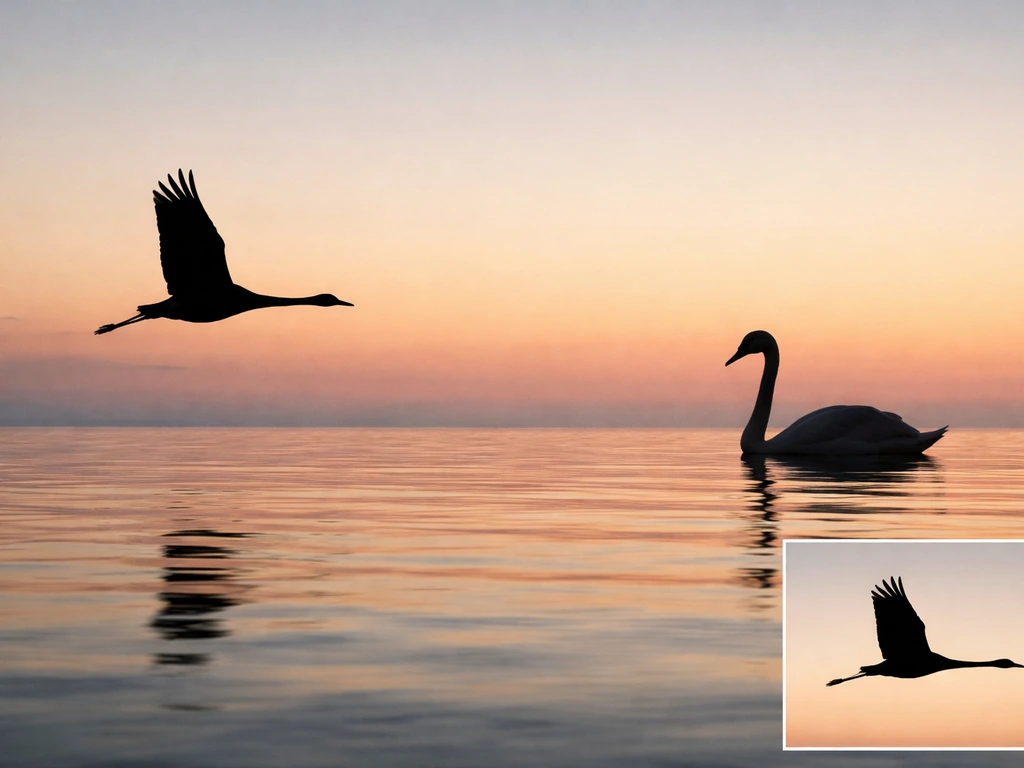
Silhouette is your single fastest tool. A swan sits low on the water like a boat, body compact, neck rising in a graceful curve or upright column depending on the species. A crane stands erect on long, stilt-like legs, body held more horizontal, neck extended like a periscope. Even when a crane is standing still in tall marsh grass, those legs give it away. The overall body shape of a crane is taller and leaner, with a bustle of drooping feathers over the tail (called a "bustle" or "tertial plume"), while a swan's body is broad, rounded, and low-slung.
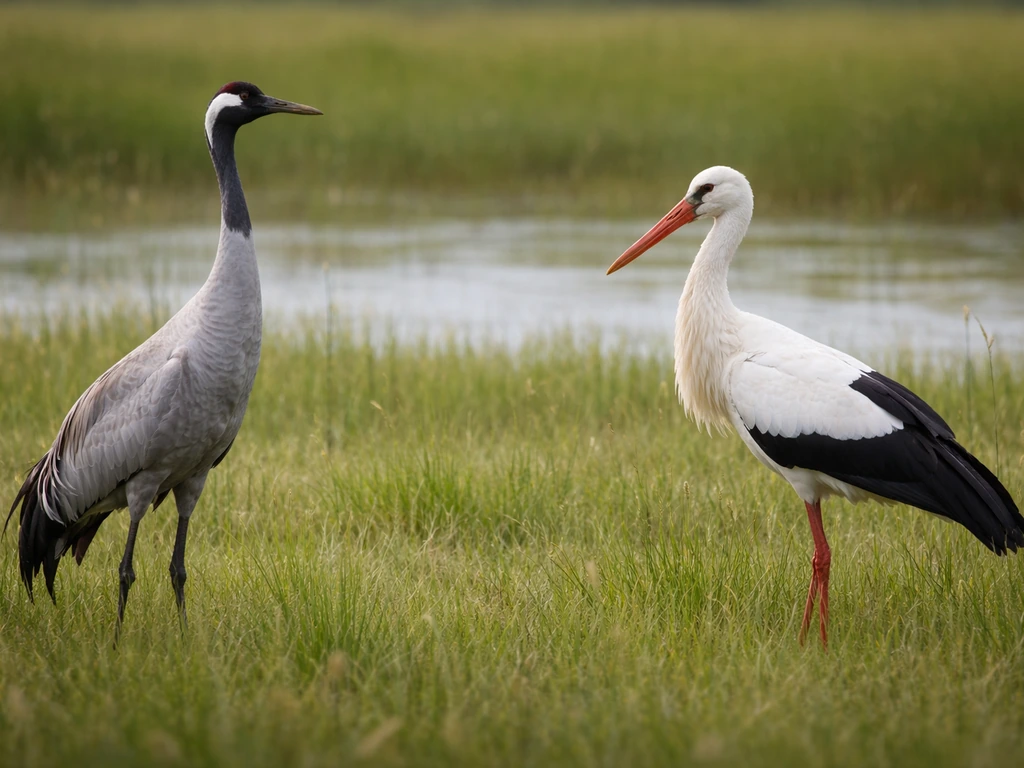
In flight, the difference is even more dramatic. Cranes fly with their neck fully stretched out straight in front and their long legs trailing behind like a pair of stilts, giving them a cross-shaped silhouette. Swans fly with the neck extended too, but their legs are short and tucked, and the overall shape is more torpedo-like, heavier in the body. If you see a large bird in flight with legs dangling behind it, that is a crane, full stop. If you want a simple comparison beyond cranes and swans, check a crane bird vs stork guide for quick silhouette and posture differences.
| Feature | Crane (e.g., Sandhill) | Swan (e.g., Mute, Trumpeter) |
|---|---|---|
| Body posture | Tall, upright, legs very long and visible | Low on water, compact and buoyant |
| Neck shape at rest | Long and straight, held erect | Long, often S-curved (especially Mute Swan) |
| Neck in flight | Fully extended straight out | Extended but body heavier, legs short/tucked |
| Legs in flight | Long, trailing visibly behind body | Short, not prominently visible |
| Overall silhouette | Lean, cross-shaped in flight | Torpedo or rounded, boat-like on water |
Bill, head, and plumage features that separate cranes from swans
The bill alone will close most IDs. Crane bills are long, straight, and pointed, longer than the length of the head. They look like a spear. Swan bills are shorter, broad, and flat across the top, built for filtering and grabbing aquatic vegetation.
On a Mute Swan, there is [an orange bill with a distinctive black knob at the base and black facial skin around the eye](https://www. mbr-pwrc. usgs. gov/id/htmid/h1782id.
html). On a Trumpeter Swan, the bill is all black with a V-shaped intrusion of white feathering from the forehead into the bill, and the eye is almost enclosed by black skin. Tundra Swans have a black bill with a small but useful yellow spot just in front of the eye. None of these bill shapes look anything like a crane's bill in a photo or in the field.
Head markings are another giveaway, especially for cranes. The Sandhill Crane has a bright red forehead patch on bare skin that stands out immediately when you get any decent look at the face. The Common Crane (found mainly in Eurasia, rare in North America) has a bold pattern: gray body, black head and neck, a broad white stripe running behind the eye down the neck, and a red crown patch. Swans, in contrast, have plain white heads with no bare-skin patches or patterning, just the bill and eye details described above.
Plumage color is often the first thing people notice. Adult swans in North America are entirely white. Most common cranes are gray, not white. Sandhill Cranes are gray overall with rusty-brown staining that varies by individual and season. If the large bird you are looking at is gray rather than white, it is not a swan.
Neck posture and typical movement on water vs land
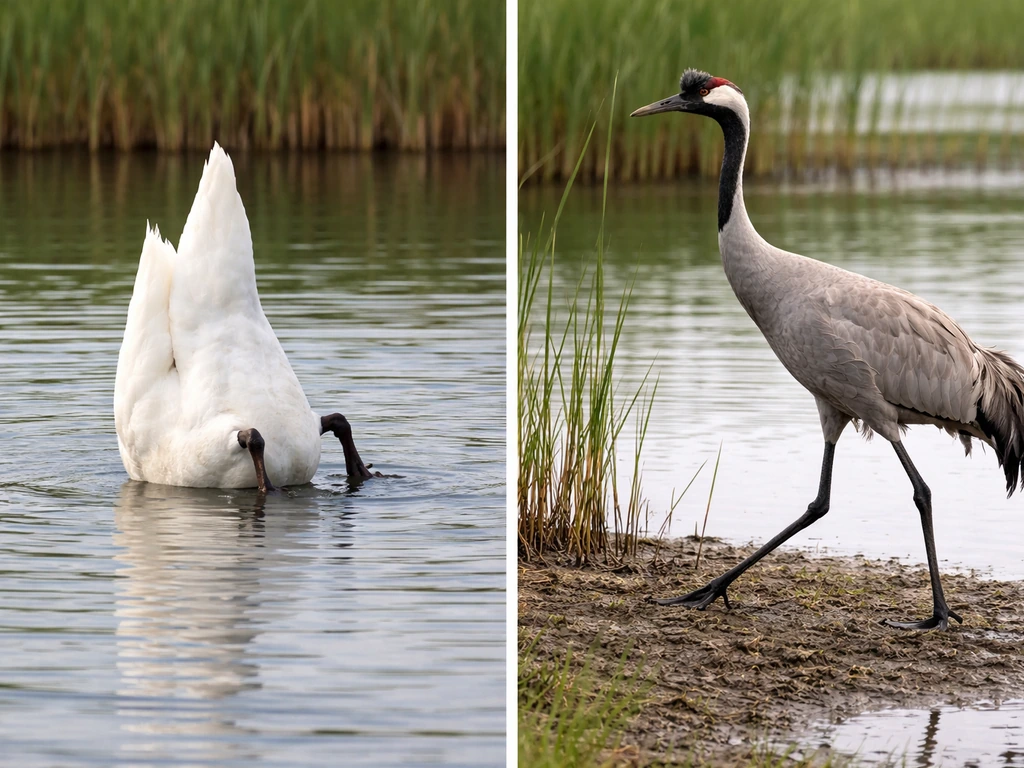
Swans are water birds at heart. They spend most of their time floating, feeding by reaching their long necks below the surface, upending tail-up to get at submerged vegetation in shallow areas, or dabbling along the waterline. Wildfowl research material describes “forward posture” as the head and neck held erect, which helps interpret how crane versus swan neck posture differs when birds are moving on water or nearshore [reaching their long necks below the surface](https://www. wildfowl.
wwt. org. uk/index. php/wildfowl/article/viewFile/118/118).
The Mute Swan's neck is famous for its S-curve when the bird is relaxed on the water. When alert, swans hold the neck more upright but still with a gentle curve at the base. You will not see a swan walking purposefully across a field with its head bobbing low.
Cranes are fundamentally land and wetland-edge birds. They walk steadily forward, head bobbing in rhythm with their steps, probing the soil and shallow water with that spear-like bill for invertebrates, seeds, and plant matter. They move through marshes, wet meadows, and agricultural fields in a deliberate, striding gait. When a crane does stand in water, it tends to be in very shallow areas at the edge, not floating in the middle of a pond. If the bird you are watching is walking across a field or marsh and actively probing the ground, it is a crane.
Habitat and where to look
Swans gravitate toward open, deeper water with abundant aquatic vegetation: ponds, lakes, slow rivers, and sheltered bays. They are year-round residents in many parks and nature reserves, and in North America you can find Mute Swans on urban lakes and coastal marshes. Tundra and Trumpeter Swans appear at larger wetlands, estuaries, and agricultural fields during migration, primarily in fall and winter outside their northern breeding grounds.
Cranes prefer wetlands combined with open upland areas. Sandhill Cranes stage in massive numbers at places like the Platte River in Nebraska each spring, using a mix of shallow riverine wetlands by night and agricultural cornfields by day. They also breed in northern marshes, bogs, and wet meadows across Canada and parts of the northern and western United States. During winter they move to the southern U.S. and northern Mexico. If you are standing at the edge of a broad, open marsh or a flooded farm field and you see large birds walking through it in loose flocks, start with crane as your first hypothesis.
One useful shortcut: if the bird is floating, it's almost certainly a swan. Cranes don't swim or float. They stand, walk, and fly.
Vocalizations and other telltale behaviors
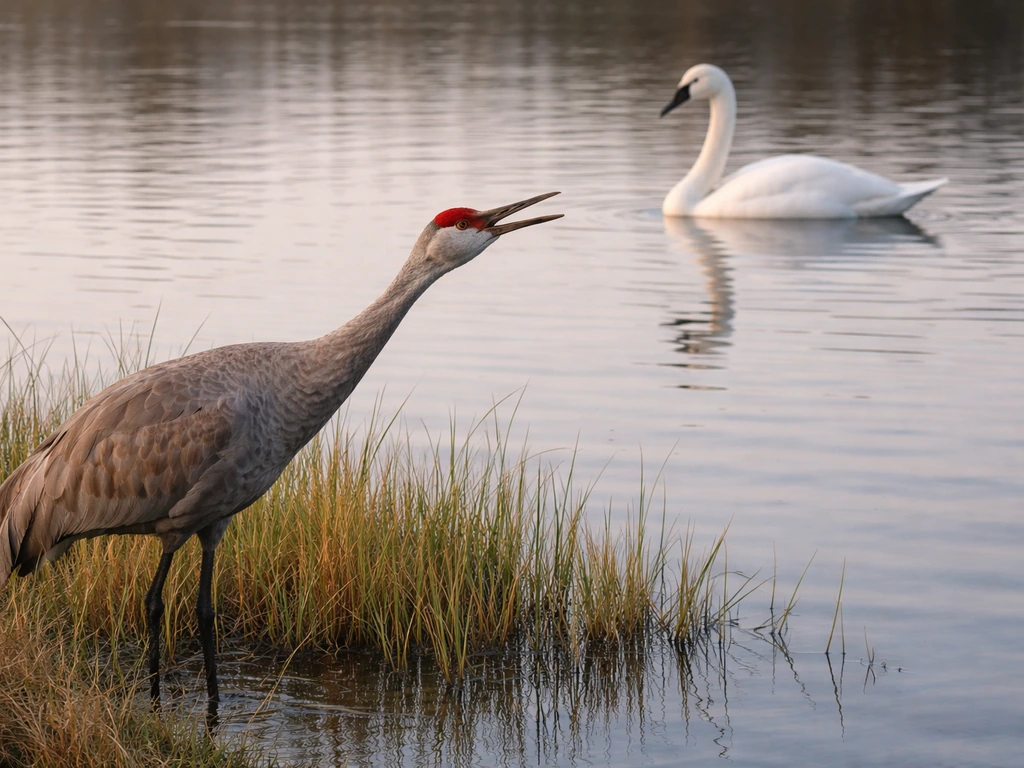
Sound is one of the most reliable ID tools you have, even before you get eyes on the bird. Sandhill Cranes produce a loud, rolling, rattling "kar-r-r-r-o-o-o" call that carries for miles. It is unlike anything a swan produces. Once you have heard it, you will never forget it. Whooping Cranes have a loud, bugling call. Common Cranes, if you are birding in Europe or happen to encounter a rare visitor to North America, call with a loud trumpeting bugle.
Swans are generally quieter but not silent. Trumpeter Swans give a deep, resonant "oh-OH" trumpeting call with emphasis on the second syllable. Tundra Swans produce softer, higher-pitched honking and cooing sounds. Mute Swans live up to their name for the most part, though they hiss loudly when threatened and make snorting, grunting sounds at close range. If you hear a loud, bugling, rattling call from a wetland, go with crane. If you hear a mellow trumpeting or nothing at all, lean toward swan.
Behavior at the group level helps too. Cranes perform elaborate, leaping courtship dances during breeding season, bowing and jumping with wings spread. They also roost communally in huge numbers at traditional staging sites. Swans are more solitary or found in family groups outside migration, and they are famously territorial on water, often aggressively chasing away other waterfowl. Mute Swans in particular can be aggressive toward humans when nesting.
Common lookalikes and where the confusion really comes from
Most of the genuine crane-versus-swan confusion happens in a few specific situations. First, Whooping Cranes are large and white, which is unusual for cranes in North America, and at a distance they can superficially resemble a swan or a large white heron. However, Whooping Cranes have red and black facial markings, black wingtips (visible in flight), and those characteristic long trailing legs in flight that no swan shows.
Second, juvenile or immature swans of any species have grayish-brown plumage rather than clean white, which throws people off. A juvenile Mute Swan with dingy brown feathers floating on a pond can look strange and unfamiliar, but the shape and behavior still say swan: it will be floating, dabbling, and showing a bill structure that, even when duller in color, still has the characteristic broad, flat shape.
Juvenile cranes are also worth noting. Young Sandhill Cranes lack the adult's red forehead patch and have a brownish, mottled appearance. They stay close to their parents, so if you see two adults with a mottled, slightly smaller bird walking beside them on land, that is a crane family, not a mixed-species group. Age-related bill color variation is also a trap with swans: juvenile Trumpeter and Tundra Swans can both show mostly black bills in winter, making species separation between those two harder. The key is to not rely on one field mark alone, especially with young birds.
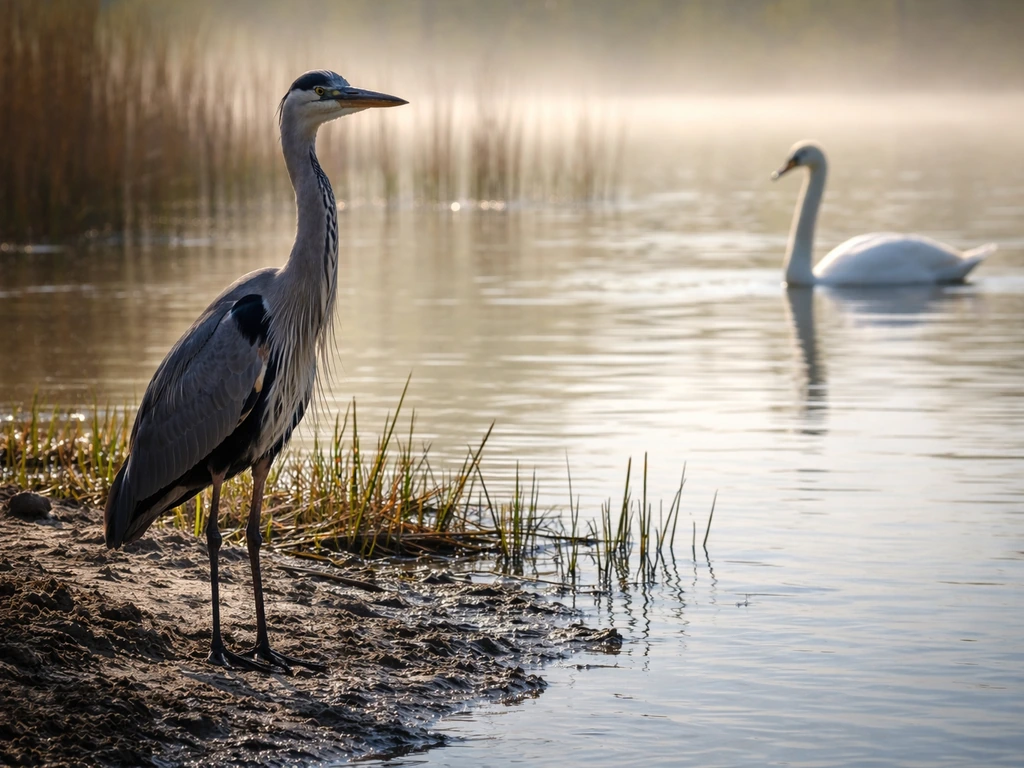
People who are already familiar with other large wading birds sometimes confuse cranes with herons or storks. Cranes are structurally similar to herons in some ways, and the confusion between a crane and a Great Blue Heron is actually more common than crane-versus-swan. The critical difference there: herons fold their neck into an S-shape in flight, while cranes fly with the neck fully outstretched. If those comparisons come up in your region, they are worth exploring alongside this guide.
Similarly, cranes versus storks is a real ID challenge in some parts of the world, given the overlapping silhouette of tall, long-legged wading birds. Pelican vs stork is another common confusion, but the bill shape and overall silhouette give them away quickly. Cranes and storks can look especially similar at a distance, so comparing neck and leg posture in flight is a good next step cranes versus storks.
Range is also a useful reality check before you commit to an ID. If you are in the continental United States and you see what looks like it might be a Common Crane with bold black and gray patterning, double-check: Common Cranes are accidental visitors to North America and extremely rare. You are almost certainly looking at a Sandhill Crane or possibly a Great Blue Heron before you are looking at a Common Crane.
Your quick decision checklist
Run through these questions in order when you spot a large bird and are not sure what you are looking at. You will usually have your answer by question three or four.
- Is the bird floating on water? If yes, it is almost certainly a swan. Cranes do not float.
- Can you see long legs lifting the body high off the ground or trailing behind in flight? If yes, lean strongly toward crane.
- What color is the body plumage? Mostly gray or rusty-brown means crane. All white means swan (or a rare white crane like Whooping Crane, which still has long trailing legs in flight).
- What does the bill look like? Long and pointed like a spike: crane. Short, broad, and flat (orange with a black knob, or all-black): swan.
- Is there a bare red or patterned patch on the forehead or face? Red forehead patch: Sandhill Crane. Bold black-and-white head pattern: Common Crane. No bare patches, just colored feathers and bill: swan.
- What is the neck doing? Relaxed S-curve: Mute Swan. Straight and fully extended while the bird walks: crane. Straight but held upright while floating: Trumpeter or Tundra Swan.
- What sound is it making? Rolling, rattling bugle: crane. Deep resonant trumpet or soft honking: swan. Hissing at you: Mute Swan.
What to photograph for later confirmation
If you are not 100 percent sure in the moment, here is what to prioritize with your camera or phone. Get a shot of the bill, including the base and any knob or bare skin around the eye. Get a full body photo that shows the legs and body height. If the bird is in flight, get a shot from the side that shows the neck posture and leg position. A photo of the face showing any bare-skin color (red patch, yellow spot near the eye) will often clinch the ID when you get home. Finally, note the habitat: floating in open water versus standing in shallow marsh versus walking in a field.
Next steps to confirm your ID
- Cross-reference your sighting location with eBird (ebird.org) to see what species have been reported at that spot recently. If dozens of other birders have recorded Sandhill Cranes there in the same season, that is strong supporting evidence.
- Use the Merlin Bird ID app from Cornell Lab of Ornithology: you can enter your location, date, and the field marks you observed and it will narrow down the options fast.
- Check season and migration timing. Sandhill Cranes have very predictable migration windows and staging locations. Tundra Swans arrive at specific wintering areas in fall. Matching the calendar to known species movements adds another layer of confidence.
- Listen to recordings on All About Birds (allaboutbirds.org) to compare calls if you heard the bird vocalize. The difference between a crane's rattling bugle and any swan call is immediately obvious once you hear both.
- If you are still unsure, post clear photos to a community like the r/whatsthisbird subreddit or iNaturalist. Give the location, date, and any behavioral notes. Experienced birders there can typically give a confident ID within hours.
FAQ
What’s the quickest “one thing” to check if the bird is far away and I only get a moment to look?
Use silhouette and posture first. If the neck looks straight like a periscope with long legs extended and visible, start with crane. If the bird sits low on the water with an S-shaped or gently curved neck and a compact body, start with swan. Bill details help later, but posture is usually visible at distance.
Can a crane ever float or look like it’s on the water?
Cranes do not typically float like swans. If you see the bird fully buoyant on the surface with a low, boat-like body, that points to swan. At most, cranes may stand in shallow water at the edge, then lift off with legs trailing, which is a different look than true floating.
How do I tell the difference between a swan on a pond and a crane standing in wetlands when both are near shore?
Look for the “buoyancy cue.” A swan keeps its body low and stable on the water and feeds by reaching and upending, with its tail often raised. A crane, even when in water, tends to appear tall and upright with long legs clearly seen, and it probes with the bill while walking or standing along the edge.
What should I do if I suspect a juvenile swan that isn’t white yet?
Treat floating behavior and bill shape as the deciding factors. Juvenile swans can look gray-brown, but they still float, dabble, and feed with the broad, flat-topped bill. Also check for the neck posture on water, it should still show the characteristic relaxed curve at the base rather than the crane-like straight neck-periscope look.
How can I avoid mixing up cranes with herons in flight?
In flight, cranes keep the neck fully outstretched. Herons typically tuck the neck into an S-shape during flight. If you can get a side view, the neck posture usually ends the debate quickly.
If I only have audio, how reliable is sound for crane bird vs swan?
Sound is highly useful, especially for Sandhill and Whooping Cranes, their calls are distinctive and carry. Swans are generally quieter, with Trumpeter Swans producing deep, resonant calls and Mute Swans mostly hissing when close. If you hear a loud rattling or bugling call from a wetland, prioritize crane.
Do cranes have a “bob” like wading birds, and does that help identification?
Yes, crane heads often bob in rhythm with their steps while walking and probing. That head-bobbing stride, combined with long legs and a spear-like bill used to probe soil, is a strong crane pattern. Swans are more likely to move by walking slowly and are much less associated with repeated probing steps.
What photo angles give the fastest ID confirmation back home?
Capture: (1) a close shot of the bill including any bare skin or knob near the eye, (2) a full-body shot showing legs and overall height, (3) if in flight, a side view that clearly shows neck posture and whether legs trail, and (4) a face shot that shows red, yellow, or other bare-skin markings. Also note habitat in your notes, floating on open water versus walking at a marsh edge versus field walking.
How should I interpret “white bird” confusion in North America, especially Whooping Cranes?
Do not rely on white color alone. Whooping Cranes have distinctive facial markings and black wingtips in flight, and their legs still trail long in flight like other cranes. If the bird looks white but behaves like a crane, with straight neck and trailing legs, treat it as a crane first.
Is range a valid clue, or will it cause mistakes?
Range is a good reality check when you’re unsure, but it should not override strong field marks. For example, a “Common Crane” look in the continental U.S. is extremely unlikely, so you should double-check for Sandhill Crane or possibly a heron. If habitat and posture strongly match crane or swan, then fine-tune using bill and face details rather than range alone.
Next Article
Crane Bird vs Stork: Key Differences for Easy ID
Learn to tell cranes from storks by neck, bill, flight posture, foraging, habitat, and color to avoid misidentifying loo