The 'Neelkanth' most people are referring to is the Indian roller (Coracias benghalensis), not a kingfisher. They are two completely different birds that happen to share a lot of blue coloring, which is where the confusion starts. Frigate birds and albatrosses are another common comparison pair, especially when people mix up size, silhouette, and flight style at a distance frigate bird vs albatross. The Indian roller is a bulky, broad-winged bird about the size of a small crow, while the common kingfisher is a compact, sparrow-sized bird built around a dagger bill. Once you know what to look for, you can separate them in seconds, even from a moving vehicle.
Neelkanth Bird vs Kingfisher: Field ID Guide

Marcus Hendricks
4 Jul 2026
Quick ID summary: Neelkanth vs kingfisher
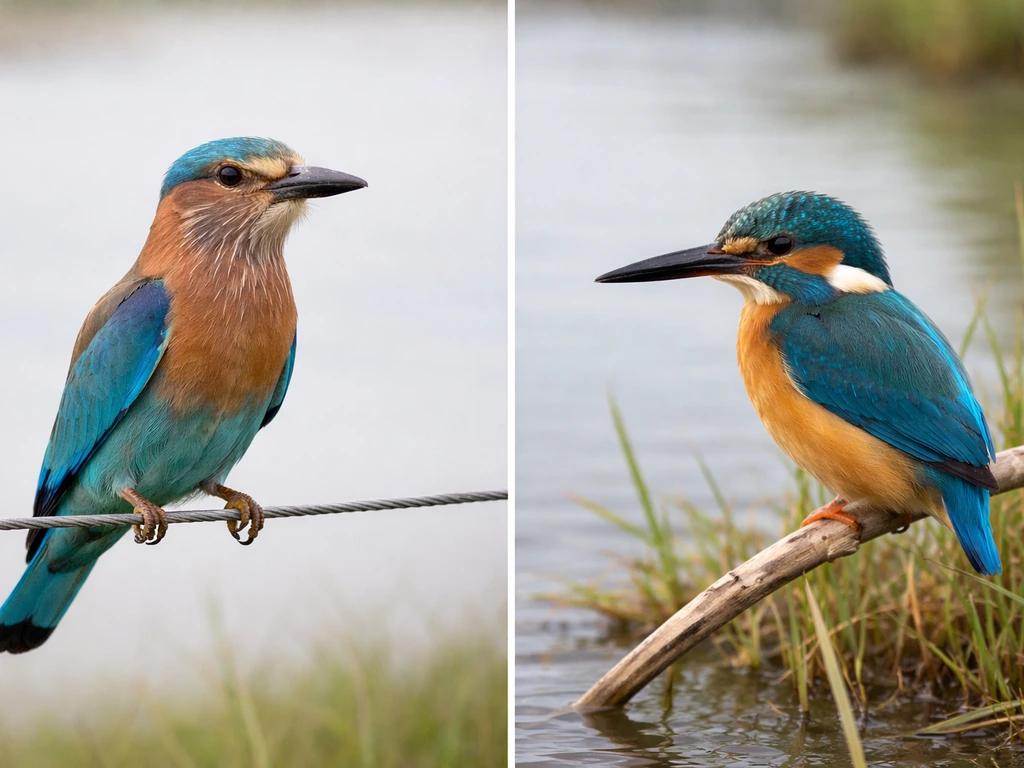
Before going deeper, here is the fast version. The Indian roller is big, sits on open wires and fence posts away from water, has a brown back, and flashes electric blue wings in flight. The common kingfisher is tiny, almost always near water, has solid iridescent blue upperparts, a vivid orange belly, and a massive bill relative to its body size. If the bird you're looking at is the size of a myna and perching on a roadside wire in a dry field, it's almost certainly the Indian roller. If it's the size of a sparrow, sitting low over a river, and looks like a flying blue-and-orange jewel, it's a kingfisher.
| Feature | Indian Roller (Neelkanth) | Common Kingfisher |
|---|---|---|
| Scientific name | Coracias benghalensis | Alcedo atthis |
| Length | 30–34 cm | ~16 cm |
| Wingspan | 65–74 cm | 23–28 cm |
| Weight | 166–176 g | 25–46 g |
| Overall shape | Bulky, broad-winged, large head, short neck | Compact, short-tailed, oversized bill |
| Dominant colors | Blue wings + brown/rufous back | Iridescent blue above, rufous-orange below |
| Bill | Short, slightly hooked | Long, dagger-like, mostly black |
| Habitat | Open fields, roadsides, dry scrub | Rivers, streams, ponds, lakesides |
| Hunting method | Drops to ground for insects/lizards | Dives into water for fish |
Neelkanth vs kingfisher: size, shape, and key field marks

Size is your single fastest cue. The Indian roller measures 30 to 34 cm in length with a wingspan of 65 to 74 cm and weighs around 166 to 176 g. That's a substantial bird. The common kingfisher measures just about 16 cm long with a wingspan of 23 to 28 cm and weighs a mere 25 to 46 g. Put simply, the Indian roller is roughly twice the length and more than four times the weight of a common kingfisher. If you're looking at something that feels 'crow-sized' or 'myna-sized,' you're looking at a roller. If it's sparrow-sized, think kingfisher.
Body shape reinforces this immediately. The Indian roller is bulky and broad-winged with a large rounded head and a short neck, giving it a stocky, almost pigeon-like posture when perched. The common kingfisher, by contrast, looks almost like a head and bill with a stubby body attached. Its tail is extremely short, which makes the bill look disproportionately large. That 'front-heavy' silhouette is one of the kingfisher's most reliable field marks.
Bill, head pattern, throat and breast colors, and plumage differences
The bill alone will close most identifications. The Indian roller has a relatively short, slightly hooked bill, similar in proportion to a crow or starling. The common kingfisher has a long, straight, dagger-like black bill that is unmistakable once you know to look for it. Local observers often note this intuitively: 'neelkanth has a short beak, kingfisher has a long beak.' That folk knowledge is accurate.
Head and upperpart coloration is where things get more nuanced. The Indian roller has a light blue crown that matches the wing color, a brownish or greenish mantle across the back and shoulders, and a reddish-brown collar on the hindneck. The name 'Neelkanth' means 'blue throat' in Hindi and is culturally tied to the Shiva legend, but the bird's throat is actually more of a streaked blue-purple-brown mix rather than a clean blue bib. The brownish mantle is a key field mark because it breaks up what might otherwise look like an all-blue bird.
The common kingfisher's plumage is dramatically different in feel. Its upperparts, including the head, wings, and back, are a vivid iridescent metallic blue-green. The underparts are a warm rufous-orange from the chin down to the belly. There's also a distinctive orange cheek patch and a white throat patch on the face. When you get a close look, the head pattern has subtle orange and blue-white patches around the eye that give it a jeweled appearance. On females, you can sometimes see a reddish lower mandible, which is a useful confirmation cue at close range.
One important misconception to clear up: when people call the Indian roller 'neelkanth' because it looks entirely blue, that's only half true. Perched on a wire in dull light, the roller looks blue-brown and relatively unremarkable. It is only in flight, when those brilliant electric blue wing patches flash open, that the name suddenly makes sense. The kingfisher, by contrast, glows blue even while perched because its entire upperside catches light from any angle.
Habitat and perching style: where you spot each
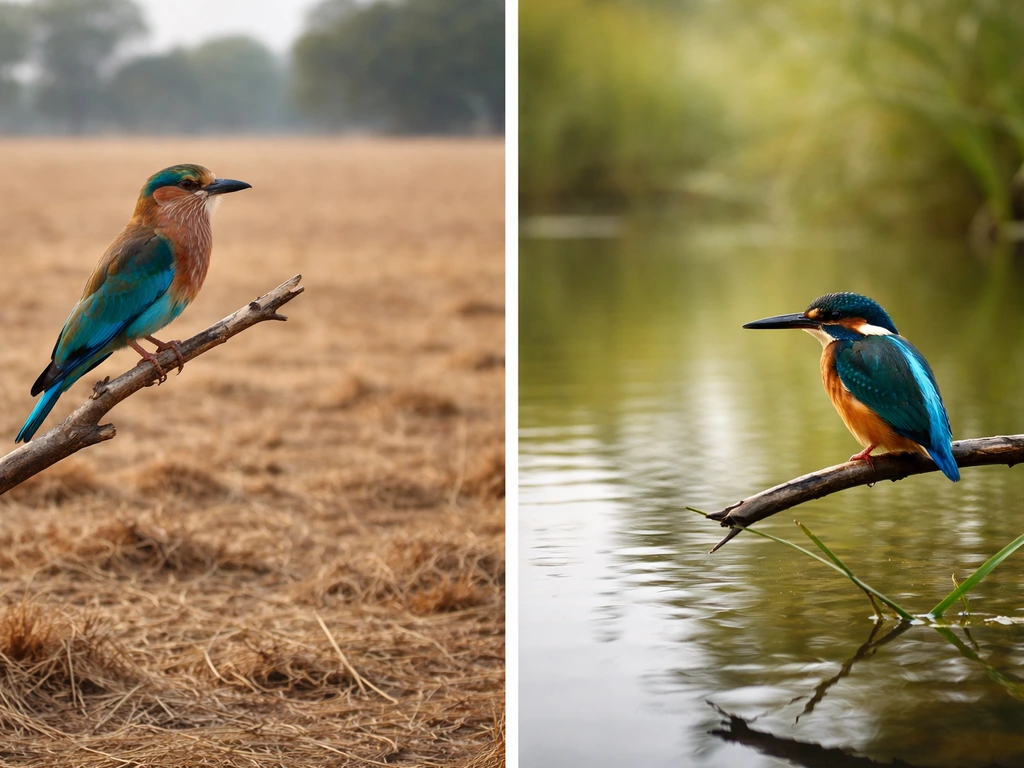
Habitat is arguably the most reliable single contextual clue. The common kingfisher is essentially water-dependent. If you want to compare it with other water birds, learn the anhinga bird vs cormorant differences too kingfisher. You will find it at rivers, streams, ponds, and lakes with clear water, sitting low on branches or roots just above the surface. It needs clean water for visibility when hunting. If you're more than 50 meters from water, a sighting of a common kingfisher is unusual enough to double-check.
The Indian roller is the opposite. It actively prefers open, dry habitats: agricultural fields, roadsides, scrubland, open forest edges, and grasslands. It's the bird you see perched on electrical wires and telephone poles along Indian highways, scanning the ground below. It doesn't need water at all for its daily hunting. Spotting a blue bird on a roadside wire in a dry area is almost a guaranteed Indian roller.
Perching style also differs noticeably. The Indian roller sits upright and exposed, often on the highest available vantage point like a wire, dead tree top, or fence post, with a bold, alert posture. It's a prominent, visible bird. The kingfisher typically perches lower, closer to the water surface, and often in slightly sheltered spots like overhanging branches. It tends to be more discreet until it dives.
Feeding behavior and hunting method: what each bird does with its beak
Feeding behavior is one of the most visually dramatic differences between these two birds, and it tells you exactly what that bill is designed for. If you are comparing other long-billed water birds too, a snake bird anhinga vs cormorant matchup can also help you separate what you are seeing by hunting style Feeding behavior is one of the most visually dramatic differences between these two birds.
The common kingfisher is a fish hunter. It watches the water from a perch, and when it spots prey, it dives bill-first into the water with a controlled plunge. After catching a fish, it returns to its perch, stuns the fish by striking it against the branch, and then swallows it head-first. This whole sequence: the fixed stare downward, the plunge, the perch return, and the striking behavior, is one of the most distinctive behavioral signatures in birding. If you watch a bird dive cleanly into water and return with a fish, you're watching a kingfisher.
The Indian roller hunts completely differently. It drops from its elevated perch to the ground to grab insects, lizards, small frogs, and other terrestrial prey. It doesn't dive into water. It swoops down, picks up prey in its bill, and returns to the perch to eat. This 'drop-to-ground' hunting style mirrors what you'd see from a shrike or a large flycatcher. There's no water involvement at all. If a blue bird is repeatedly dropping to dry ground and returning to a wire, that's your Indian roller.
Vocalizations and flight style cues

Both birds call in flight, and the sounds are very different. The Indian roller gives a monosyllabic, harsh call that varies from a sharp 'chack' to a longer, harsher 'tschow.' It's a grating, crow-like sound that carries well across open ground. During display flights, males also make a series of rolling cries while performing aerobatic twists and turns, which is where the family name 'roller' comes from.
The common kingfisher's call is completely different in pitch and character. It gives a high-pitched, shrill whistle, usually described as 'tsee-tsee' or a sharp 'peep-peep,' often delivered in rapid flight. This is a thin, piercing sound that carries well over water. Many experienced birders actually hear the kingfisher before they see it. The contrast between the roller's harsh, crow-like chack and the kingfisher's thin, high whistle is stark enough that audio alone can confirm your identification from a distance.
Flight style is also a strong clue. The Indian roller is an aerobatic bird. During displays it performs rolling dives and twists, and its broad wings give it a loose, buoyant flight pattern. Even routine flight looks more crow-like, with deeper wingbeats. The common kingfisher flies fast, low, and direct, typically hugging the surface of the water in a straight line. Its flight is rapid and whirring because of its small size and short wings. A fast, low, straight-line flight above a river is almost always a kingfisher.
A note on why the name 'Neelkanth' causes confusion
The word 'neelkanth' literally means 'blue throat' in Hindi, and is culturally linked to Lord Shiva, who is said to have a blue throat. The Indian roller is the bird most officially associated with this name in ornithological and cultural contexts across India. However, in practice, the name gets applied loosely. Local observers in some regions use 'neelkanth' for any striking blue bird they can't immediately name, which sometimes includes kingfishers, particularly the white-throated or pied kingfisher variants. This is why online discussions often show people posting kingfisher photos and calling them 'neelkanth,' or vice versa. When someone asks you 'what is a neelkanth bird,' the textbook answer is Coracias benghalensis, the Indian roller. But always verify with the physical bird in front of you, not just the name.
Best step-by-step method to confirm in the field

Use this sequence when you're looking at a blue bird and aren't sure what you've got. Work through it top to bottom and you'll have your answer in under a minute.
- Check the size first. Is it roughly sparrow-sized (about 16 cm)? Think kingfisher. Is it roughly myna or small-crow-sized (30+ cm)? Think Indian roller.
- Look at the bill. Is it long, straight, and dagger-like, clearly oversized for the bird's body? That's a kingfisher bill. Is it short and slightly hooked, more proportionate to the head? That's a roller bill.
- Note the habitat. Are you near water (river, stream, pond, lake)? A blue bird here is more likely a kingfisher. Are you in dry fields, on a roadside, near farmland? It's almost certainly an Indian roller.
- Watch the perch. Is the bird sitting low, near or over water, looking downward at the surface? Kingfisher. Is it sitting high on a wire, pole, or tree top, scanning open ground below? Indian roller.
- Watch the hunting behavior for 30 seconds. Does it dive headfirst into water and return with a fish? Kingfisher, confirmed. Does it drop to dry ground to grab prey? Indian roller, confirmed.
- Listen for the call. High-pitched, thin 'tsee-tsee' or sharp whistle? Kingfisher. Harsh, grating 'chack' or 'tschow'? Indian roller.
- Check the belly color. Vivid rufous-orange underparts contrasting with blue above? Common kingfisher. Brownish or blue-purple washed belly with a brownish mantle on the back? Indian roller.
- If still unsure in flight, watch the wing pattern. Do the wings flash brilliant electric blue against a browner body as the bird banks? That diagnostic wing flash in open-country flight is the Indian roller's signature move.
If you work through those eight steps, you will not confuse these two birds. The overlap in confusion comes almost entirely from the shared blue coloring and the loose use of the name 'neelkanth.' The actual physical birds, in their actual habitats, doing their actual things, look and behave nothing alike. The Indian roller is a bold, open-country bird that puts on an aerial show above dry fields. The kingfisher is a water-tied, secretive little jewel that lives and dies by its ability to hit a fish from a perch. Once you've seen both in the field, the confusion disappears entirely. In the same way that egret bird vs crane comparisons rely on habitat and size cues, these two blue birds can be separated once you check the basics.
This kind of lookalike confusion is common across many waterbird families too. The same identification logic, layering habitat, size, bill shape, and behavior into a decision sequence, applies whenever you're separating similarly colored birds. Birdfact’s beginner approach emphasizes using multiple cues like blank" rel="noopener noreferrer">bill shape, flight pattern, habitat, and call in a decision-tree sequence. Getting comfortable with that framework will serve you across a wide range of species beyond just these two. That same approach helps when comparing an egret bird vs heron, where habitat and stance can quickly narrow the possibilities.
FAQ
Can a Neelkanth (Indian roller) and a kingfisher both look like the same blue bird on a wire?
Yes, the same “blue bird on a wire” clue can still be misleading in low-visibility conditions. In rain, glare, or dusk, the Indian roller can look less distinct because its brownish mantle and throat streaks fade, so rely on the overall size (myna/crow versus sparrow) and the hunting action (drop to ground for prey versus dive into water).
What should I watch for if the bird is near water but I cannot clearly see the bill?
Use the “where is the hunting happening” test. If the bird is repeatedly dropping bill-first into the water and then returning with a fish, it is a kingfisher, even if the water is small and the dive is brief. If it repeatedly drops to dry ground to grab insects or small animals, it is an Indian roller, even if a pond is nearby.
I saw a blue bird, and it seemed far from water, how do I avoid misidentifying a kingfisher?
Common kingfishers are strongly tied to water, so a “kingfisher” far from water is often a miscall. As a practical check, estimate the nearest water source from where you are standing, if it is more than roughly 50 meters, double-check size, perch height, and whether any feeding dives actually occur.
From a distance, what visual cue is most reliable if color is hard to see?
Look for the silhouette: kingfishers have an extremely short tail and look like a large bill attached to a compact body, giving a front-heavy profile. Indian rollers have a more rounded head, short neck, and broader wings, with a bulkier, pigeon-like body shape. This works even when plumage color is muted.
Why do some photos of “neelkanth” look much less blue than expected?
The Indian roller is more likely to be mistaken as “neelkanth” when it is perched and only shows blue in flashes. In dull light on a wire, it can appear blue-brown and plain, so confirmation should come from either the flight wing flashes or the distinctive feeding pattern (swoop down to ground, return to wire).
How reliable are face details, like orange patches or female mandible color, for telling kingfishers apart?
Yes, sex and age can affect the face and mandible cues, especially in close views. If you cannot see the lower mandible color in females, do not rely on that single trait. Instead, anchor on bill length and shape (dagger-like long bill versus shorter hooked bill) plus the orange underparts and the short-tail silhouette of kingfishers.
Can I identify Neelkanth vs kingfisher using calls alone?
Audio can confirm quickly if you are in the right setting. The roller call tends to be harsher and more crow-like, while kingfisher sounds are higher-pitched, thin, and often described as repeated whistles. If there is heavy wind or traffic noise, prioritize the diving or drop-to-ground behavior instead of sound alone.
Do different kingfisher types cause extra confusion with Indian roller sightings?
Be careful with “pied” or white-throated kingfisher appearances, because they can change the balance of blue, white, and orange and may look less like a classic jewel when perched. Even then, the decision should still be size, the very long dagger bill, the short tail, and the unmistakable fish-hunting dive sequence.
What is the quickest step-by-step checklist if I only have a few seconds to identify?
Yes. The easiest backup method is a quick sequence: 1) estimate size, 2) check perch distance from water, 3) inspect bill shape, 4) watch the next feeding attempt. If your next movement shows a dive into water with a fish, you can stop there. If it drops to dry ground to snatch prey, it is an Indian roller.
Next Article
Frigate Bird vs Albatross: Key Field Marks to Tell Them Apart
Learn frigate bird vs albatross field marks: size, wings, flight, head and habitat, plus quick ID decision steps.