
Here is the most important thing to know upfront: "red bird of paradise" and "Mexican bird of paradise" are almost always referring to plants, not birds, and in many cases they refer to the exact same plant. The red bird of paradise is most commonly Caesalpinia pulcherrima, a flowering shrub. Mexican bird of paradise can refer to the same species or to a closely related plant, Caesalpinia mexicana. If you are searching because you spotted a dramatically plumed tropical bird, the actual bird called the red bird-of-paradise is Paradisaea rubra, a species native to the islands of West Papua, Indonesia. That bird is essentially never seen outside a zoo or wildlife documentary. So if you are in the American Southwest, a garden center, or a suburban yard, you are almost certainly looking at a plant.
Red Bird of Paradise vs Mexican Bird of Paradise ID Guide

What people actually mean by each name
The naming situation here is genuinely messy, and it trips up a lot of people. Let me break it down clearly.
Red bird of paradise
In the plant world, red bird of paradise almost universally refers to Caesalpinia pulcherrima. This is the name you will see at nurseries, on city plant guides (Austin, Texas lists it this way), and in University of California Master Gardener materials. It is a tropical to subtropical shrub with feathery, fern-like foliage and striking clusters of red and orange flowers with long, showy stamens. In the bird world, red bird-of-paradise refers to Paradisaea rubra, a true bird-of-paradise from the Paradisaeidae family. The male has crimson and brown plumage, a yellow head, and long, wire-like tail feathers used in elaborate courtship displays. It lives only on a few islands in eastern Indonesia and is essentially never spotted in North America.
Mexican bird of paradise
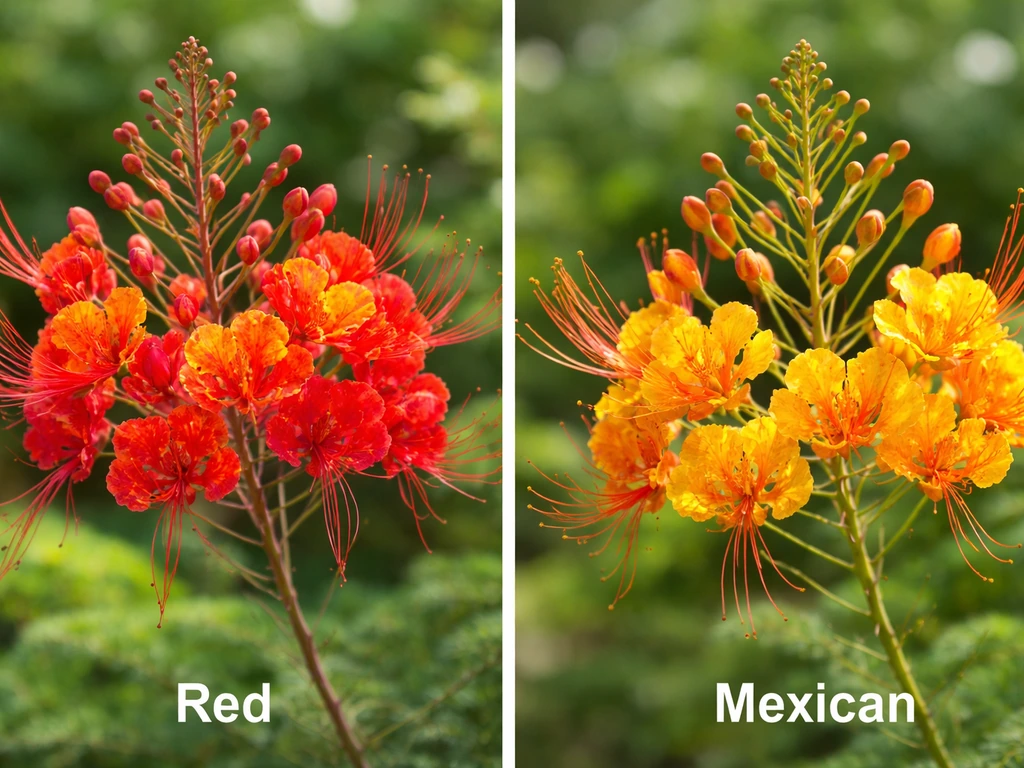
Mexican bird of paradise is primarily a plant name too, but it can mean one of two things depending on who you ask. Some people use it as another common name for Caesalpinia pulcherrima (same plant as red bird of paradise), which is why the Wikipedia bird-of-paradise entry flags the name overlap explicitly. Others use it to refer specifically to Caesalpinia mexicana, a closely related species that tends to be slightly more cold-hardy and typically produces yellow flowers rather than red-orange ones. There is no bird species commonly known as the "Mexican bird of paradise" in ornithological circles. The confusion exists almost entirely in the plant trade.
Quick comparison checklist
| Feature | Red Bird of Paradise (C. pulcherrima) | Mexican Bird of Paradise (C. mexicana) | Red Bird-of-Paradise (Paradisaea rubra) |
|---|---|---|---|
| What it is | Flowering shrub (plant) | Flowering shrub (plant) | Tropical bird |
| Primary flower/plumage color | Red and orange | Yellow | Crimson, brown, yellow |
| Native range | Tropical Americas, widely cultivated | Northern Mexico, widely cultivated | Raja Ampat Islands, Indonesia |
| Where you will see it | Southwest US gardens, warm climates | Southwest US gardens, warm climates | Indonesian rainforest, zoos only |
| Bloom/display season | Spring through fall (May onward in Tucson) | Spring through fall | Breeding season displays year-round |
| Height | Up to 10 feet tall as a shrub | Up to 20 feet, more tree-like | About 12 inches (bird body length) |
| Key identifier | Red-orange flowers, long red stamens | Yellow flowers, more upright form | Wire-like tail feathers, red plumage |
Appearance: size, shape, color, and key features
Red bird of paradise (Caesalpinia pulcherrima)
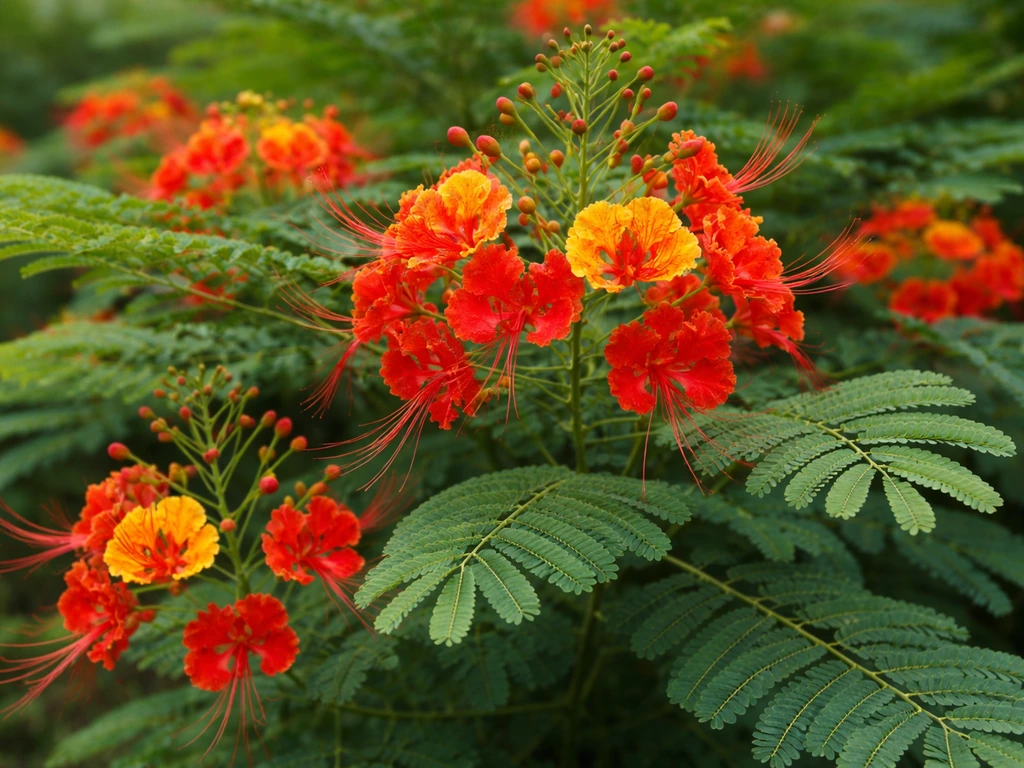
As a plant, C. pulcherrima grows as a multi-stemmed shrub reaching around 6 to 10 feet tall and equally wide. The leaves are bipinnate, meaning they are divided twice into small leaflets that give the whole plant a delicate, ferny appearance. The flowers are the showstopper: each bloom is a loose cluster of five ruffled petals in vivid orange and red, with long stamens that extend well beyond the petals, sometimes 3 to 4 inches outward. Those stamens are what give the flower its bird-like look and earned it the name. The flower clusters sit at the ends of branches and are highly visible from a distance. As Paradisaea rubra (the actual bird), the male is about 33 centimeters long, not counting the extraordinary ribbon-like tail wires that can add another 35 centimeters. His body is brown on the back, with a yellow crown, a dark green throat, and flanks covered in long crimson plumes that he fans out during display. Females are plain brown with no ornamental feathers.
Mexican bird of paradise (Caesalpinia mexicana)
C. mexicana grows larger and more tree-like than C. pulcherrima, often reaching 15 to 20 feet when mature. Its foliage is similar: bipinnate and feathery. The biggest visual difference is the flower color. Mexican bird of paradise blooms bright yellow, not red-orange, and the individual flowers are slightly smaller but produced in dense, upright spikes. The bark tends to be smoother and the branching habit more open and arching than the denser C. pulcherrima. If you see a bird-of-paradise plant in a Southwest garden and the flowers are yellow, that is most likely the Mexican species.
Behavior and display: how each one acts
For the plants, there is no behavior in the animal sense, but there are growth and bloom differences worth noting. C. pulcherrima blooms heavily and almost continuously from late spring through fall, dying back in areas that experience frost and re-sprouting from the roots. C. mexicana is more cold-tolerant and may behave more like a true evergreen shrub or small tree in milder winters. It also tends to rebloom after pruning.
For the actual bird, Paradisaea rubra, behavior is where identification becomes unmistakable. Male red birds-of-paradise gather in communal display trees called leks, where they compete for female attention by hanging upside down, spreading their crimson flank plumes into a fan, and vibrating their tail wires. They call loudly during these displays, producing a harsh, crow-like series of wak-wak-wak notes. Females are silent and inconspicuous by comparison. If you ever see a bird doing this kind of performance in the wild, there is zero ambiguity: you are either in eastern Indonesia or you are at a zoo.
Where each one lives
Caesalpinia pulcherrima originated in the tropical Americas and is now cultivated across warm-climate regions worldwide, including the American Southwest, Florida, Hawaii, and similar zones. In Tucson, Arizona, it typically begins blooming around May and stays in flower through October. It thrives in USDA hardiness zones 9 through 11 and is drought-tolerant once established, which makes it a popular choice in xeriscape gardens.
Caesalpinia mexicana is native to northeastern Mexico and has naturalized in parts of the southern United States, particularly Texas. It is slightly hardier (tolerating zone 8b in some sources) and is more commonly sold in Texas nurseries than in Arizona or California ones. If you are in the Texas Hill Country or San Antonio area and see a bird-of-paradise plant with yellow flowers, this is the most likely candidate.
Paradisaea rubra lives only on the islands of Waigeo, Batanta, Saonek, and Gam in the Raja Ampat archipelago of West Papua, Indonesia. It occupies lowland and hill forest, spending most of its time in the forest canopy. There is no wild population anywhere outside these islands. If you are reading this from North America, the plant interpretation is the only one that applies to your situation.
Common lookalikes and misidentification traps
The single biggest source of confusion is the shared common name. When someone types "red bird of paradise vs Mexican bird of paradise" into a search engine, they could be asking about plants or birds, and the results often mix both without flagging which is which. The plant Caesalpinia pulcherrima alone goes by at least half a dozen common names: red bird of paradise, Mexican bird of paradise, peacock flower, Pride of Barbados, and poinciana. That last name, Pride of Barbados, is the subject of its own comparison, and it is the same plant as C. pulcherrima just under a different regional nickname.
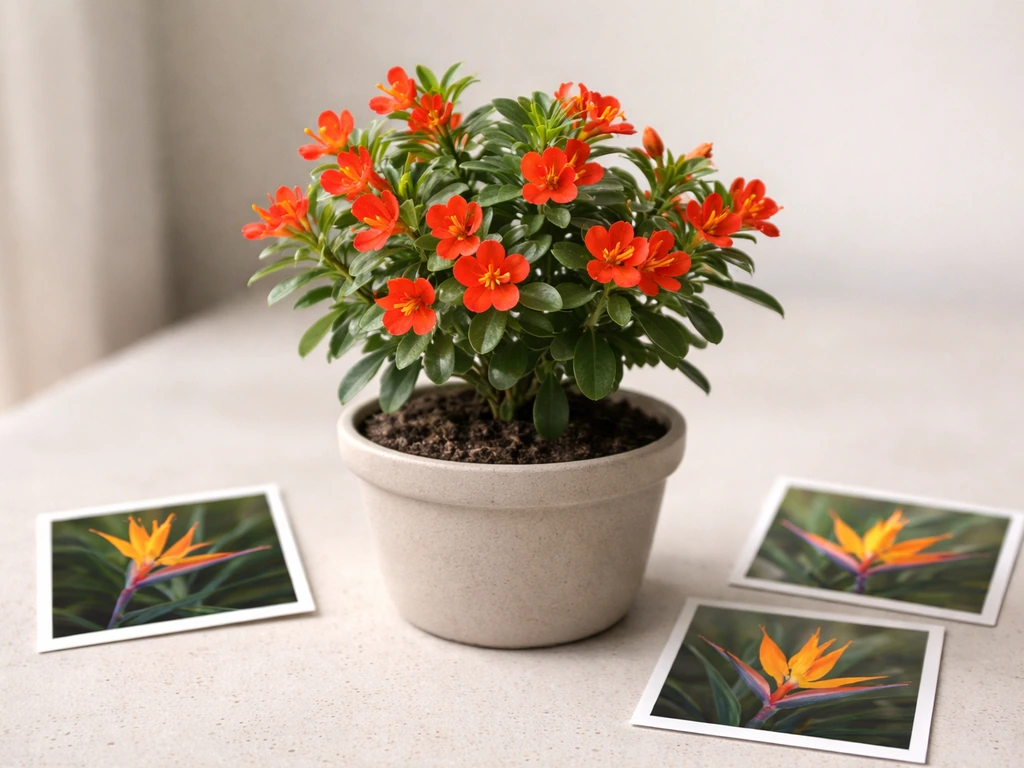
In the garden center, C. pulcherrima (red) and C. mexicana (yellow) are sometimes sold under the same "bird of paradise" label, which is how buyers end up with a yellow-flowered plant when they expected red. Always confirm flower color on the tag or ask specifically. A third plant that causes confusion is Strelitzia reginae, the orange-and-blue bird of paradise commonly seen as a cut flower. That one is in a completely separate genus and looks nothing like a Caesalpinia up close, but the name similarity catches people off guard, especially those exploring comparisons between related plants like white bird of paradise versus the standard bird of paradise. In particular, the white bird of paradise is often a different plant or species than the standard bird of paradise, so confirm the exact name on the label or in the listing.
On the bird side, first-time birders sometimes confuse the red bird-of-paradise with other Paradisaea species like the greater bird-of-paradise or the raggiana bird-of-paradise. The red is distinguished by its specifically crimson (not yellow or orange) flank plumes and its geographic restriction to the Raja Ampat islands. If you are in Papua New Guinea, you are not looking at a red bird-of-paradise: that is a different species.
How to confirm what you are looking at

Whether you are trying to identify a plant in a yard or a bird in the field, these steps will get you to a reliable answer quickly.
- Establish your context first. Are you in North America, in a garden or yard? You are looking at a plant, not the bird. Are you in Indonesia? Then the bird becomes a real possibility.
- Check the flower or plumage color. Red-orange flowers with long protruding stamens pointing to Caesalpinia pulcherrima. Bright yellow flowers on a taller, more tree-shaped plant pointing to Caesalpinia mexicana. Crimson body plumes with wire-like tail extensions on a bird pointing to Paradisaea rubra.
- Look at the plant's overall shape. C. pulcherrima is a bushy, multi-stemmed shrub typically under 10 feet. C. mexicana grows taller and more open, often 15 feet or more with fewer stems.
- Photograph the flowers and leaves together. Bipinnate (doubly divided) feathery leaves are shared by both Caesalpinia species, so the flower color is your clearest split. Submit photos to iNaturalist or PlantNet for automated confirmation.
- For the bird, note the location precisely. Check the tail feathers: the long, wire-like tail ribbons of Paradisaea rubra are unique among birds and leave no room for doubt. Use eBird to check whether the species has any verified records from your region.
- If you bought a plant and got the wrong color, check the nursery tag for the Latin name. Caesalpinia pulcherrima and Caesalpinia mexicana are sometimes both sold as 'bird of paradise' without specifying which. The Latin name removes the ambiguity entirely.
The bottom line is that most people searching this comparison are dealing with two closely related garden plants that share confusing common names. The flower color (red-orange vs yellow) and plant size (shrub vs small tree) are the two fastest ways to tell them apart. If you are genuinely looking at a dramatic plumed bird, you already know you are somewhere extraordinary, and the crimson plumes with tail wires are unmistakable. For anyone interested in how bird-of-paradise plants compare to other large tropical-looking plants in the garden, the distinctions between related species like banana trees, elephant ears, and monsteras follow similar logic: similar silhouettes, very different identities once you look closely. If you are comparing lookalike tropical foliage plants, a bird of paradise vs monstera comparison can also help you separate common names from the actual species you have monsteras. A quick side-by-side comparison of bird of paradise plants versus elephant ears can make the identification much easier. If you are comparing bird of paradise plants to banana trees, use the same approach: look at the leaf shape and the type of flowering structure to confirm which plant you have bird of paradise vs banana tree.
FAQ
I bought something labeled “Mexican bird of paradise” but the flowers look red. How can I tell which plant it actually is?
Check the flowering organs first. In the plant lookalike comparison, Caesalpinia pulcherrima typically shows red-orange and orange-red flowers in loose clusters, while Caesalpinia mexicana typically shows bright yellow flowers in dense upright spikes. If the flowers are yellow, it is much more likely the “Mexican” species (C. mexicana), even if the tag says “bird of paradise.”
How do I avoid confusing Caesalpinia “bird of paradise” plants with Strelitzia?
Don’t rely on the common name alone. Many listings reuse “bird of paradise” for multiple genera, including Strelitzia reginae (orange-and-blue cut-flower type). If the plant has paddle-shaped orange petals with a blue component and a banana-like “beak” look, it is probably Strelitzia, not Caesalpinia.
If I think I saw a red bird-of-paradise, how can I confirm it is Paradisaea rubra and not another bird-of-paradise?
If you see the bird in a real-world setting, use geography as your primary filter. Paradisaea rubra is limited to specific islands in West Papua (Raja Ampat area). If you are outside that region, a true red bird-of-paradise is exceptionally unlikely, and the sighting is probably another Paradisaea species or a zoo escape.
In my climate, what seasonal or maintenance clues help me distinguish C. pulcherrima from C. mexicana?
For the plant, use bloom time plus flower color, not just general appearance. C. pulcherrima usually blooms from late spring through fall, and then may die back and re-sprout after frost. C. mexicana is more likely to behave like an evergreen or small tree in milder winters and can rebloom after pruning.
What should I ask for at a nursery so I do not end up with the wrong color “bird of paradise” plant?
When buying from a nursery, confirm the cultivar or scientific name on the tag, or ask staff to read it off the inventory sheet. Because the same common names are reused, two plants can both be sold as “red bird of paradise” depending on the seller, so the botanical name (C. pulcherrima or C. mexicana) is the decision-maker.
My “red bird of paradise” looked dead after a cold night. Is that normal?
If your plant is in the ground and you experience occasional cold snaps, watch for dieback. C. pulcherrima can die back in frost-prone areas and then regrow from the roots, so a spring “recovery” is normal. If it never shows regrowth after a cold event, it may not have been the expected species or may be planted too deep or in a poorly drained spot.
What watering or soil mistake most commonly causes yellowing or poor blooms in these Caesalpinia plants?
In warm zones, C. pulcherrima is often drought-tolerant once established, but it still needs a deep initial watering schedule for the first growing season. For both species, choose fast-draining soil and avoid consistently soggy conditions, since wilting or yellowing can result from root stress as well as from nutrient issues.
If my plant is already mature, what physical traits are best for distinguishing C. pulcherrima versus C. mexicana?
For quick identification, measure the structure you can see. C. pulcherrima is typically a multi-stemmed shrub around 6 to 10 feet tall and wide, while C. mexicana matures larger and more tree-like (often 15 to 20 feet). If you have a mature plant, the overall growth form is a strong clue even before the next flowering cycle.