Meta description: Bennu bird vs phoenix compared side by side: origins, appearance, rebirth myths, symbolism, and how they differ from the Vermilion Bird, Thunderbird, and other mythic birds.
Bennu Bird vs Phoenix: Key Differences & Cultural Origins

Marcus Hendricks
26 Jul 2026
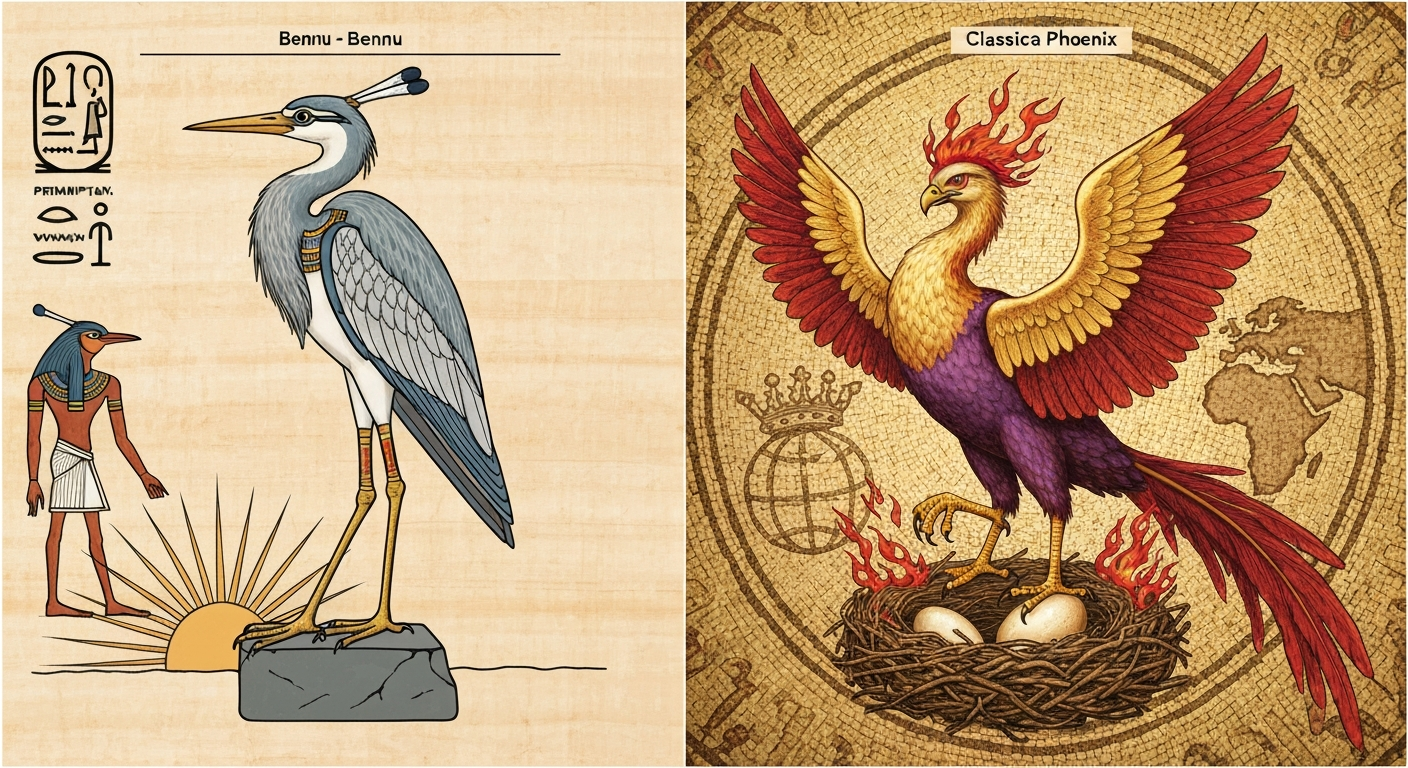
The Bennu and the Phoenix are not the same bird. The Egyptian Bennu (Middle Egyptian bnw) is a Heliopolitan solar and funerary symbol depicted as a heron-like bird, attested in Pyramid Texts as far back as the Old Kingdom and closely tied to creation and the soul's transformation in the afterlife. The classical Phoenix is a composite Greco-Roman literary creature with gold and red plumage, a legendary lifespan measured in centuries, and a dramatic rebirth cycle that varies considerably depending on which ancient author you read. They share a broad family resemblance because Greek writers almost certainly drew on Egyptian Heliopolitan priestly lore when describing the phoenix, but treating them as identical is a mistake that blurs two distinct symbolic traditions separated by culture, language, and purpose.
How to use this guide
This article is written for students, myth enthusiasts, writers building fictional worlds, heraldry researchers, and anyone who has Googled 'bennu bird vs phoenix' and found the answers frustratingly vague. For readers comparing avian myths to modern animal comparisons, see the related guide on bearded dragon vs bird. I've organized it so you can jump straight to whichever section matters most: the Bennu's Egyptian roots, the classical Phoenix tradition, the side-by-side comparison table, or the broader family of mythic birds (Vermilion Bird, Thunderbird, and others). Each section names the original-language terms because the word 'phoenix' in English is a blunt instrument that routinely gets hammered onto at least four distinct traditions. Knowing which tradition you're actually talking about makes every comparison sharper.
The Egyptian Bennu: solar bird of Heliopolis
The Bennu (Egyptian bnw, sometimes transliterated as 'benu') is one of the oldest attested mythic birds in recorded history. Its earliest written appearances come from the Pyramid Texts of the Old Kingdom, including Utterance 600, where the bird is linked to the creator-god Atum and the benben, the Heliopolitan primordial mound believed to be the first thing to emerge from the waters of chaos at the moment of creation. Linguistically, Egyptologists trace bnw to the verb wbn ('to rise, to shine'), which tells you immediately that this bird is about solar rising, not spectacular combustion.
By the New Kingdom the Bennu had expanded its theological role considerably. Chapters of the Book of the Dead include transformation formulas that allowed the deceased to 'become the Bennu,' merging their identity with the bird to secure solar rebirth and safe passage through the afterlife. The Bennu was also associated with the morning star, reinforcing the sunrise-and-renewal symbolism that defined it from the start. What is notably absent from these primary Egyptian texts is the idea of the bird burning itself alive and rising from its own ashes. That dramatic fire-and-resurrection plot belongs to the later Greek and Roman literary tradition, not to the Egyptian source material.
Iconographically, the Bennu looks nothing like the fiery eagle-peacock hybrid that most people picture when they hear 'phoenix.' New Kingdom and later artists depicted it as a long-legged, heron-type bird, typically with a distinctive two-feather crest, standing on the benben stone or a stylized perch. Egyptologists commonly identify the grey heron (Ardea cinerea) as the most likely visual model, with some earlier Heliopolitan versions possibly based on smaller waterbirds like the yellow wagtail. Funerary amulets and vignettes used the Bennu as a compact emblem of rebirth, and it appears on heart-scarabs as a protective and transformative symbol for the dead.
The Phoenix: a composite myth built over centuries
The Greek word phoinix (φοῖνιξ) already carried multiple meanings before it was attached to a mythic bird: it meant 'Phoenician,' 'purple-red,' and 'date palm' depending on context. As a bird, the Phoenix first gets a detailed classical description in Herodotus's Histories (Book II, chapter 73), where he reports what Egyptian priests at Heliopolis told him: the Phoenix appears only every 500 years, is roughly eagle- or peacock-sized, has gold and red plumage, and carries its predecessor's remains to the Sun temple in a myrrh-encased egg or tomb. Crucially, Herodotus himself was skeptical and presented the account as second-hand priestly lore rather than something he personally verified.
What Herodotus started, later Roman writers amplified and complicated. Pliny the Elder's Naturalis Historia records variants with different lifespans, nests built from cinnamon and myrrh, and differing accounts of whether the bird rises from a dying predecessor or from an egg. The Roman imperial period added political weight: phoenix imagery appeared on coins and in propaganda from the Hadrianic and Antonine periods onward, where the bird on a globe with a radiate crown symbolized dynastic continuity and eternal regeneration. The 'phoenix on the globe' was essentially an imperial logo for the idea that the empire would never die.
Ovid wove the phoenix into the Metamorphoses as an emblem of unique, self-renewing life, and by the time the Latin poem De ave Phoenice (traditionally if uncertainly attributed to Lactantius) circulated in Late Antiquity, Christian writers had adopted the bird wholesale as an allegory for resurrection and Christ's immortality. The 'burn and rise from ashes' narrative that most modern readers associate with the phoenix is really this Late Antique and medieval crystallization of the story, not a single coherent ancient original. Scholars R. T. Rundle Clark and Joseph Nigg both stress that the classical phoenix tradition was built by recombining Egyptian Heliopolitan motifs with Near Eastern and Greco-Roman imagery, making it a genuine hybrid rather than a clean borrowing. R. T. Rundle Clark, 'The Origin of the Phoenix' (scholarly discussion of Egyptian–classical connections) argues that Greek phoenix motifs trace their closest textual reference to Egyptian bnw/Bennu and Heliopolitan priestly lore while also stressing recombination with Near Eastern and Greco‑Roman imagery.
Side-by-side: Bennu vs Phoenix at a glance
| Attribute | Bennu (Egyptian bnw) | Phoenix (Greek/Roman phoinix) |
|---|---|---|
| Origin culture | Ancient Egypt (Heliopolitan theology) | Classical Greece and Rome (with Egyptian priestly input) |
| Earliest attestation | Old Kingdom Pyramid Texts (c. 2400–2300 BCE), Utterance 600 | Herodotus, Histories II.73 (c. 450 BCE) |
| Appearance | Heron-like, long-legged, two-feather crest; grey/blue-grey plumage | Eagle- or peacock-sized; gold and red (or purple) feathers; later often shown with flame |
| Real-bird visual model | Grey heron (Ardea cinerea) most commonly identified | No single identified species; composite imagery |
| Lifecycle/rebirth motif | Solar rising and transformation; no primary-text self-immolation by fire | Variable: carried in myrrh egg, rises from dying predecessor, or rises from ashes (accounts differ by author) |
| Lifespan | Not specified in primary texts as a fixed number | 500 years most cited (Herodotus); other accounts give 540, 1,000, or 1,461 years |
| Core symbolism | Solar creation, renewal, morning star, funerary transformation | Uniqueness, cyclical renewal, imperial eternity, resurrection (later Christian adaptation) |
| Fire association | Not a primary feature in Egyptian texts | Central in Greco-Roman and later Western tradition |
| Linked deity/concept | Atum (creator-god), Ra (solar deity), the benben mound | Helios/Sol (sun), later Christ (Christian allegory) |
| Primary textual sources | Pyramid Texts, Coffin Texts, Book of the Dead | Herodotus, Pliny, Ovid, De ave Phoenice (Lactantius?) |
| Iconographic setting | Standing on benben stone; funerary amulets; vignettes | Perched on pyre or nest; Roman coins; later heraldry |
| Modern heraldry/pop culture | Less common; specialist Egyptian revival contexts | Ubiquitous: city arms, sports teams, logos, fantasy fiction |
Greek and Roman phoenix traditions in depth
The Greek and Roman phoenix tradition is more of a rolling editorial project than a fixed myth. Herodotus reported what Egyptian priests told him and was upfront about his own skepticism. Pliny compiled what he could find and noted the contradictions without resolving them. Ovid used the phoenix as a poetic device to cap the Metamorphoses with an image of self-renewing life. Each author adjusted details to serve their rhetorical purpose, which is why the bird's lifespan ranges from 500 to over 1,400 years depending on the source, and why some accounts describe the bird building a funeral pyre of aromatic wood while others describe it sealing a predecessor's body in a myrrh egg and flying to Heliopolis.
The Roman imperial use of phoenix imagery is particularly concrete and well-documented. From the reign of Hadrian onward, phoenix coins showed the bird standing on a globe with a radiate nimbus, the visual vocabulary of solar divinity repurposed for dynastic propaganda. When an emperor died and was deified, phoenix imagery reinforced the idea that Rome's divine authority renewed itself in the new ruler. This is a very different application from the Egyptian Bennu's funerary transformation role, even though both birds operate in a symbolic space around death and renewal. The Roman phoenix was a political instrument; the Egyptian Bennu was a theological one.
Late Antique Christian writers found the phoenix almost tailor-made for their purposes. The poem De ave Phoenice (possibly Lactantius, 3rd to 4th century CE) describes the bird in elaborate, sensuous detail and then tilts the allegory unmistakably toward resurrection and immortality. By the early medieval period the 'phoenix rising from ashes' had become so thoroughly absorbed into Christian symbolic language that many readers today assume the fire-and-resurrection story is ancient and universal rather than a relatively late crystallization of a much messier classical record.
The East Asian Vermilion Bird (Zhuque): not the same thing
The Chinese Zhuque (朱雀, 'Vermilion Bird') is one of the Four Symbols of Chinese cosmology, associated with the south, summer, and fire. It is a directional and astral guardian creature, not a resurrecting individual bird. Confusing Zhuque with the Greco-Roman phoenix or the Egyptian Bennu is extremely common in English-language popular writing, partly because the Chinese fenghuang (鳳凰) is routinely translated as 'phoenix' in English, even though the fenghuang and Zhuque are themselves separate traditions within Chinese cosmological thought.
The key distinctions are functional and structural. The Zhuque is a guardian of a cosmic direction and season, representing summer's fire energy as part of a four-part symmetrical system (the others being the Azure Dragon, White Tiger, and Black Tortoise/Serpent). It does not undergo a personal rebirth cycle. The fenghuang, by contrast, is a symbol of high virtue, harmony, and imperial authority (particularly associated with the empress), and appears as a composite bird with features drawn from multiple species. Neither of them maps cleanly onto the classical phoenix's self-immolating lifecycle. The overlap in popular imagination is a translation artifact, not an actual mythological equivalence.
If you're comparing the Vermilion Bird to the phoenix in a research or creative context, the most important thing to keep clear is that Zhuque's 'fire' is elemental and directional, not biographical. The phoenix burns to be reborn as itself; the Zhuque embodies fire as a cosmic quality of a season and direction. For a focused discussion comparing the Vermilion Bird and the Phoenix’s respective powers, see vermilion bird vs phoenix who is more powerful. These are categorically different symbolic roles. The related comparison of the Vermilion Bird vs Phoenix in terms of which is 'more powerful' is a question worth examining separately, because the two traditions have no shared mythology in which they actually compete.
The Thunderbird: Indigenous North American traditions
The Thunderbird is a powerful supernatural bird figure found across numerous Indigenous North American nations, including but not limited to Ojibwe, Lakota, Haida, Algonquin, and Pacific Northwest peoples. It is typically associated with storms, lightning, and rain, and in many traditions it is an active agent in spiritual and cosmological narratives, capable of battling sea monsters, protecting humans from malevolent forces, and manifesting thunder through the beating of its wings. Thunderbird traditions are oral, living, and culturally specific, meaning there is no single unified 'Thunderbird mythology' any more than there is a single unified Indigenous American religion.
Comparing the Thunderbird to the Bennu or Phoenix requires honesty about the category difference. The Bennu and the Phoenix are textual, literary, and artistic traditions from ancient literate civilizations in the Mediterranean and Near East. The Thunderbird traditions are sacred living cultural heritage maintained by communities whose descendants are alive today, and they should not be treated as equivalent material for a mythology-comparison exercise without that distinction being clearly stated. The surface-level comparison (giant supernatural bird, elemental powers, cosmological role) is obvious, but the Thunderbird's active spiritual and communal function within living nations is a genuinely different thing from a literary motif in Herodotus or a funerary symbol in the Book of the Dead. For a focused comparison, see the internal guide phoenix bird vs thunderbird.
On the specific question of how the Thunderbird differs from Bennu or Phoenix in symbolic terms: the Thunderbird is associated with weather and atmospheric power rather than solar rebirth or cyclical renewal. It is not characterized by self-sacrifice, fire-death, or resurrection as a defining narrative feature. Where the Phoenix and Bennu are both fundamentally about renewal and the persistence of life through transformation, the Thunderbird's primary register is power, protection, and the management of cosmic conflict. These are overlapping but not identical symbolic territories.
Other mythic birds in this family: a quick orientation
The Persian Simurgh (also written Seemurgh or Senmurv) is another bird that gets folded into 'phoenix' comparisons in popular writing, and it deserves a more accurate description. In Zoroastrian, Pahlavi, and epic Persian literature, especially Ferdowsi's Shahnameh, the Simurgh is a vast, ancient, wise bird associated with healing and guidance, not cyclical death and rebirth. In the Shahnameh it nurtures the hero Zal and later assists his son Rustam. See Simurgh in the Shahnameh, Staatliche Museen zu Berlin (discussion of simurgh imagery and role in Ferdowsi’s epic) Simurgh in the Shahnameh — Staatliche Museen zu Berlin (discussion of simurgh imagery and role in Ferdowsi’s epic). Its role is guardian and helper, not self-renewing solar symbol, and its iconography (often shown as a composite beast with dog or lion features in early Sasanian art) is entirely distinct from either the heron-shaped Bennu or the flame-wreathed classical Phoenix.
The Phoenix vs Dragon comparison comes up in fantasy and gaming contexts far more than in academic mythology, but it is worth noting that within no ancient tradition do the Phoenix and a dragon directly compete in the same mythological frame. They come from different cultures, and any 'who would win' framing is a modern creative exercise. Similarly, the Phoenix vs Griffin pairing is a product of heraldic and fantasy traditions rather than ancient mythology. In European heraldry both creatures appear as charges and supporters, but they carry different symbolic weights: the griffin combines eagle and lion as a symbol of strength and vigilance, while the phoenix specifically represents uniqueness and deathless renewal.
The Liver Bird, associated particularly with the city of Liverpool, is a heraldic creature derived from a stylized cormorant or eagle and bears no mythological connection to the phoenix. It appears in the same family of searches because it is a famous 'bird that is not a real bird,' but its origins are civic and heraldic rather than drawn from solar or resurrection mythology.
What about real birds? The heron connection
One of the most genuinely interesting threads in Bennu scholarship is the question of which real bird inspired the iconography. The strong consensus among Egyptologists is that the grey heron (Ardea cinerea) provided the visual template for the Bennu, particularly the long legs, the upright posture, and the distinctive head plumes that correspond to the Bennu's two-feather crest. Some earlier Heliopolitan imagery may reference smaller waterbirds, but the mature New Kingdom depiction is unmistakably heron-based. There is also a long-extinct species sometimes called the 'Bennu heron,' a giant prehistoric relative of the grey heron (now formally Ardea bennuides) that may have survived into early Egyptian history in the Arabian Peninsula, giving the mythology a potentially literal root in a real, giant bird.
The classical Phoenix has no single identified real-bird inspiration. The gold-and-red plumage evokes the colors of sunrise and fire, which is clearly symbolic rather than naturalistic. Some researchers have noted that the peacock and eagle appear in Herodotus's size comparisons, but these are reference points for scale, not claims about the bird's actual species. The phoenix is a literary composite, assembled from symbolic requirements rather than field observation, which is the opposite of how the Egyptian artists worked when they chose the heron as their theological shorthand for solar rising.
Common misconceptions, cleared up
- The Bennu does NOT burn itself alive and rise from ashes in primary Egyptian texts. That specific narrative belongs to the later Greco-Roman phoenix tradition and was not part of the original Heliopolitan theology.
- The Phoenix is NOT a single, fixed myth with one consistent lifecycle. Ancient sources give wildly different lifespans and rebirth mechanisms, and the 'ashes' version is a Late Antique and medieval crystallization.
- The Chinese fenghuang is NOT the same as the Greek-Roman phoenix, even though it is routinely translated that way in English. They come from entirely separate traditions with different symbolic functions.
- The Zhuque (Vermilion Bird) is NOT a personal resurrection figure. It is a directional cosmic guardian associated with south and summer.
- The Simurgh is NOT a fire-bird. It is a wisdom and healing figure in Persian literature with no self-immolation cycle.
- The Thunderbird is NOT equivalent to the phoenix. It represents storm power and cosmic protection in living Indigenous North American traditions, not solar rebirth.
- Bearded dragons and other real reptiles named 'dragon' are living animals, not mythological beings. Comparisons like 'bearded dragon vs bird' arise from naming overlap, not actual mythological connection.
- The Bennu and the Phoenix did NOT originate independently and then coincidentally resemble each other. Scholarly consensus holds that Greek writers adapted Egyptian Heliopolitan priestly lore (reported by Herodotus himself) as a source, but then recombined it with Greek and Near Eastern elements, making the classical phoenix a derivative-yet-transformed tradition.
Bennu and Phoenix in heraldry and modern culture
The classical Phoenix became one of the most widely used symbols in European heraldry and civic identity. Cities including Atlanta, San Francisco, and Phoenix (Arizona) use it as a civic emblem, typically referencing rebuilding after destruction. In heraldry the phoenix is shown 'in flames' or 'in its fire,' depicted as an eagle-like bird rising from a stylized pyre, and it appears in both noble family arms and institutional logos. The bird on a globe with a radiate nimbus, borrowed directly from Roman imperial coinage, still shows up in academic and ecclesiastical contexts as an emblem of immortality and continuity.
In modern fantasy literature and gaming, the Phoenix has been amplified into an elemental fire creature with healing powers, feathers that serve as magical components, and a rebirth mechanic that game designers use as a resurrection ability. Harry Potter's Fawkes, the phoenixes in Magic: The Gathering, and countless video game 'fire bird' bosses all descend from this tradition. The Bennu, by contrast, remains largely in specialist Egyptological and art-history contexts, occasionally appearing in Egyptian-themed games and museum gift shops but without anything like the global pop-culture reach of its Greco-Roman relative.
For writers and world-builders, the takeaway is practical: if you want a bird that burns and resurrects, you're working in the classical Phoenix tradition. If you want a bird that symbolizes the soul's transformation and the promise of solar rebirth after death, the Bennu gives you richer, older material with a specific theological architecture built around the idea of rising (the very meaning of its name) rather than burning. The two birds are cousins, not twins, and the distinction will make your world-building more precise.
Choosing the right term for your context
The word 'phoenix' in modern English carries so much accumulated baggage from Greco-Roman literature, Christian allegory, medieval bestiaries, Renaissance heraldry, and contemporary fantasy that it has become an unreliable descriptor unless you specify which tradition you mean. The same problem applies to translating every fire-bird or rebirth-bird as 'phoenix.' Using the original-language terms (Egyptian bnw/Bennu, Greek phoinix, Persian Simurgh/Seemurgh, Chinese 朱雀 Zhuque or 鳳凰 fenghuang) and naming the primary cultural context removes the ambiguity immediately.
For students and researchers, the most productive approach is to identify the earliest primary source for whichever tradition you're discussing, note what language it is written in, and describe the bird's function in that specific cultural context before making any cross-cultural comparison. The Bennu's function is solar creation and funerary transformation within Egyptian theological writing. The classical Phoenix's function shifts depending on which author you read: natural history curiosity in Herodotus, imperial propaganda on Roman coins, resurrection allegory in Christian texts. Once you can see those different functions clearly, the comparison becomes genuinely informative rather than just a recycling of the same vague 'magical fire bird' description.
FAQ
Meta description
Clear, evidence‑based comparison of the Egyptian Bennu (bnw) and the classical/near‑Eastern/modern phoenix traditions: origins, appearance, life‑cycle motifs, symbolism, iconography, cultural variants, common confusions with other mythic birds and living species, and modern uses in heraldry and pop culture.
Quick answer (summary)
Bennu is an ancient Egyptian Heliopolitan solar and funerary bird (bnw) tied to creation, the ben‑ben, and rebirth in mortuary texts; the classical ‘phoenix’ (Greek/Roman and later variants) is a composite Greco‑Roman literary motif—often red/golden and described as periodically renewing itself—which draws on Egyptian material but developed independent, variable life‑cycle stories (Herodotus, Pliny, Ovid). Both symbolize renewal and the sun, but Bennu is primarily a theological/ritual emblem in Egyptian religion while the phoenix is a flexible literary/imperial/resurrection allegory across cultures.
How is the Egyptian Bennu identified and attested in primary sources?
Bennu (Egyptian bnw) appears in Old Kingdom Pyramid Texts (e.g., Utterance 600) and later funerary texts and Book of the Dead formulae where it links to Heliopolitan creator gods (Atum) and the ben‑ben. Egyptologists read bnw as part of solar/‘rising’ vocabulary (linked to wbn ‘to rise, shine’) and as a symbol for transformation and the morning‑star motif rather than a literal fire‑rebirth bird.
How is the classical phoenix identified in primary sources?
Classical accounts begin with Herodotus (Histories II.73) describing a gold/red bird that appears at long intervals (reported 500 years), carries its predecessor to the Sun‑temple in myrrh, and is peacock/eagle‑sized. Later Roman authors (Pliny, Ovid) offer divergent lifespans and rebirth motifs (nest of cinnamon/myrrh, rising from a nest/egg or old body), producing a patchwork tradition used as imperial and religious symbolism.
Side‑by‑side attributes (concise table summary)
Appearance: Bennu — heron‑like, long‑legged, two‑feather crest; Phoenix — large, gold/red plumage, often peacock/eagle mix. Origin: Bennu — Egyptian Heliopolis, Pyramid/Coffin/Book of the Dead texts; Phoenix — Greco‑Roman literary tradition with Egyptian priestly lore and Near‑Eastern input. Life cycle/rebirth: Bennu — mortuary/transformation symbol; no explicit ancient self‑immolation in primary Egyptian texts; Phoenix — variable rebirth myths (nest/egg/ashes), classical sources differ. Powers/abilities: Bennu — solar/creation, renewal of the dead; Phoenix — renewal, uniqueness, longevity, sometimes omen/imperial legitimacy. Symbolism: Bennu — creation, sunrise, resurrection of the deceased; Phoenix — immortality, cyclical renewal, empire/resurrection allegory. Typical depictions: Bennu — heron atop ben‑ben or perch in Egyptian art; Phoenix — stylized red/gold bird in classical, medieval, and modern art. (Synthesis: Joseph Nigg, R. T. Rundle Clark, Herodotus, Pliny.)
How should writers distinguish Bennu from the phoenix in prose or fiction?
Use original terms and contexts: call the Egyptian bird Bennu (bnw) and ground its role in Heliopolitan solar theology and funerary transformation. Reserve ‘phoenix’ for the composite Greco‑Roman motif or later literary/Christian allegory. If merging features, state the artistic licence—don’t attribute classical self‑immolation narratives to Bennu without evidence.
Next Article
Bearded Dragon vs Bird: Key Differences, Care & Choice
Bearded dragon vs bird: clear comparison of biology, care, costs, health, legality, and a decision guide for pet seekers