
These two birds look nothing alike once you know what to check. The secretary bird is a tall, long-legged African grassland hunter that stalks prey on foot like a stork with a raptor's attitude. The harpy eagle is a stocky, barrel-chested rainforest predator from Central and South America that ambushes sloths and monkeys from the forest canopy. PBS Nature's Harpy Eagle fact sheet describes the harpy eagle as a major rainforest predator. Different continents, different body plans, different hunting strategies, and yet people mix them up constantly, usually because both have dramatic crests and carry the word 'eagle' energy even if only one of them actually is an eagle. Here's how to tell them apart every time.
Secretary Bird vs Harpy Eagle: How to Tell Them Apart

Marcus Hendricks
5 Jul 2026
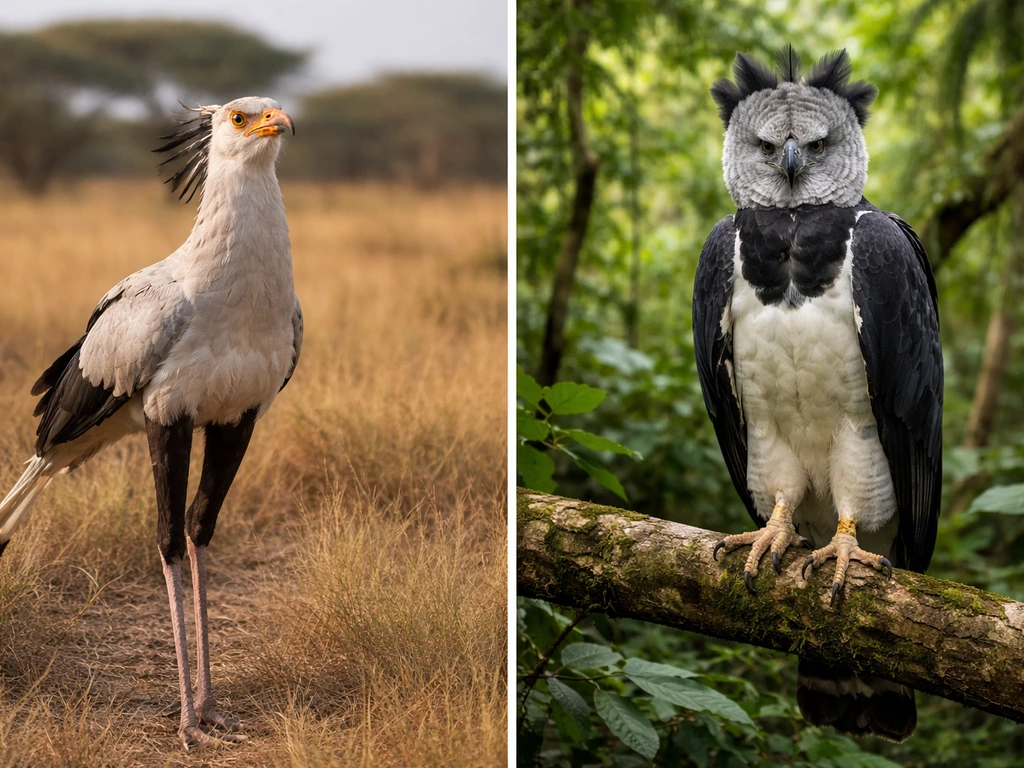
Quick identity check: what each bird looks like at a glance
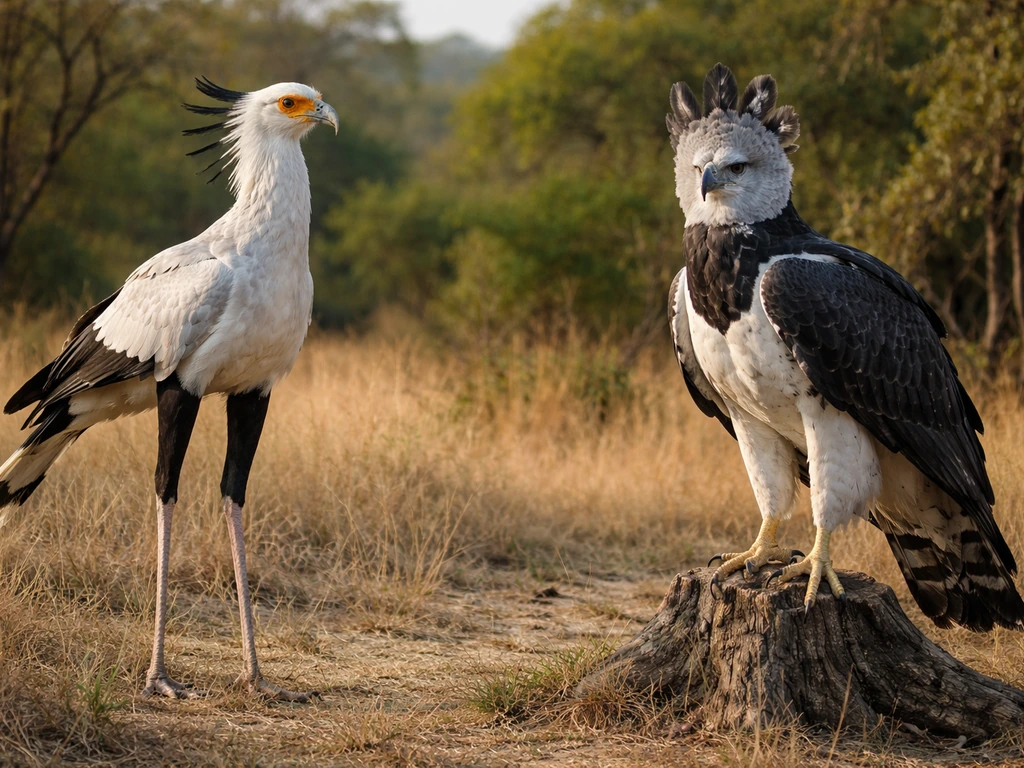
The secretary bird is instantly recognizable if you know one thing: it looks like someone attached an eagle's upper body to a crane's legs. It stands around 1.2 to 1.3 meters tall, walks upright across open savanna, and has a small hooked bill on a bare orange-red face, with a fan of long black feathers sticking out from the back of its head like quill pens tucked behind an ear (that's exactly how it got its name). The overall color is pale grey and white, with black flight feathers, black thigh patches, and those unmistakable long pinkish-grey legs.
The harpy eagle looks like something built specifically to intimidate. It's a massive, compact raptor with a broad pale grey face framed by a divided crest of dark feathers that fans out into two distinct lobes when raised. The chest is white with a bold black breast band, the back is dark grey to black, and the legs are thick, heavily feathered, and tipped with talons so large they look almost impractical. At a glance, a harpy eagle sitting in a tree looks like a powerful, broad-shouldered predator designed for dense forest, which is exactly what it is.
Size, build, and field marks (head, wings, tail, feet)
Size is the first thing to pin down, but these birds are roughly in the same weight class, which surprises people. What differs dramatically is the body plan, how that mass is distributed.
| Feature | Secretary Bird | Harpy Eagle |
|---|---|---|
| Body length | ~125–150 cm (standing) | ~86–107 cm (body length) |
| Wingspan | ~190–210 cm (~2 m) | ~176–224 cm |
| Weight | ~3–4 kg | ~4–9 kg (females larger) |
| Leg length | Extremely long; crane-like | Short, thick, heavily feathered |
| Feet/talons | Short, blunt, powerful strike feet | Massive curved talons; longest ~13 cm |
| Crest | Long black quill-like feathers at nape | Double-lobed grey-black fan crest |
| Facial skin | Bare orange-red facial patch | Feathered; pale grey facial disk |
| Tail | Long, graduated; central feathers extend past feet in flight | Medium-length, broadly barred |
| Bill | Small, hooked, yellow-orange | Large, strongly hooked, grey-black |
| Plumage base color | Pale grey and white with black markings | White below, dark grey-black above, bold black breast band |
The legs are the single most useful field mark. Secretary birds have impossibly long, bare, pinkish-grey legs built for walking kilometers of African grassland every day. Harpy eagle legs are short, thick, and feathered right down to the ankle, built for explosive gripping force in a forest canopy. If you see long bare legs, you're looking at a secretary bird, full stop. If the legs are feathered and stocky, you're looking at the harpy.
The crest difference is equally decisive. The secretary bird's crest is a loose spray of individual long black feathers that project backward from the nape, they look like old-fashioned writing quills and tend to blow around in the wind. The harpy eagle's crest is a structured, bifurcated fan of dark feathers that raises and fans outward from the crown when the bird is alert, giving it an almost owl-like framed face. One looks windswept; the other looks deliberate.
Hunting style and diet: ground stalker vs. canopy ambusher
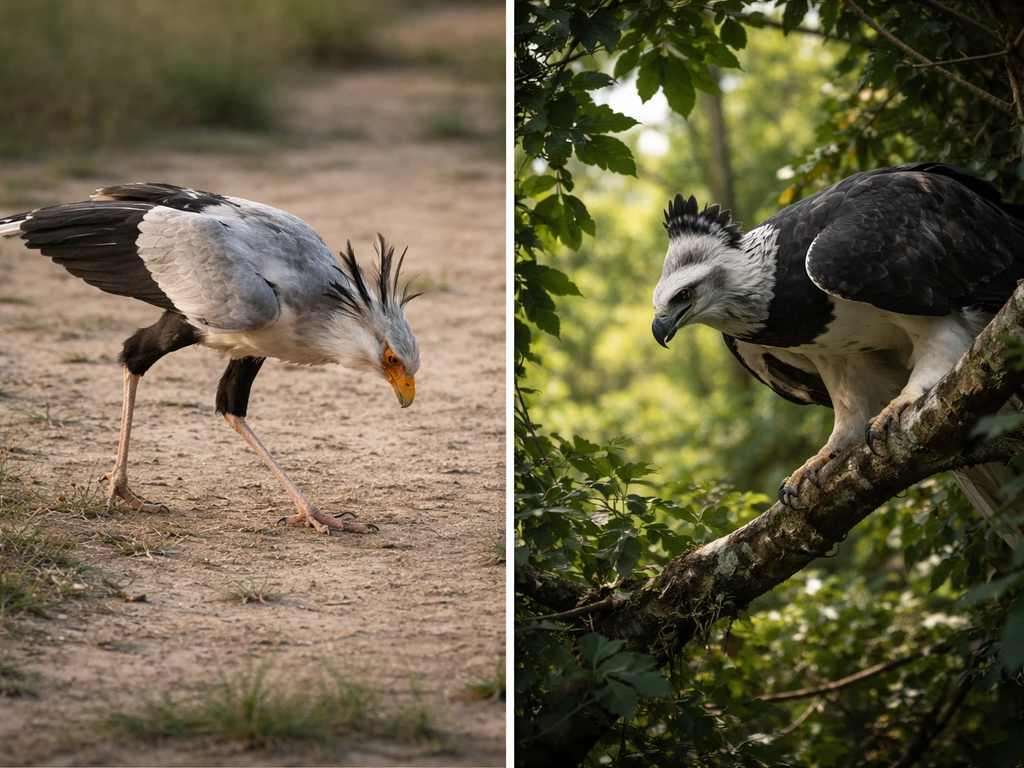
This is where the two birds couldn't be more different, and understanding the hunting style makes the anatomy make sense. Secretary birds and crested caracaras are the only birds of prey known to hunt primarily on the ground rather than from the air. The secretary bird walks up to 30 km a day through African grassland and savanna, flushing prey and then delivering rapid, forceful kicks with those long legs.
This ground-based strategy is exactly what makes kori bustard vs secretary bird comparisons so useful for spotting hunting behavior differences in the wild Secretary birds and crested caracaras. Research has measured these foot-strikes as among the fastest and most forceful of any bird, the kick is powerful enough to stun or kill a snake in a fraction of a second, reducing the snake's opportunity to strike back. Their diet spans small rodents, frogs, lizards, and reptiles including venomous snakes.
When a snake does try to strike, the secretary bird has a defensive trick: it spreads its wings to create a feathery shield while continuing to kick.
The harpy eagle hunts from inside the forest, not above it. It perches in the canopy or emergent layer, scans from a branch, and then launches into short, agile flights through the trees to intercept prey. Its main targets are arboreal (tree-dwelling) mammals: sloths dominate the diet in most studied populations, followed by monkeys, opossums, and similar prey.
A PMC article on harpy eagle diet in the Atlantic Forest reports that harpy eagles feed mainly on arboreal prey such as sloths and monkeys, based on diet composition evidence from identified remains [sloths dominate the diet](https://www. ncbi. nlm. nih.
gov/pmc/articles/PMC10600338/). Studies have recorded prey items weighing up to around 6 kg, which is remarkable for a bird. The harpy's short broad wings and long tail give it the maneuverability to chase prey through dense forest, a body plan almost the opposite of what the secretary bird needs on open ground.
Habitat and range: where you're likely to see each bird
Geography alone rules out most confusion between these two species in the field. They don't share a continent.
Secretary birds live exclusively in sub-Saharan Africa, from Senegal and Sudan in the north down through eastern and southern Africa. Their preferred habitat is open grassland, savanna, and dwarf shrubland, often with scattered acacia trees for roosting and nesting. They avoid forests, dense thickets, and very arid desert, those habitats physically prevent the ground-walking hunting style that defines the species. They can be found at elevations from sea level up to about 3,000 meters.
If you're on an African savanna and you see a tall bird walking through the grass, it's a secretary bird. The comparison with the closely related seriema bird (found in South America) is worth noting for readers who encounter both. If you're trying to compare a seriema vs secretary bird, the geography and overall silhouette are the quickest tells seriema bird.
Harpy eagles range from southern Mexico through Central America and into South America as far as Bolivia, Brazil, and northern Argentina. They are birds of lowland and foothill tropical rainforest, hunting in the canopy and rarely seen in open country. They are rare throughout their range and increasingly threatened by deforestation. Your best realistic chance of seeing one is at a specialist ecotourism destination in places like Tambopata in Peru, the Pantanal in Brazil, or Darien in Panama. Even in prime habitat, sightings require patience. The confusion between harpy eagles and other large Neotropical forest raptors (like the crested eagle) is a known identification challenge, and habitat confirmation is always part of a good ID workflow.
Flight behavior and calls: what to notice in the wild or on video
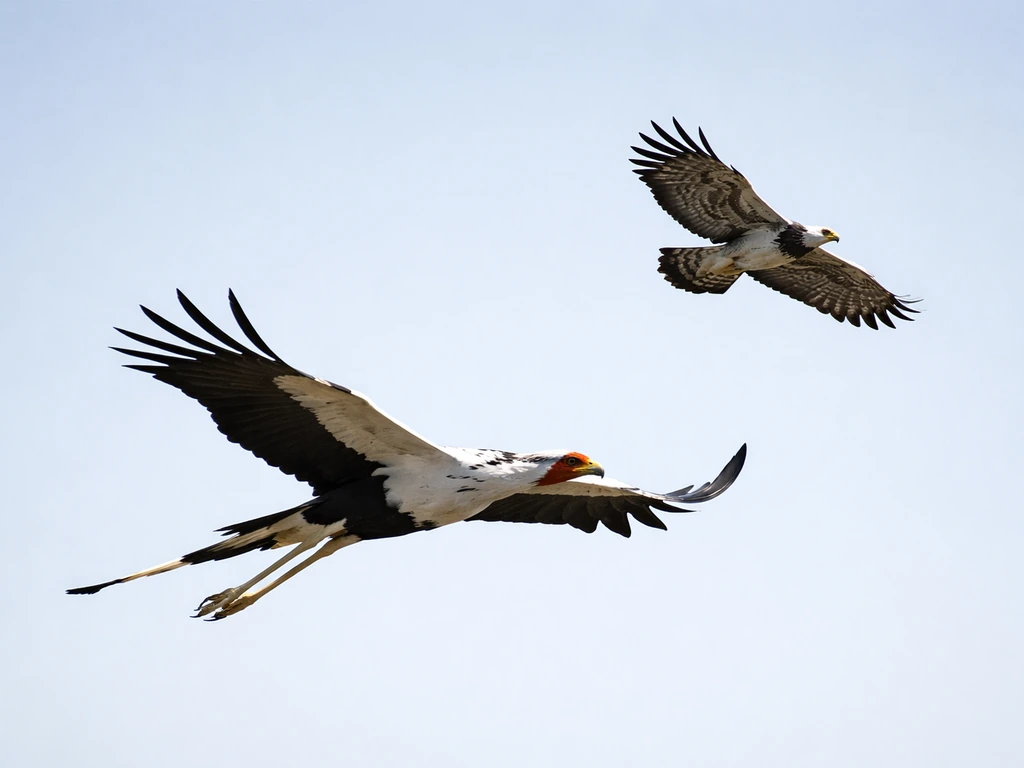
In flight, the secretary bird is one of the most distinctive silhouettes in African skies. The neck stretches forward, the long legs trail behind, and the elongated central tail feathers extend past the feet, creating a unique cross-shaped silhouette. During courtship and territorial displays, secretary birds soar on thermals and perform pendulum-like undulating flights.
The wingspan reaches about 2 meters, and the bird looks graceful but somehow ungainly at the same time, like a very large, slow heron with raptor wings. Vocally, they're not loud; you'll hear a guttural, hoarse croaking sound mainly during courtship displays or near the nest. If you want a quick side-by-side, compare the secretary bird's call and shape against the harpy eagle in the bird siren vs harpy ID section.
Harpy eagles in flight look powerful and compact. The short broad wings and long barred tail make them highly maneuverable in forest, and when seen in open sky they look heavy-bodied and purposeful. They don't soar or display the way secretary birds do, they move between perches in short, direct flights through or above the canopy. Their vocalizations near the nest include weak but penetrating screams, and males have a distinct call described as repetitive and somewhat hollow-sounding. You're far more likely to find a harpy eagle by locating a nest site with a guide than by hearing one at distance.
Raptor basics and misconceptions: are they 'eagles'?
Here's where classification clears up a lot of the confusion. A raptor is any bird of prey characterized by keen eyesight, a hooked bill, and strong taloned feet used to catch and kill prey. Both birds qualify as raptors in that broad sense. But their family relationships are very different.
The harpy eagle is a true eagle, it belongs to the family Accipitridae, the same family as most hawks, kites, Old World vultures, and true eagles. Within that family it sits in its own genus (Harpia) and is considered one of the world's most powerful raptors by grip strength and prey size relative to body weight. When people say 'eagle,' this is the kind of bird they're imagining.
The secretary bird is something else entirely. It is the only living member of the family Sagittariidae, a monospecific family with no close living relatives. The U. S.
Fish and Wildlife Service places it within diurnal raptors, and it is classified in the order Accipitriformes alongside the harpy eagle, but it diverged so early and so distinctly that it has its own unique family. Think of it as a raptor that evolved to walk rather than soar, developing crane-like legs for a completely different ecological strategy.
Calling it an 'eagle' in the casual sense isn't quite accurate, even though it has an eagle-like body and is clearly a bird of prey. It's genuinely in its own category. This singular status also comes up when comparing it to the cassowary or ostrich, large terrestrial birds that raise similar questions about classification. Cassowaries and secretary birds can both show up in discussions about terrestrial classification, but they are from very different lineages cassowary.
One persistent misconception is that the secretary bird's common name refers to it being a 'secretary' to some other bird or person, it doesn't. This comparison, often searched as secretary bird vs python, is a fun way to think about how different predators target and subdue their prey secretary bird's common name. The most widely accepted explanation is that the name comes from the crest feathers resembling quill pens that 19th-century secretaries would tuck behind their ears. The scientific name Sagittarius serpentarius translates roughly to 'the archer of serpents,' which is a much cooler description of what it actually does.
Photo-to-ID guide: how to confirm which bird you're looking at
Whether you're looking at a photo, a video, or a live bird, run through this checklist in order. The first question usually resolves it before you get to the second.
- What continent or region? Africa = secretary bird is in play; Central or South America = harpy eagle is possible. These ranges don't overlap at all.
- What is the bird standing on? Ground in open grassland = secretary bird. Tree branch in dense forest = harpy eagle.
- Check the legs. Long, bare, pinkish-grey = secretary bird. Short, thick, heavily feathered = harpy eagle.
- Check the crest. Loose spray of long black quill-like feathers from the nape = secretary bird. Structured double-lobed dark fan crest from the crown = harpy eagle.
- Check the face. Bare orange-red facial skin around the eye = secretary bird. Pale grey feathered facial disk with no bare skin = harpy eagle.
- Check the body proportions. Tall, slender, long-necked, crane-like overall = secretary bird. Compact, barrel-chested, broad-shouldered = harpy eagle.
- In flight: long legs and tail projecting well behind the body in a cross shape = secretary bird. Short, broad-winged with a long barred tail, maneuvering through forest = harpy eagle.
In photos specifically, the legs and body proportions are your fastest confirmation. A secretary bird in a cropped head shot can look superficially similar to a harpy eagle because both have dramatic crests and hooked bills, but pull back to see the body and the confusion evaporates instantly. If you're seeing a crested raptor and you can't see the legs or body in the frame, check the facial skin: bare orange-red skin around the eye is secretary bird only. A feathered face with no bare skin patch points to harpy eagle.
A common lookalike confusion worth flagging: the crested caracara is a medium-sized raptor with long legs and a flat-topped head crest that sometimes gets confused with secretary birds in casual images. But the caracara is much smaller, has a much more colorful bare facial patch, and is found in the Americas, not Africa. Geography plus size will rule it out quickly. Similarly, the seriema (a South American ground bird with a crest and snake-hunting habits) sometimes gets compared to the secretary bird, and while the ecological parallels are interesting, the seriema is far smaller and has a distinctly different silhouette.
Side-by-side summary: secretary bird vs. harpy eagle
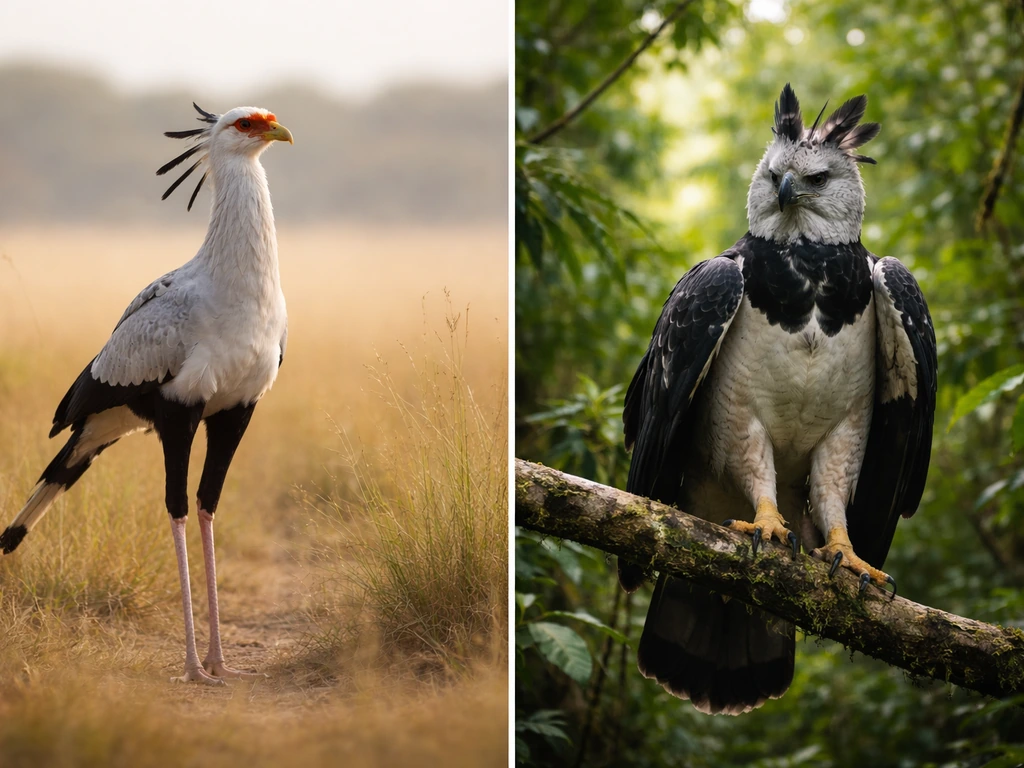
| Category | Secretary Bird | Harpy Eagle |
|---|---|---|
| Family | Sagittariidae (unique, monospecific) | Accipitridae (true eagle) |
| Range | Sub-Saharan Africa | Mexico to northern Argentina (rainforest) |
| Habitat | Open grassland, savanna, sparse shrubland | Lowland tropical rainforest |
| Hunting method | Walks and kicks prey on the ground | Perch-hunts from canopy; ambushes prey |
| Main prey | Snakes, rodents, lizards, frogs | Sloths, monkeys, arboreal mammals |
| Body build | Tall, slender, crane-like legs | Compact, heavy, short-legged |
| Wingspan | ~190–210 cm | ~176–224 cm |
| Crest type | Loose black quill-like nape feathers | Bifurcated structured dark fan crest |
| Facial feature | Bare orange-red skin around eye | Pale grey feathered facial disk |
| Tail in flight | Long, graduated; extends past feet | Medium, broadly barred |
| Vocalization | Guttural hoarse croaking (displays) | Penetrating screams near nest |
| Best quick ID cue | Long bare legs walking on ground | Massive talons, forest canopy perch |
These are two extraordinary birds that represent very different evolutionary solutions to being a top predator. The secretary bird is one of nature's most unusual raptors, a walking, kicking snake-killer that evolved legs instead of talons as its primary weapon. This quick comparison of secretary bird vs eagle also highlights the key differences that show up in the field. The harpy eagle is arguably the most powerful aerial raptor in the Americas, built for explosive force in a three-dimensional forest environment. Once you understand what each bird is actually doing with its body, you'll never mix them up again.
FAQ
If I see a crested raptor in a photo, how can geography and habitat rule it out fast?
Yes. If the bird is in Africa (or you are seeing open savanna), a tall, long-legged raptor with hooked bill and bare orange-red facial skin is overwhelmingly likely to be a secretary bird. If the bird is in Central or South American rainforest or you see thick, feathered legs and a stout, broad-chested form, it is much more consistent with a harpy eagle.
What should I do when the picture is cropped and I cannot clearly see the legs?
In many cases, you can. Harpy eagles often look bulky even from a distance because of the barrel chest and heavily feathered legs, while secretary birds look lanky and “leggy” even when perched. If the photo only shows the head and crest, prioritize the face, secretary birds have bare orange-red skin around the eye, harpy eagles have a fully feathered face.
Are these birds closely related because both are called “eagle”?
Don’t rely on “eagle” in casual naming. Harpy eagles are true eagles in the raptor family Accipitridae, secretary birds are the only living member of their own family (Sagittariidae). So their body plan and behavior can be very different even if both have strong talons and impressive crests.
How can I tell them apart if I only have a brief video of movement?
Use motion cues. A secretary bird typically appears to be walking or stalking, with long legs moving in a steady, deliberate way through grass, and it may suddenly kick prey. A harpy eagle is more likely to be stationary on a branch, then make short, direct launch and pursuit bursts inside the canopy.
What is the most reliable field mark if I am uncertain about the crest shape?
Look at the legs and the “starting point” of the feathered area. Secretary birds have bare, long legs up to the lower part of the shins, harpy eagles have legs that are feathered well down toward the ankle. If both legs seem feathered, secretary bird becomes unlikely.
If I spot one in the sky, what flight pattern tells me which species I’m seeing?
Be careful with timing. In flight, secretary birds show that elongated tail and trailing legs silhouette, and their flight style can include undulating, display-like movements on thermals. Harpy eagles usually move between perches with short, purposeful flights, and they are rarely associated with the graceful soaring pattern described for secretary birds.
Could a crested caracara or another raptor in the area be mistaken for one of these birds?
Yes, and it is a common mistake. If the bird has a crest plus African location plus very long bare legs, that points to secretary bird. If you are in the Americas and the raptor has a crest but smaller overall size, especially with a more colorful bare facial patch, the crested caracara becomes a stronger candidate than either of the two.
What is a quick step-by-step checklist I can follow in the field?
For a confident ID workflow, don’t stop at one feature. Check, in order: (1) continent and habitat type (savanna versus rainforest canopy), (2) leg appearance (bare and very long versus short and feathered), (3) face skin (bare orange-red versus feathered), (4) crest structure (windswept loose quills versus bifurcated fan).
How useful is call identification if I’m not near the nest?
If you hear only one vocalization, it is easy to mislead yourself. Secretary birds are generally not loud and their guttural, hoarse croaks are mainly tied to courtship or near nests. Harpy eagles tend to be associated with weaker but penetrating screams near nesting areas. If you are far from the nest, use visuals and habitat more than sound.
What are realistic chances of seeing each bird, and how should that affect my confidence?
If you encounter one at a known ecotourism site in the Neotropics, your odds can rise, but sightings still take patience because the bird is rare and canopy-based. If you are in Africa’s open grassland, you should expect the secretary bird to be more plausible than the harpy eagle even if the bird has a dramatic crest.
Next Articles
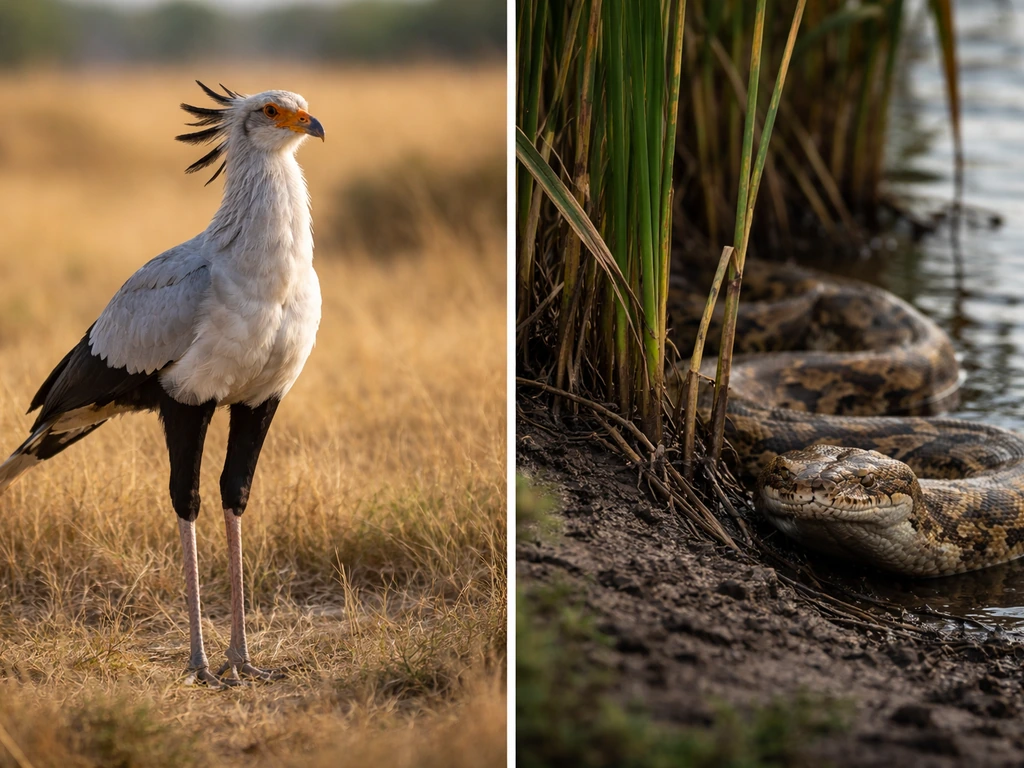
Secretary Bird vs Python: Key Differences and Spotting Cues
Compare secretary bird and python: anatomy, habitats, hunting cues, and how each preys or defends in the wild.
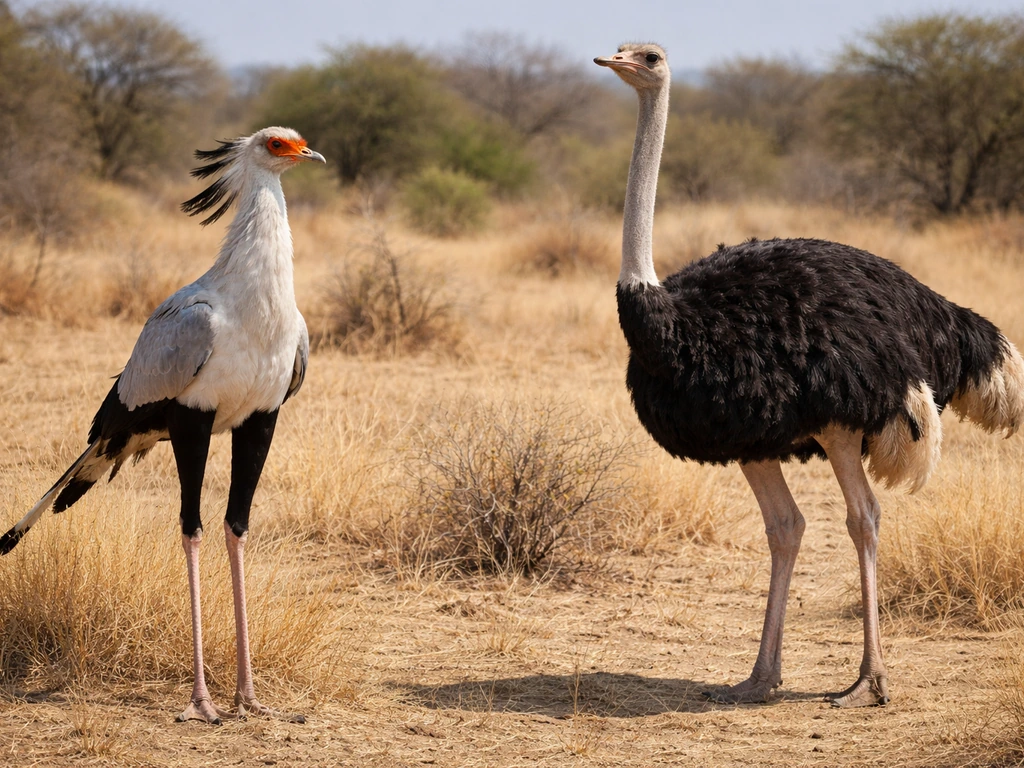
Secretary Bird vs Ostrich: How to Tell Them Apart Fast
Fast guide to secretary bird vs ostrich: range, key field marks, behavior, and a photo checklist to tell them apart.
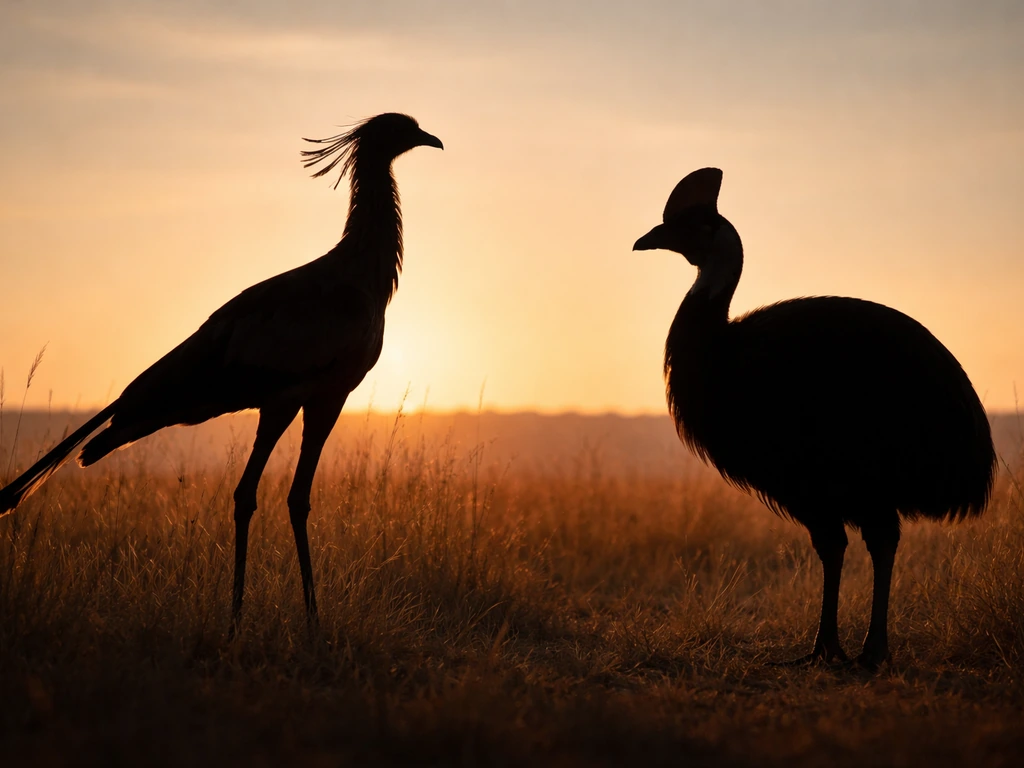
Secretary Bird vs Cassowary: Key Differences and ID Guide
Compare secretary bird vs cassowary with a quick ID guide covering looks, feet, beaks, habitat, diet, behavior, and safe