A secretary bird and a python are about as different as two animals can be: one is a tall, long-legged African raptor that walks the savannah stomping prey with its feet, and the other is a heavy-bodied constrictor snake that lies motionless waiting for prey to wander past. There is no realistic way to confuse one for the other in the field.
Secretary Bird vs Python: Key Differences and Spotting Cues

Marcus Hendricks
8 Jun 2026
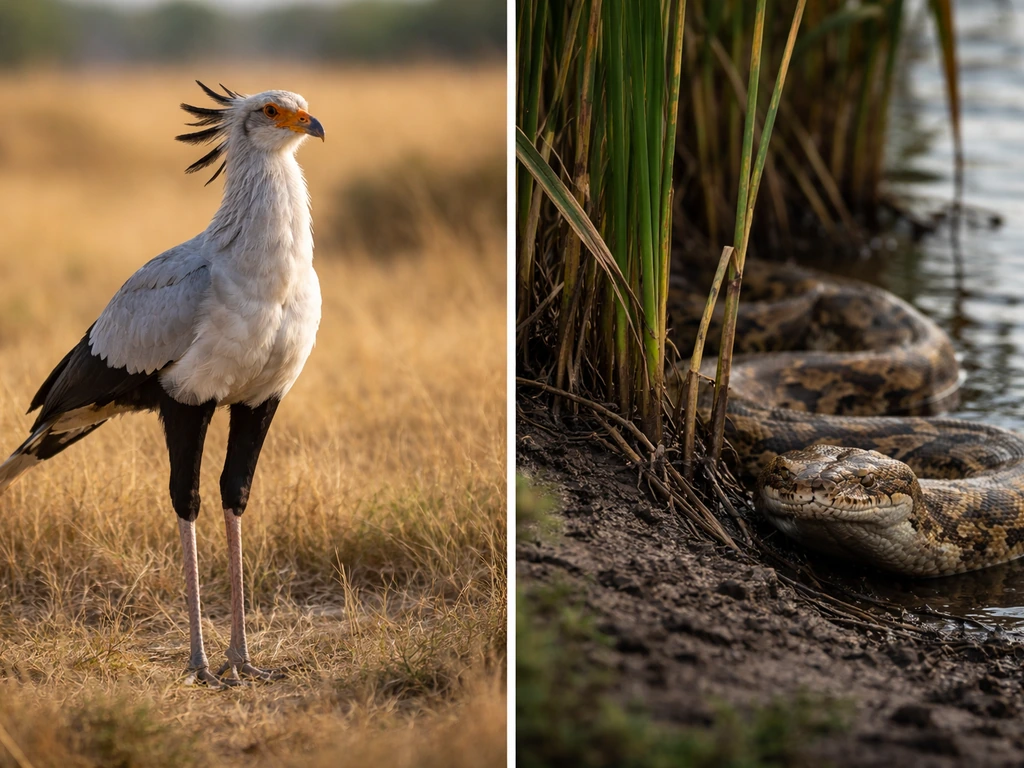
What most people are actually asking when they search this comparison is either "can a secretary bird kill a python? " or "how do these two animals interact in the wild? " The honest answer is yes, secretary birds do eat snakes, but large adult pythons are a different matter entirely, and the full picture is more nuanced than the dramatic YouTube footage suggests.
What each animal actually is
The secretary bird (Sagittarius serpentarius) is the only living species in its family, Sagittariidae, and sits within the order Accipitriformes alongside hawks and eagles. It is a raptor, but it hunts almost entirely on foot rather than from the air, which makes it unlike virtually every other bird of prey on the planet. Its scientific name literally nods to its snake-eating habits: "serpentarius" means snake-handler. It is found only in sub-Saharan Africa.
Pythons are not a single species but a whole family, Pythonidae, containing roughly 39 recognized species across about 10 genera. They are nonvenomous constrictors found across Africa, Asia, and Australia. In the African context, the most relevant species is the African rock python (Python sebae), which is one of the largest snakes in the world and shares significant geographic overlap with the secretary bird. The Encyclopaedia Britannica describes the African rock python (Python sebae) as one of the representative African python species (syn. “African python”) African rock python (Python sebae) as a representative African python species. When people imagine a "python" in a secretary bird encounter, the African rock python is almost certainly the animal in question.
Where they live and how they fit their ecosystems
Secretary birds prefer open landscapes: grasslands, savannahs, and semi-arid scrub across sub-Saharan Africa. They do particularly well in areas where grass stays below about 50 cm tall because they hunt by walking and need to see (and reach) prey on the ground. You will not find them in dense tropical forest or the Congo Basin. Their range extends from sea level up to around 3,000 meters.
African rock pythons overlap with this range considerably. They also favor savanna, open woodland, and grassland, but they have one additional preference: proximity to water. Rock pythons are strong swimmers and tend to stay near rivers, lakes, and wetlands. Like the secretary bird, they avoid the driest deserts and high cool elevations. The two species share a great deal of habitat, which is exactly why encounters happen at all.
Ecologically, they fill completely opposite roles. The secretary bird is an active, diurnal ground predator that covers large distances every day in search of prey. The African rock python is one of the region's largest ambush predators, spending most of its time completely still, waiting for prey to come to it. One animal is always moving; the other is almost never moving until it has to be.
How different do they look? A body-plan comparison
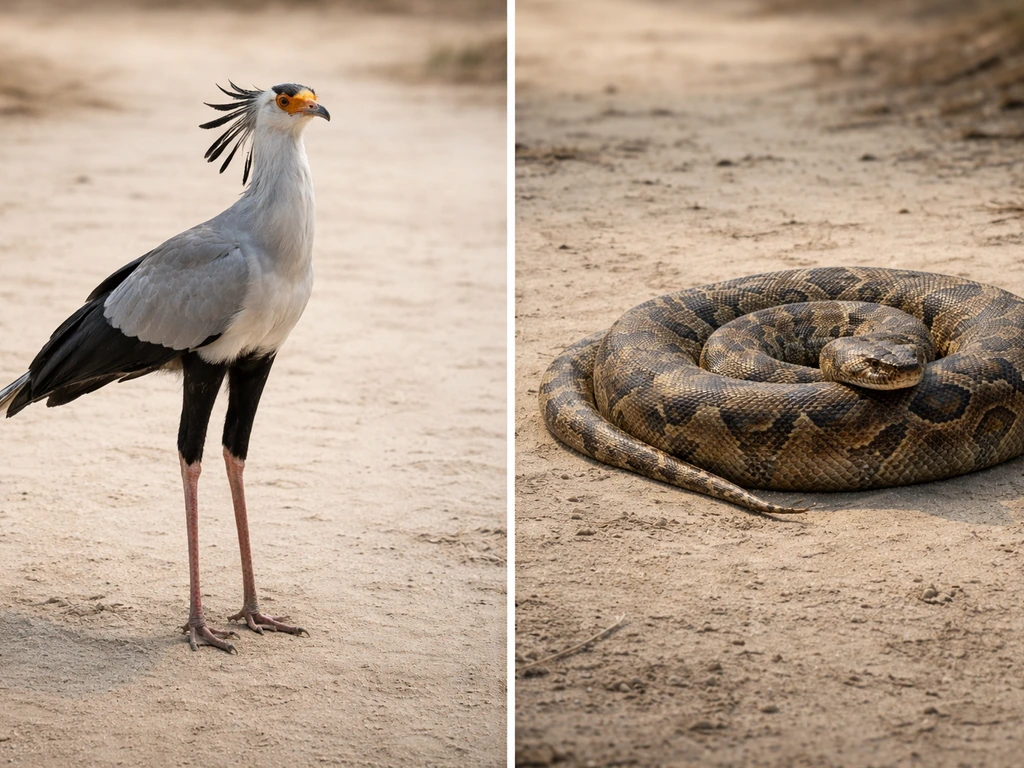
Honestly, there is no universe in which you would mix these two up visually. But spelling out the differences is still useful for understanding why each animal operates the way it does.
| Feature | Secretary Bird | African Rock Python |
|---|---|---|
| Body type | Upright, feathered bird on two long legs | Elongated, legless, muscular snake |
| Length | 125–150 cm bill to tail; stands ~1.2 m tall | Commonly 3–5 m; large adults can exceed 5 m |
| Weight | 3.1–4.1 kg | Can exceed 55 kg in large adults |
| Limbs | Two wings, two long scaled legs with clawed feet | No limbs |
| Coloring | Grey body, black flight feathers and thighs, red/orange bare face | Brown/tan with dark blotched pattern for camouflage |
| Key feature | Long black crest feathers at the back of the head, pink legs | Heat-sensing labial pits along the jaw |
| Locomotion | Walks on ground; flies when needed | Lateral undulation, sidewinding, or rectilinear crawling |
| Wingspan | Over 2 meters | Not applicable |
The secretary bird's most immediately striking features are its extraordinary legs, those dramatic black crest feathers fanned out behind its head like quill pens (which is actually the likely origin of its common name), and the vivid orange-red bare skin around its face. Up close or in a good photo, it looks almost like someone attached a hawk's head and wings to the body of a crane. The python, by contrast, is a thick, heavy rope of muscle covered in patterned scales designed to disappear against leaf litter and dry grass. Their heat-sensing labial pits, small holes along the jaw, are visible on inspection but not a field ID feature at distance.
How each animal hunts
The secretary bird: a stomping machine
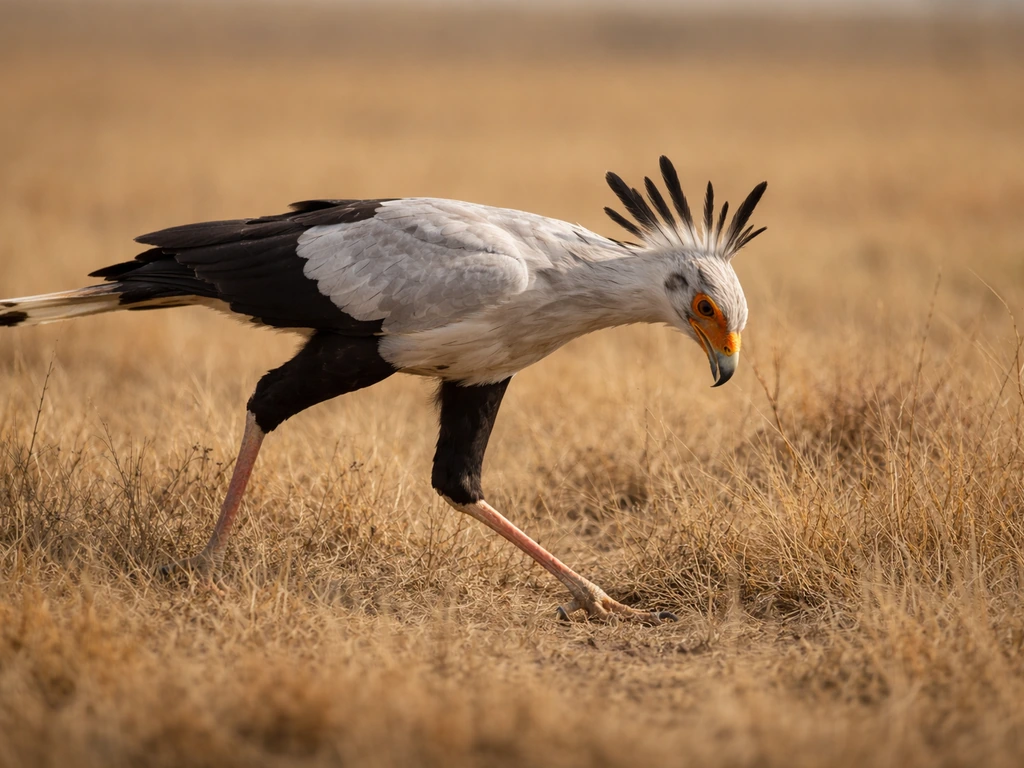
Secretary birds hunt by walking, sometimes covering 20 or more kilometers a day on foot through open grassland. When they locate prey, they do not dive from altitude like a falcon or clutch from a perch like an eagle. You can also compare how a secretary bird’s on-foot hunting contrasts with an eagle’s hunting style. They stomp it.
Their thick-scaled legs deliver rapid, precisely targeted kicks that generate enough force to stun or kill prey almost instantly. A 2016 biomechanics study measured the striking force of a captive secretary bird named Madeleine and found the strikes were both extremely fast and forceful enough to incapacitate prey reliably. Against snakes specifically, the bird aims for just behind the head, a strike location designed to snap the neck or at least immobilize the animal before it can bite back.
The thick scales on the secretary bird's lower legs are not decoration: they are armor against retaliatory strikes from venomous prey.
Secretary birds hunt alone or in pairs. They also use their beak to deal with prey, but the feet are the primary weapon. Think of them as the karate practitioners of the bird world: precise, powerful, and fast on their feet.
The python: wait, strike, constrict
Pythons do almost the opposite. They find a concealed position, often near a game trail or water source, and wait. Their camouflaged scales make them nearly invisible in dry grass or leaf litter. When warm-blooded prey passes within range, heat-sensing labial pits along their jaw detect the infrared signature of the animal even in low light or darkness. The python strikes explosively, biting to grip, then immediately coils its body around the prey. Constriction works by tightening with each breath the prey exhales, gradually preventing the next inhalation until the prey suffocates. The snake then swallows the prey whole.
Rock pythons take a wide range of prey including birds, mammals, and even crocodiles in some documented cases. Their ambush strategy means they are almost never the animal chasing something down. If a threat approaches them, their first response is typically to hold still and rely on camouflage, then to flee if possible, then to bite defensively as a last resort.
Do secretary birds actually eat pythons?
Secretary birds absolutely eat snakes, and snakes are a well-documented and significant part of their diet. Secretaries bird vs cassowary is a different kind of comparison, since cassowaries are large flightless birds that rely on foot-powered foraging and have a very different lifestyle secretary bird vs cassowary. The species name "serpentarius" was not chosen arbitrarily. They have been observed taking cobras, adders, mambas, and a range of other species. So yes, a secretary bird will kill and eat a snake.
But here is where the realistic predator-prey context matters. The snakes secretary birds typically take are manageable in size relative to the bird. A secretary bird weighs roughly 3.1 to 4.1 kg. A large African rock python can weigh well over 55 kg and stretch past 5 meters. That is not a prey item a secretary bird is going to stomp to death and swallow. A juvenile or small python is a different story: a young rock python might be thin enough and short enough to fall within the range of prey a secretary bird can handle, but an adult rock python is a genuinely dangerous animal that poses a real threat in the other direction.
It is also worth noting that while snakes are prominent in the secretary bird's diet, their importance has historically been overstated. Secretary birds eat a varied diet that includes small mammals, lizards, tortoises, amphibians, insects, birds' eggs, and crustaceans. Snakes are a key prey category, not the exclusive one. The bird is an opportunistic ground predator that eats what the grassland offers.
Busting the "who would win" myths
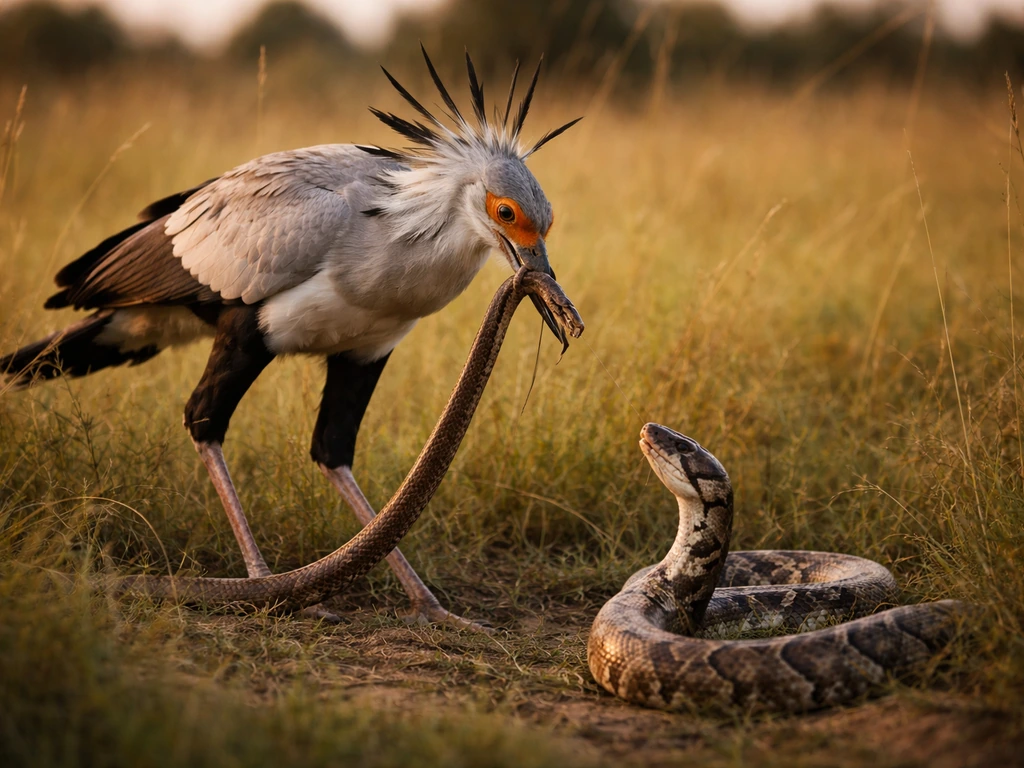
The internet loves a wildlife showdown, and "secretary bird vs python" gets framed as a combat matchup fairly often. If your question is really about the kori bustard versus secretary bird, their different hunting styles and habitats lead to a very different kind of matchup kori bustard vs secretary bird. A few misconceptions come up repeatedly and are worth addressing directly.
- "Secretary birds can kill any snake." Not quite. They are formidable against snakes of manageable size, including venomous ones. A large adult African rock python is a different proposition entirely. The bird's stomp-and-kill technique depends on being able to control the snake's movements. A 5-meter, 55 kg constrictor is simply too large and powerful for that to be realistic.
- "A python would easily crush a secretary bird." Against a large rock python, a secretary bird would almost certainly retreat rather than fight. But the idea that any python automatically dominates is wrong: smaller pythons would be prey, not predators, in that encounter.
- "Secretary birds fly in, grab snakes from the air." This is a mix-up with other raptors. Secretary birds are ground hunters. They walk up to prey and stomp it. They do not do dramatic aerial strikes on snakes.
- "Pythons are venomous." Pythons are nonvenomous constrictors. They kill by squeezing, not by venom. This is a very common misconception, especially when people compare them to other large snakes.
- "The secretary bird's crest means it's related to crested birds like cockatoos." The secretary bird is a raptor, not remotely related to cockatoos or other crested species. Its taxonomic position is unique: it is the sole member of its family and has no close living relatives.
The more useful frame is not "who wins" but "under what conditions do these animals interact at all? If you are wondering about bird siren vs harpy comparisons, it helps to focus on how hunting style, habitat, and body size change the outcome under what conditions do these animals interact at all? .
In realistic terms, that means comparing a secretary bird to a python is most accurate when you consider size, cover, and hunting strategy these animals interact at all. " In most realistic field scenarios, a secretary bird encountering a large rock python would avoid it. That is why the question kori bustard vs secretary bird often comes up, because people compare large birds and their hunting niches.
A secretary bird encountering a smaller snake, python juvenile or otherwise, has the tools and instincts to handle it efficiently. Encounters are not random tournaments: they are shaped by size, context, hunger, and the odds of success.
How to identify each animal in the field
If you are in sub-Saharan Africa and trying to confirm what you are looking at, here is what to focus on.
Spotting a secretary bird
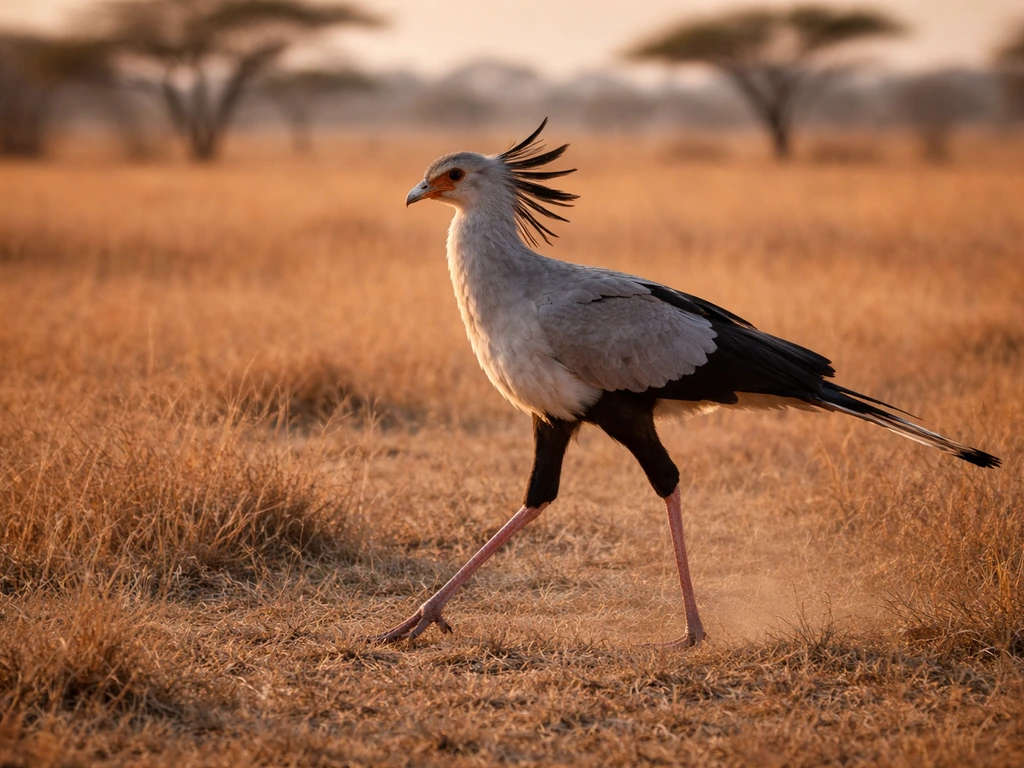
- Look for a large bird walking through open grassland or savannah, usually alone or in a pair.
- The combination of very long pink legs, grey and black plumage, and long black crest feathers trailing behind the head is unmistakable.
- The bare orange-red skin around the face (the loral area) is visible at moderate distance with binoculars.
- In flight, the long legs trail behind the tail, giving it an unusual silhouette compared to other large raptors. The wingspan exceeds 2 meters.
- It moves deliberately and steadily across the ground, pausing to stamp at grass clumps to flush hidden prey.
- Open grassland, savannah, and semi-arid scrub with short grass are the right habitat. Dense forest is a strong indicator you are looking at something else.
Spotting an African rock python
- Look along water edges: riverbanks, lake margins, and wetland fringes are prime rock python habitat.
- The body pattern is brown and tan with irregular darker blotches, highly effective camouflage against dry grass and soil.
- At rest, the snake is often coiled or stretched out straight, barely moving. If you see what looks like a thick log or a rope in the grass, look carefully.
- Size is a key indicator for adults: a rock python is noticeably thick-bodied, often thicker than a human forearm even at moderate lengths.
- If you are close enough, the labial pits (small heat-sensing openings along the jaw) are visible, but do not get that close intentionally.
- Rock pythons are dangerous at close range. If you spot one, maintain distance and observe from a safe position.
Practical next steps if you want to learn more or observe responsibly
If the secretary bird has caught your interest, it is worth knowing that the species is listed as Vulnerable on the IUCN Red List, with populations declining due to habitat loss and agricultural expansion across sub-Saharan Africa. Responsible wildlife tourism and conservation support matter for this bird. The best places to observe secretary birds in the wild are open national parks and reserves in countries like South Africa, Kenya, Tanzania, Botswana, and Namibia, where open savannah habitat remains intact.
For field identification, a good regional field guide covering African raptors will have detailed plates on the secretary bird. Apps like Merlin Bird ID (by the Cornell Lab of Ornithology) cover many African species and can help confirm a sighting using photos or audio. The secretary bird is visually distinctive enough that a clear photo is usually all you need for a confident ID.
For pythons, the same regional herp guides and wildlife apps can help, but the most important practical advice is about safety rather than identification: do not approach a large snake you cannot confidently identify at a safe distance. African rock pythons are powerful animals. Observation with binoculars from a respectful distance is the right approach. If you are on a guided safari, your guide will have the experience to identify and handle the situation correctly.
If you are working through related comparisons, the secretary bird sits in a fascinating ecological space. A similar matchup shows how a secretary bird vs harpy eagle would differ since a harpy eagle is a rainforest canopy predator with different hunting styles secretary bird sits in a fascinating ecological space. Comparing it to other large African birds like the kori bustard or the ostrich shows just how unusual its raptor-on-foot niche really is, and comparing it to eagles or harpy eagles highlights how differently a bird of prey can be built depending on what and how it hunts. Each comparison reveals something new about how anatomy and behavior are shaped by ecological role.
FAQ
If a secretary bird can eat snakes, does it always attack a python it encounters?
In the real world, a secretary bird typically assesses risk before committing, so interactions skew toward avoidance with fully grown African rock pythons. The bird’s hunting is precise and on-foot, and it often benefits from ambushing smaller, more manageable snakes, rather than engaging something that can seriously injure it.
What are the best cues to tell a python vs a secretary bird from a distance?
Focus on behavior and setting rather than size alone. A python encounter is more likely when you see prolonged stillness in tall dry grass near a game trail or water edge, while a secretary bird tends to be actively walking, stopping to probe or stomp, and often shows visible crest and leg motion in open ground.
Can I use the heat-sensing features to identify a python in the field?
Heat-sensing pits on pythons can only be confirmed at close range, and trying to get closer is the wrong priority for safety. If you are trying to ID in the field, use the overall body form (thick-bodied, patterned, low and camouflaged) and habitat preference (still, near cover and water) instead of looking for jaw pits.
How does the outcome change if the python is juvenile versus an adult rock python?
Yes, but the “win” depends heavily on the snake’s size and the cover. A secretary bird has an advantage when the python is small enough to be stomped or struck effectively, or when the bird can keep distance and strike the neck area. With adult rock pythons, the risk flips because the snake can bite defensively and exert constriction power.
What should I do if I spot a secretary bird and a large snake near each other while on safari?
Because secretary birds are ground hunters, the closest real risk scenario is not a direct confrontation, it is accidental encounter at short range near a path or water edge. The safest approach is to keep distance, avoid cornering any snake, and watch from behind vegetation cover or with binoculars, especially in open woodland and savanna edges.
What misconceptions lead people to overestimate a secretary bird versus python “fight”?
Common mistake: assuming all “pythons” behave the same or all encounters are evenly matched. Another is treating the comparison like an always-possible fight, when in reality the bird’s prey choice, hunger level, and the snake’s willingness or ability to hold defensive position heavily shape whether an encounter happens at all.
Which python species is most likely when people ask “secretary bird vs python” in Africa?
In Africa, the python most likely relevant to a secretary bird encounter is the African rock python, but your region and local species matter. If you are outside its range, you may be dealing with different constrictor species that vary in maximum size and temperament, which changes how risky “a python encounter” could be.
Why is a secretary bird’s hunting method different from other birds of prey when facing snakes?
Secretary birds do not rely on venom or flying attacks, so the “strategy” is fundamentally different from what many people expect. The bird’s key tool is rapid, targeted leg strikes, which works best against snakes that are small enough to be immobilized quickly.
How can I get a reliable ID photo without putting myself at risk?
If you want to photograph or confirm an ID, use longer focal lengths and avoid closing the gap. For birds, a clear shot showing the crest and orange-red facial skin is usually enough, while for snakes you often should prioritize documenting pattern and resting position from a safe distance rather than attempting closer inspection.
What is the safest way to handle a possible secretary bird and python situation in the field?
A practical safety rule is to treat large constrictors as if they can defend themselves effectively. Keep a wide buffer, do not try to move the animal, and follow your guide’s instructions, especially because misidentification of “harmless” versus “dangerous due to size” is a frequent real-world problem.
Next Articles
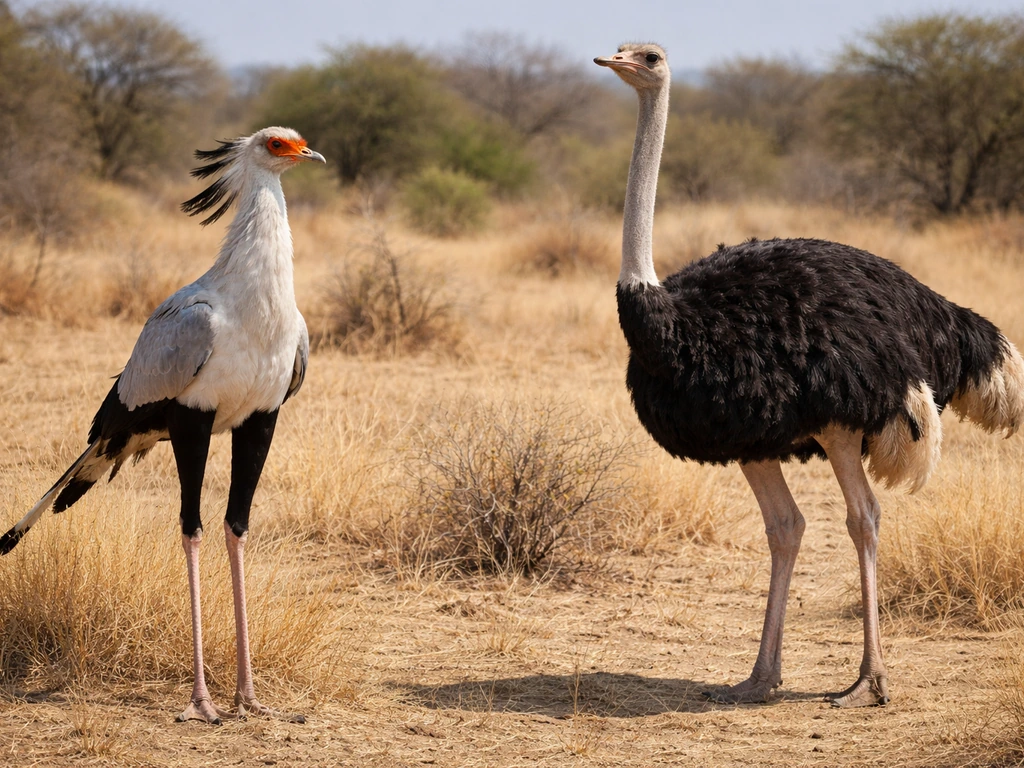
Secretary Bird vs Ostrich: How to Tell Them Apart Fast
Fast guide to secretary bird vs ostrich: range, key field marks, behavior, and a photo checklist to tell them apart.
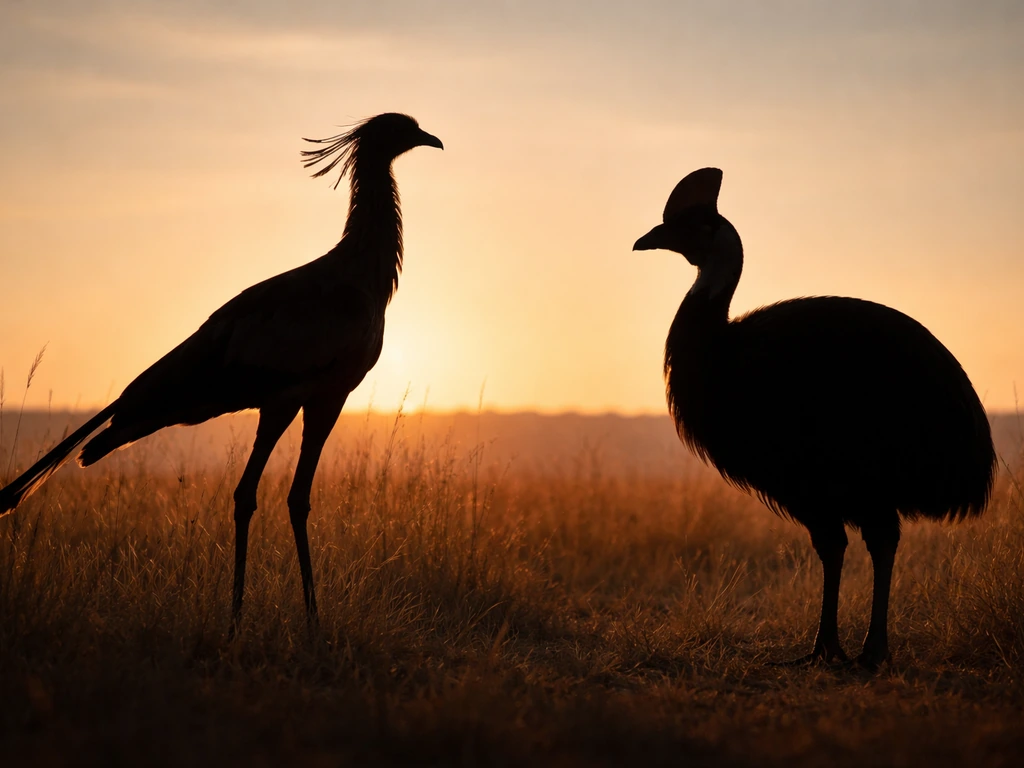
Secretary Bird vs Cassowary: Key Differences and ID Guide
Compare secretary bird vs cassowary with a quick ID guide covering looks, feet, beaks, habitat, diet, behavior, and safe
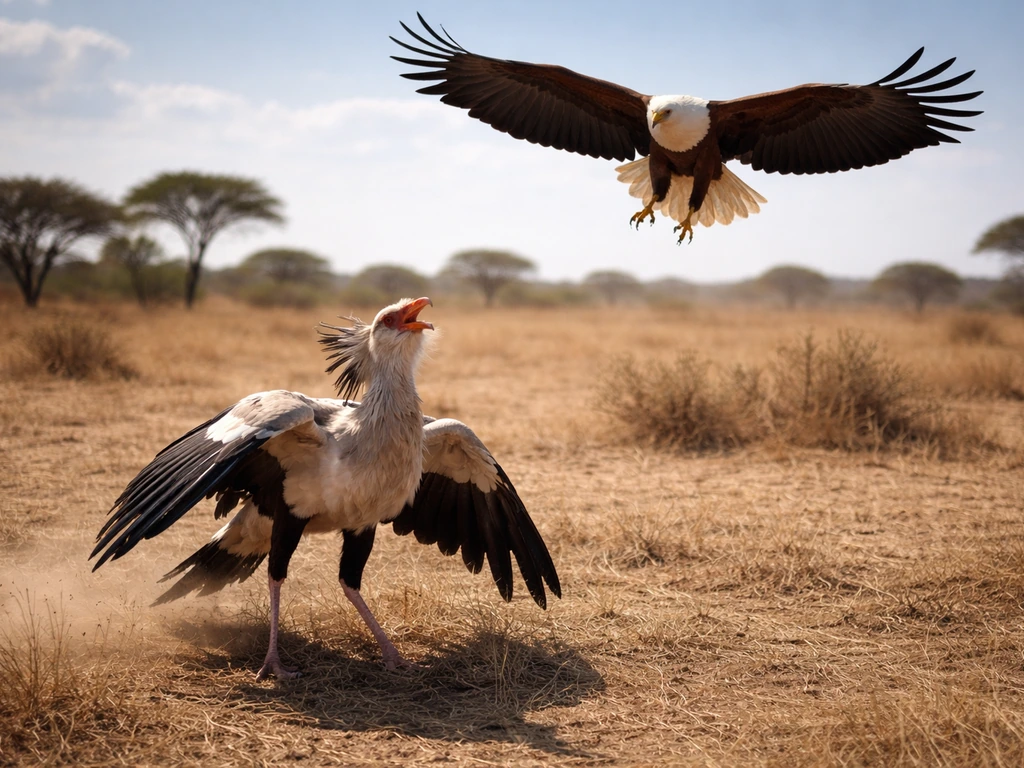
Secretary Bird vs Eagle: Who Would Win a Fight?
Ground-savanna fighter or aerial predator? Compare secretary bird vs eagle by size, speed, hunting weapons, and key vari