
The Kori Bustard and the Secretary Bird are both large, long-legged birds that stalk African grasslands on foot, and from a distance that shared profile can cause real confusion. But spend even a few seconds with either species and the differences become stark: the Kori Bustard (Ardeotis kori) is a massive, barrel-chested bird with cryptic barred plumage built for blending in, while the Secretary Bird (Sagittarius serpentarius) is a slender, stilt-legged raptor with a bare orange face, black crest quills, and a silhouette unlike anything else on the savanna. They share open-country habitat across eastern and southern Africa, they both eat snakes (though less often than people assume), and they are both in serious trouble conservation-wise. Beyond that, almost everything about them is different.
Kori Bustard vs Secretary Bird: Field ID, Behavior & Facts

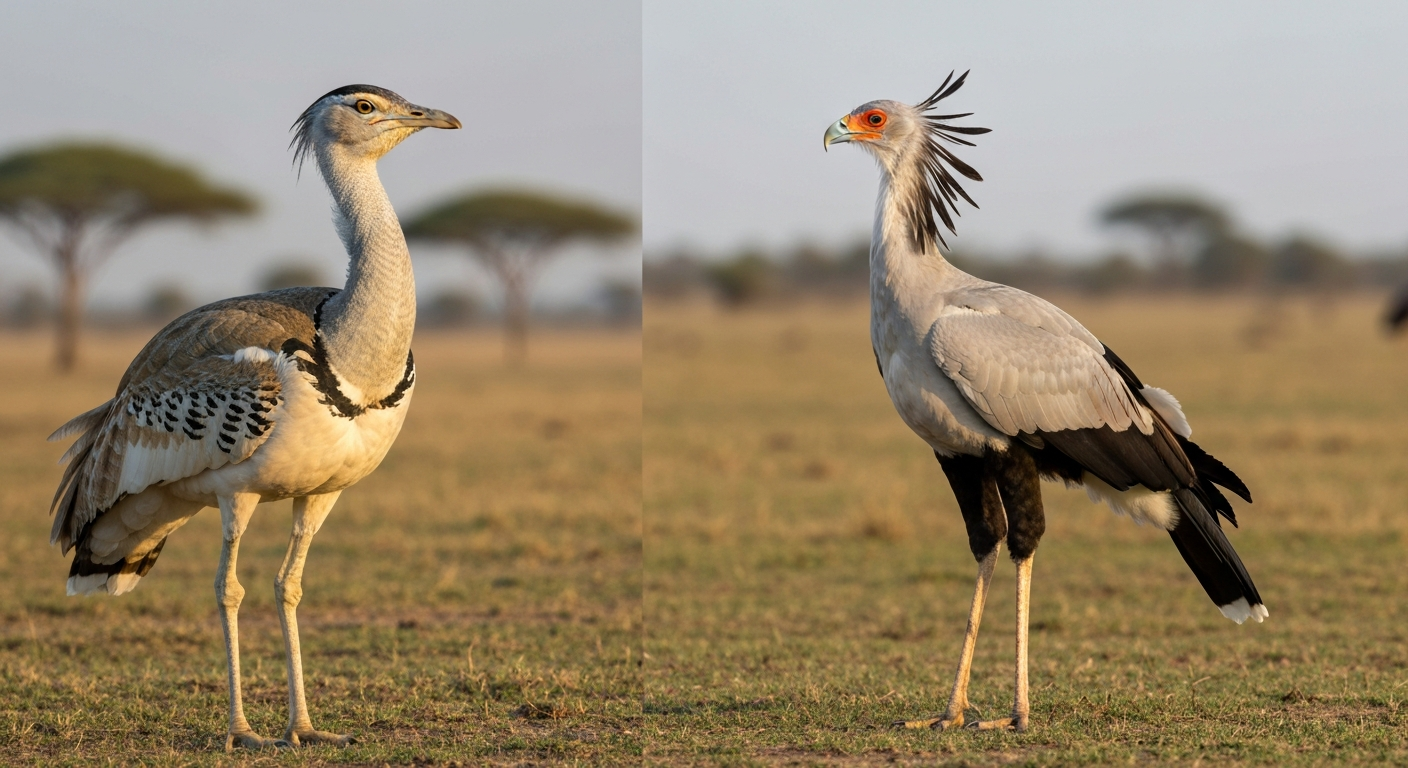
At-a-Glance ID Summary
If you are in the field and need a quick call, these are the features that will separate them immediately. The Kori Bustard is heavy and horizontal, built like a turkey crossed with a crane, with buff and grey barred upperparts and a relatively low-slung posture for its size. The Secretary Bird is tall, vertical, and unmistakably two-toned, with long black-tipped legs visible from a great distance, a grey body, and a conspicuous bare facial patch of orange or yellow skin around the eye.
- Kori Bustard: bulky body, barred buff/grey upperparts, relatively short legs, three forward toes, flies reluctantly but powerfully
- Secretary Bird: stilt-like legs, grey body with black flight feathers and thighs, bare orange/yellow facial skin, long black crest plumes, long central tail streamers
- Head shape: Kori has a rounded grey head with a fine black-and-white crest; Secretary Bird has a flat-topped head dominated by those distinctive quill-like crest feathers splayed backward
- Bill: Kori has a sturdy, slightly decurved bill; Secretary Bird has a short, hooked raptor-style bill
- Ground posture: Kori crouches and creeps when alarmed; Secretary Bird walks upright with a high, purposeful stride
- In flight: Kori shows broad, rounded wings with bold white and black panels; Secretary Bird trails its long legs behind and shows long central tail streamers — a completely different silhouette
- Family: Kori Bustard belongs to Otididae (bustards); Secretary Bird is the sole living member of Sagittariidae — it is technically a raptor more closely related to hawks and eagles than to any bustard
Side-by-Side Comparison Table
| Feature | Kori Bustard | Secretary Bird |
|---|---|---|
| Scientific name | Ardeotis kori | Sagittarius serpentarius |
| Family | Otididae | Sagittariidae (sole member) |
| Order | Otidiformes | Accipitriformes |
| Height | Up to ~1.5 m (males) | ~1.2–1.5 m |
| Body mass | Males ~11–19 kg; females roughly half | ~2.3–4.3 kg |
| Wingspan | ~2.3–2.8 m (estimated range) | ~2.1 m |
| Leg length | Moderate; three forward toes | Longest of any raptor; heavily scaled |
| Facial skin | None; feathered throughout | Bare orange/yellow patch around eye |
| Crest | Fine black-and-white erectile crest | Long black quill-like plumes, splayed backward |
| Plumage (upper) | Cryptic buff, grey and brown barring | Pale grey body, black flight feathers and thighs |
| Bill shape | Sturdy, slightly decurved | Short, hooked (raptor bill) |
| Diet | Omnivorous: insects, lizards, small mammals, snakes, seeds | Primarily arthropods (~87%); rodents, lizards, snakes (~1%) |
| Hunting method | Walk and peck/flush; opportunistic | Active pursuit on foot; powerful stomping kicks |
| Breeding system | Polygynous; lek-like displays | Monogamous; large stick nest in tree |
| Range | Eastern and southern Africa (patchy) | Widespread sub-Saharan Africa |
| Habitat | Open grassland, lightly wooded savanna | Open grassland and short savanna |
| IUCN status (2025) | Near Threatened | Endangered (uplisted 2020) |
| Primary threats | Habitat loss, power line collision, hunting | Habitat loss, power line collision, secondary poisoning |
Size and Shape: Who Is Actually Bigger?
This is where the comparison gets genuinely surprising. The Kori Bustard is one of the heaviest flying birds on Earth. Males can tip the scales anywhere from about 11 to 19 kg, making them dramatically heavier than a Secretary Bird (which weighs roughly 2.3 to 4.3 kg). That weight difference is enormous, nearly the difference between a domestic cat and a large dog. Kori Bustard females are roughly half the mass of males, which is one of the most pronounced examples of sexual dimorphism among birds.
In terms of standing height, the two species are actually close, both reaching roughly 1.2 to 1.5 metres. But they achieve that height very differently. The Kori Bustard's height comes from its sheer body bulk, with relatively short, sturdy legs underneath a massive torso. The Secretary Bird's height is almost entirely leg. Its body is compact and its legs are extraordinarily long, the longest of any raptor species, which creates that unmistakable stilted profile. Stand them side by side and the Kori looks like a fortress; the Secretary Bird looks like it is walking on stilts.
Wingspan tells a similar story. The Kori Bustard has broad, rounded wings spanning roughly 2.3 to 2.8 metres to lift that heavy body, while the Secretary Bird's narrower wings span around 2.1 metres. From above, the Kori in flight looks like a flying carpet; from behind, the Secretary Bird in flight shows a narrow body with legs trailing well beyond the tail and long central tail streamers extending further still.
Plumage, Crest and Anatomy: The Diagnostic Details
Head and Face
The Secretary Bird's face is a field identification gift. That bare patch of orange to yellow skin around the eye is visible at surprising distances and is shared by no other African grassland bird of similar size. The crest feathers, long, black-tipped quills splayed out behind the head like a bunch of old-fashioned quill pens, are the feature that supposedly gave the bird its English name (though that etymology is debated). The Kori Bustard, by contrast, has a fully feathered grey head with a fine, erectile black-and-white crest that is far less dramatic. During display the male Kori puffs out its esophagus and fans its crest, but it is not the first thing you will notice in the field.
Bill
The bills are a dead giveaway for family membership. The Secretary Bird has a short, strongly hooked bill characteristic of a raptor, designed for tearing flesh. The Kori Bustard has a longer, straighter bill with a slight decurve, suited to picking up insects, seeds, and small animals from the ground. If you can see the bill clearly, you have your identification.
Body Plumage and Markings
Kori Bustard plumage is all about camouflage. The upperparts are a fine tapestry of buff, grey and brown barring that breaks up the bird's outline spectacularly in dry grassland. The underparts are paler, and the neck is streaked. In flight, the wings show a striking pattern of white and black panels that is eye-catching but rarely seen because the bird avoids flying. Secretary Birds are two-toned by contrast: pale grey on the body and upper wing coverts, with black flight feathers, black thigh feathers, and black tail feathers. The long central tail has two elongated streamers that are diagnostic in flight and on the ground.
Legs and Feet
The Secretary Bird's legs are heavily scaled and designed for impact, not gripping. Unlike most raptors that use their feet to grasp and kill prey, the Secretary Bird stamps and kicks. The scales provide some protection against biting snakes. The Kori Bustard has three forward-pointing toes (no hind toe), a typical bustard arrangement suited to walking on firm ground but not to gripping or killing prey the way a raptor does.
Locomotion and Flight: Two Very Different Relationships with the Air
Both birds spend most of their time on the ground, but for different reasons and with very different styles. The Kori Bustard is essentially ground-bound by choice and by weight. It is reluctant to fly, preferring to walk or crouch when threatened, and when it does take to the air it needs a long running takeoff to become airborne. Once airborne it is a capable, powerful flier, but it will walk kilometres before committing to flight. In the air, those broad wings and heavy body make it unmistakable.
The Secretary Bird, despite being a raptor, is also primarily terrestrial in its daily hunting life. It walks up to 20 to 30 kilometres per day through open grassland, flushing and pursuing prey on foot. It does fly readily, however, soaring on thermals and flying to and from its tree nest. In flight the Secretary Bird looks nothing like other raptors: the long trailing legs extend well beyond the tail, the central streamers add further length, and the overall impression is of a slender, elongated bird. A soaring Secretary Bird is sometimes mistaken for a crane at distance, much as a soaring Kori Bustard can be mistaken for an eagle, so both birds have identification pitfalls in the air as well as on the ground.
The walking style is also distinctive. The Kori Bustard has a slow, deliberate, almost ponderous walk, head occasionally bobbing. The Secretary Bird has a high, purposeful stride, covering ground quickly with long, measured steps and frequently pausing to probe or stamp at vegetation. You can identify a Secretary Bird from its gait alone at the right distance.
Range and Habitat: Where They Live and Where They Overlap
The Kori Bustard occurs across eastern and southern Africa, with its strongholds in parts of Botswana, Namibia, South Africa, Tanzania, Kenya, and Ethiopia. See Ardeotis kori, GBIF species page (occurrences & specimen records) for occurrence records and specimen accessions useful for range mapping and museum specimen queries Ardeotis kori — GBIF species page (occurrences & specimen records). It favours open grassland and lightly wooded savanna, but it is patchily distributed and avoids dense vegetation. It tends to be more of an arid-country specialist than the Secretary Bird and turns up in semi-desert scrub and Karoo-type habitats where grasses are sparse.
The Secretary Bird is more widespread across sub-Saharan Africa, occurring from Senegal east to Somalia and south to the Cape. It prefers open grassland and short savanna where its long-legged walking style is effective. Taller, denser vegetation reduces its ability to hunt and move efficiently. Both species overlap geographically across much of eastern and southern Africa, and in places like the Serengeti, Kruger, and the South African highveld you can realistically encounter both on the same game drive.
Where they do overlap, they occupy slightly different microhabitats. The Kori Bustard is more tolerant of bush and light woodland edges. The Secretary Bird tends to stay in more open, shorter grassland. Both have shown range contractions and population declines in recent decades, documented through citizen science data from programs like SABAP2 and eBird Status and Trends, which is why their conservation statuses are both under pressure.
Behavior and Social Structure: Loners, Pairs, and Display Arenas
Kori Bustard males have one of the most dramatic display routines in African birds. During breeding season, males inflate their esophagus to an extraordinary degree, puffing out the throat and neck into a white, feathery balloon, while drooping their wings, fanning their tails, and producing deep booming calls. They gather in loose, lek-like groupings where multiple males display simultaneously, competing for female attention. After mating, males take no role in nesting or chick rearing. Females incubate eggs in a shallow scrape on the ground and raise chicks alone. The breeding system is polygynous: one male may mate with several females.
The Secretary Bird is monogamous and cooperative, which is the opposite end of the avian social spectrum. Pairs bond for long periods and return to the same nest site, a large platform of sticks built in a flat-topped acacia or similar tree. Both parents incubate eggs and feed chicks. Breeding can occur throughout the year in some regions, broadly tied to rainfall and prey availability rather than a strict seasonal calendar. Outside of breeding, Secretary Birds are often seen singly or in pairs walking the grassland, occasionally in loose aggregations at good foraging sites but without any structured social hierarchy.
Kori Bustards are generally crepuscular foragers, most active in the early morning and late afternoon and resting in shade during the heat of the day. Secretary Birds also tend toward morning activity, spending the hottest midday hours resting or soaring on thermals rather than walking.
Diet and Hunting Techniques: The Snake Story Is More Complicated Than You Think
Both species eat snakes, and that shared trait feeds a lot of the confusion around them. But snakes are a far bigger part of the public imagination than they are of either bird's actual diet. For the Secretary Bird, field studies and regional diet analyses show that arthropods (locusts, beetles, spiders) make up roughly 87% of prey items by number. Rodents account for around 3.9%, lizards about 3.3%, birds around 1.8%, and snakes only about 1% of recorded prey. The Secretary Bird is famous for killing snakes but lives primarily on insects. The relationship between the Secretary Bird and large snakes like pythons is a topic explored in its own right, because confrontations with large constrictors involve a completely different risk calculation than stamping on a puff adder.
The Kori Bustard is omnivorous and broadly opportunistic. Its diet has a large insect component (particularly during chick-rearing when insects are critical protein sources), but adults also take small mammals, lizards, snakes, seeds, plant matter, and occasional carrion. It is considered more carnivorous than many other bustard species. Foraging involves slow walking and visual searching, with the bird striking at prey with its bill. There is no stomping involved.
Stomping vs. Striking: How Each Bird Handles Dangerous Prey
The Secretary Bird's snake-killing method is one of the most studied bird behaviors in Africa. When confronting a snake, the bird uses its wings as a shield and shield-like distraction while delivering rapid, powerful kicks to the snake's head and body. Experimental and field studies have recorded kick forces of up to roughly five times the bird's own body mass, delivered at high speed. The heavily scaled legs provide some protection against bites. The goal is to stun or kill the snake quickly and minimize contact time. Smaller snakes are simply stamped on; larger, more dangerous individuals get a more cautious treatment, and the bird may aerialy drop prey from height to finish the kill.
The Kori Bustard has no such specialized technique. When it takes a snake it grabs it with its bill and manipulates it, much as it would a lizard. This limits the size and dangerousness of the snakes it can realistically handle. The Secretary Bird's stomping approach allows it to tackle significantly larger and more venomous species than the Kori Bustard could manage with a bill grab.
Breeding, Sexual Dimorphism and Lifespan
Sexual dimorphism in the Kori Bustard is extreme. Males are roughly twice the mass of females and are among the largest flying birds alive. Females are small enough that a first-time observer might not immediately connect them with the giant males they saw earlier. Males reach sexual maturity later than females and invest nothing in chick rearing. Nesting is a simple ground scrape, and clutch size is one to two eggs. The precocial chicks follow the female shortly after hatching.
The Secretary Bird shows far less sexual dimorphism. Males and females are similar in size and both participate in incubation and chick-rearing. Clutch size is typically two to three eggs. The nest is a large, reused platform structure that can become substantial over multiple seasons. Chicks are semi-altricial and spend weeks in the nest before fledging. Secretary Birds have been recorded living over 10 years in the wild, with longer lifespans in captivity. Kori Bustards also have relatively long lifespans for birds of their size, consistent with large-bodied species that invest in longevity over rapid reproduction.
Conservation Status: Both Are in Trouble, But One More So
The Kori Bustard is assessed as Near Threatened on the IUCN Red List, with documented declines driven by habitat loss and fragmentation, direct hunting, and mortality from collisions with power lines. Power line collision is a surprisingly significant threat for large, low-flying birds crossing open grassland, and the Kori Bustard is among the species most affected. Regional assessments in southern Africa reflect similar concern, with range contraction signals appearing in occupancy data.
The Secretary Bird's situation is more urgent. The IUCN uplisted it to Endangered in 2020 following evidence of large population declines across its range. The declines have been particularly severe in South Africa, documented through citizen-science data from SABAP2 (the Southern African Bird Atlas Project) and corroborated by GPS telemetry studies. The primary threats mirror those facing the Kori Bustard: grassland loss and degradation, power line collision, vehicle strikes, and secondary poisoning through rodenticide use. The Secretary Bird's dependence on open, short grassland makes it particularly sensitive to any change in land use that allows vegetation to become taller and denser.
Both species serve as flagship indicators for the health of African grassland ecosystems. Their declines are a signal that the open grasslands they depend on are disappearing faster than conservation action can compensate.
Field ID Checklist: Putting It All Together
Use this checklist when you have a large, long-legged bird in African open country and need a confident identification. The most reliable features in order of ease of observation are listed below.
- Leg length and proportions: if the legs are stilt-like and dominate the bird's profile, go to Secretary Bird; if the legs are sturdy but unremarkable relative to the body bulk, go to Kori Bustard
- Facial skin: any bare orange or yellow skin around the eye means Secretary Bird — the Kori Bustard has no bare facial skin
- Crest: long black quill-like plumes fanned behind the head mean Secretary Bird; a short, fine black-and-white erectile crest means Kori Bustard
- Bill shape: hooked raptor bill means Secretary Bird; longer, straighter bill means Kori Bustard
- Body bulk: if the bird looks heavy, barrel-chested and low-slung for its height, it is a Kori Bustard; if it looks slender and tall, it is a Secretary Bird
- Plumage pattern: cryptic barred buff and grey upperparts mean Kori Bustard; pale grey body with black wing and thigh markings means Secretary Bird
- Gait: the Secretary Bird's high, long-strided walk is distinctive and unlike the Kori Bustard's slower, more deliberate movement
- In flight: Kori Bustard shows broad rounded wings with bold white and black panels and a heavy body; Secretary Bird shows a narrow profile with trailing legs and long central tail streamers
- Habitat microdetail: very short open grassland strongly favors Secretary Bird; bush edges and mixed savanna with taller grass favor Kori Bustard, though both can occur in grassland
How the Secretary Bird Compares to Its Other Common Lookalikes
The Secretary Bird is frequently confused with other large, long-legged birds beyond the Kori Bustard, and it is worth knowing where those comparisons stand. For a direct comparison with true raptors such as eagles, see secretary bird vs eagle. The seriema of South America (especially the Red-legged Seriema) occupies a parallel ecological niche: a long-legged, terrestrial, snake-stomping bird of open grassland. For a focused comparison, see seriema vs secretary bird. The two are not closely related despite their similarities, which makes the convergence a fascinating case of parallel evolution. The Secretary Bird also gets compared to eagles (it is a raptor, after all, and soaring individuals can be mistaken for large eagles), to the Harpy Eagle in discussions of large raptors and their prey-handling power, to the cassowary for sheer presence and leg weaponry, and to the ostrich in general shape at extreme distance. For a direct comparison of the Secretary Bird’s predatory style with larger raptors, see bird siren vs harpy. For a focused comparison of their shapes, behaviors, and how to tell a Secretary Bird from an Ostrich at a distance, see our guide on secretary bird vs ostrich. For a focused comparison of their size, leg weaponry, and behavior, see secretary bird vs cassowary. In each case, the bare orange face, the crest quills, and the long tail streamers are the features that will settle the identification.
The Kori Bustard, for its part, is more likely to be confused with other large bustards (such as the Denham's Bustard or Ludwig's Bustard) than with the Secretary Bird, so if you are building your African grassland bird ID toolkit, the Kori vs. Secretary comparison is worth knowing cold. Once you have seen both species in the field, the confusion evaporates permanently.
FAQ
What are the scientific names and taxonomic placements of the two species?
Kori Bustard — Ardeotis kori, family Otididae (bustards). Secretary Bird — Sagittarius serpentarius, sole extant member of family Sagittariidae (a distinct raptor family). (Sources: BirdLife DataZone; BirdLife South Africa.)
How do their sizes compare (height, weight, wingspan) and is there sexual dimorphism?
Kori Bustard: very heavy-bodied; males much larger than females (males reported ~11–19 kg and up to ~1.5 m tall), females roughly half the male mass; among the heaviest flying birds. Secretary Bird: much lighter but tall-legged — height ~1.2–1.5 m, wingspan ~2.1 m, mass ~2.3–4.3 kg. Sexual dimorphism: Kori shows strong size dimorphism (males larger); Secretary Bird pairs are similar in plumage and only moderately dimorphic. (Sources: Smithsonian National Zoo; San Diego Zoo; BirdLife.)
What are the clearest field ID differences in silhouette and plumage?
Kori Bustard: bulky, heavy-bodied silhouette with relatively short legs for a ground bird, cryptically barred buff/grey upperparts and broad rounded wings (white/black wing panel in flight). Secretary Bird: very long stilt-like legs, slender tall profile, grey body with black wing and tail markings, long central tail streamers, black crest-quills and bare orange/yellow facial patch. Use leg length, crest and bare face to ID Secretary Bird; use bulk and barred upperparts for Kori. (Sources: Smithsonian; Macaulay Library; San Diego Zoo.)
How do their locomotion and foraging styles differ (terrestrial vs aerial habits)?
Both are primarily terrestrial when foraging, but differ in emphasis: Kori Bustard walks and forages on the ground and is a reluctant but capable flier. Secretary Bird is an obligate terrestrial raptor that walks long distances over grassland to hunt, with very long strides and a distinctive stomping/kicking hunting mode; it flies regularly for roosting, dispersal and display. (Sources: San Diego Zoo; Smithsonian; BirdLife South Africa.)
What are the primary diet differences and typical prey types?
Kori Bustard: omnivorous and opportunistic—large component of insects (especially grasshoppers/locusts), plus small mammals, lizards, snakes, seeds/plant matter and occasional carrion; chicks are strongly insectivorous. Secretary Bird: diet dominated by arthropods in many regions (~majority), with smaller proportions of rodents, lizards, birds and snakes; snakes are an iconic prey but often a numerically small percentage in sample-based studies. (Sources: Smithsonian; BirdLife South Africa.)
Do both species handle snakes and how do their techniques differ?
Secretary Bird: well-known for dispatching snakes by powerful rapid kicks/stomps; observational and regional studies document stomping as the primary method for larger/dangerous prey, occasionally delivering forceful blows to incapacitate snakes. Kori Bustard: will take snakes opportunistically but generally uses pecking/seizing rather than the specialized stomping technique; snake‑handling is less iconic and less specialized than in Secretary Birds. Note: observational frequency varies regionally—snakes may be numerically minor in both diets. (Sources: BirdLife South Africa; Smithsonian.)