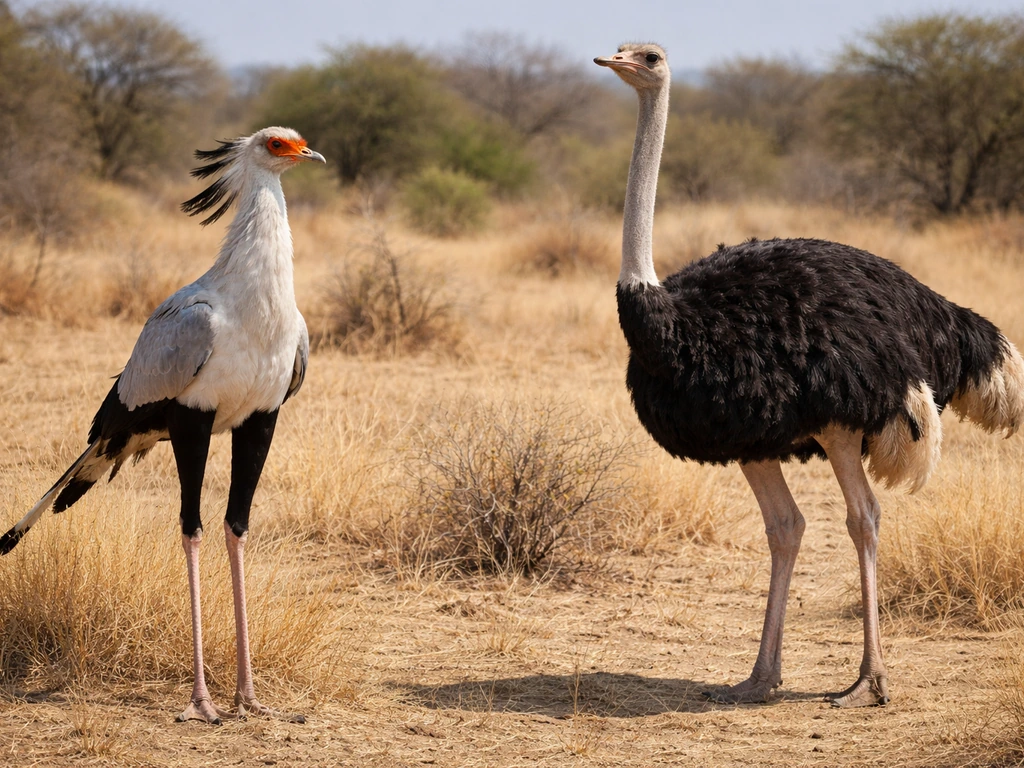
A secretary bird and an ostrich are not even close relatives, but from a distance, both are tall, long-legged African birds with striking heads, and that's enough to cause real confusion. Here's the fastest way to separate them: if the bird has a dramatic black crest of feathers fanning out from the back of its head, a bare reddish-orange face, and a compact eagle-like body on scaly crane legs, that's a secretary bird. If the bird is massive, thick-bodied, has a tiny head on a long bare neck, and a short wide bill, that's an ostrich. Once you know what to look for, you'll never mix them up again.
Secretary Bird vs Ostrich: How to Tell Them Apart Fast

Marcus Hendricks
1 Jun 2026
What each bird actually is (and why the confusion happens)
The secretary bird (Sagittarius serpentarius) is a bird of prey, technically an Accipitriform raptor and the only living member of the family Sagittariidae. Think of it as an eagle that decided to hunt exclusively on foot. It's classified in the same broad group as hawks and eagles, which makes its long legs and terrestrial lifestyle genuinely unusual in the raptor world. The ostrich (Struthio camelus), on the other hand, is a ratite, belonging to the family Struthionidae. Ratites are the group of large, flightless birds that includes emus, rheas, and kiwis. These two birds share essentially zero close taxonomic relationship, but they share enough surface-level visual cues (tall, long-legged, African, moving primarily on the ground) that people, especially beginners, lump them together.
The confusion gets compounded by two common assumptions. First, people see any tall long-legged bird in Africa and assume it's 'the same kind of thing.' Second, since ostriches are famously flightless and secretary birds mostly walk around hunting, some assume secretary birds can't fly either. They can, though they mostly don't bother unless they need to reach their treetop nests or perform courtship displays. If you've been operating with either of those assumptions, it's worth clearing them up before heading into the field.
Size, shape, and the silhouette that gives it away
The secretary bird stands about 1.2 meters tall (close to four feet) with a wingspan of roughly 2.1 meters. That's a large bird, but its body is relatively compact and slender for its height. The overwhelming impression is of a small eagle or large hawk mounted on absurdly long legs. The legs are the dominant visual feature, and the body looks almost too small for them.
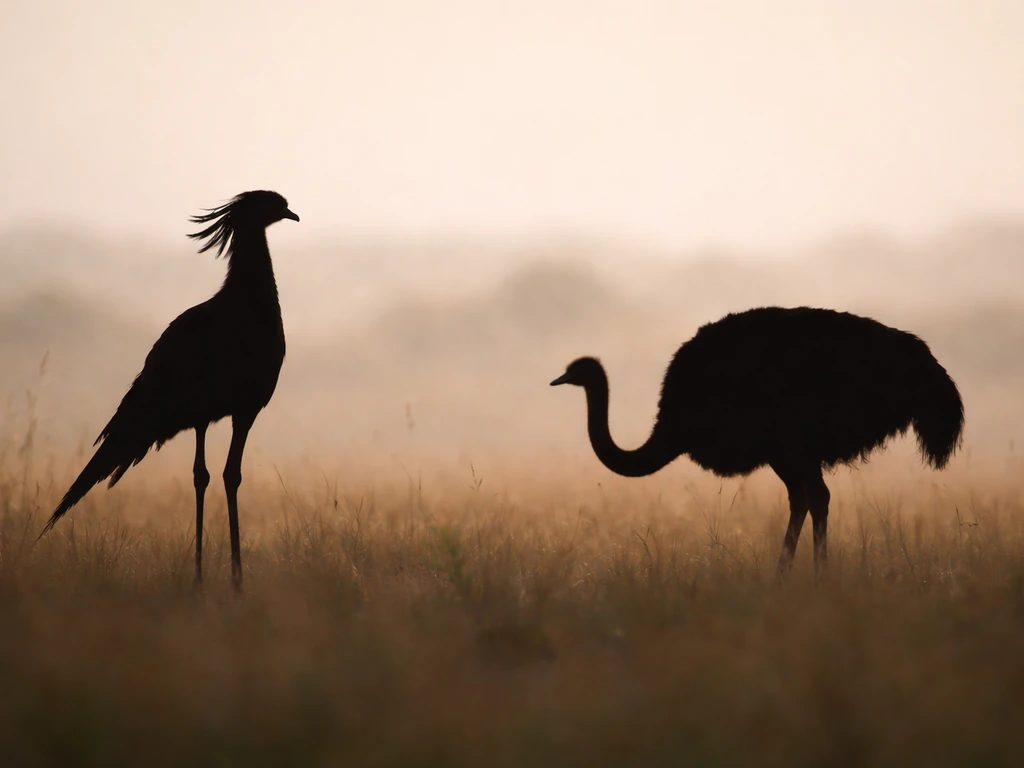
The ostrich is the largest bird alive. Its body is thick and barrel-shaped, its neck is long and bare, and the overall silhouette is dominated by that massive trunk. The head looks genuinely small compared to the body. When you see an ostrich and a secretary bird side by side, even in photos, the size difference is obvious: the ostrich's body mass dwarfs the secretary bird's in every direction, even if their standing heights might feel closer at a casual glance.
| Trait | Secretary Bird | Ostrich |
|---|---|---|
| Standing height | ~1.2 m (about 4 ft) | Up to 2.8 m (over 9 ft) |
| Wingspan | ~2.1 m | Wings present but non-functional for flight |
| Body build | Compact, slender, raptor-like | Massive, barrel-shaped, thick trunk |
| Head size relative to body | Normal raptor proportions | Small head on a long bare neck |
| Overall silhouette | Small eagle on crane legs | Large round body with long neck and legs |
Head, beak, neck, and feather details you'll spot in photos
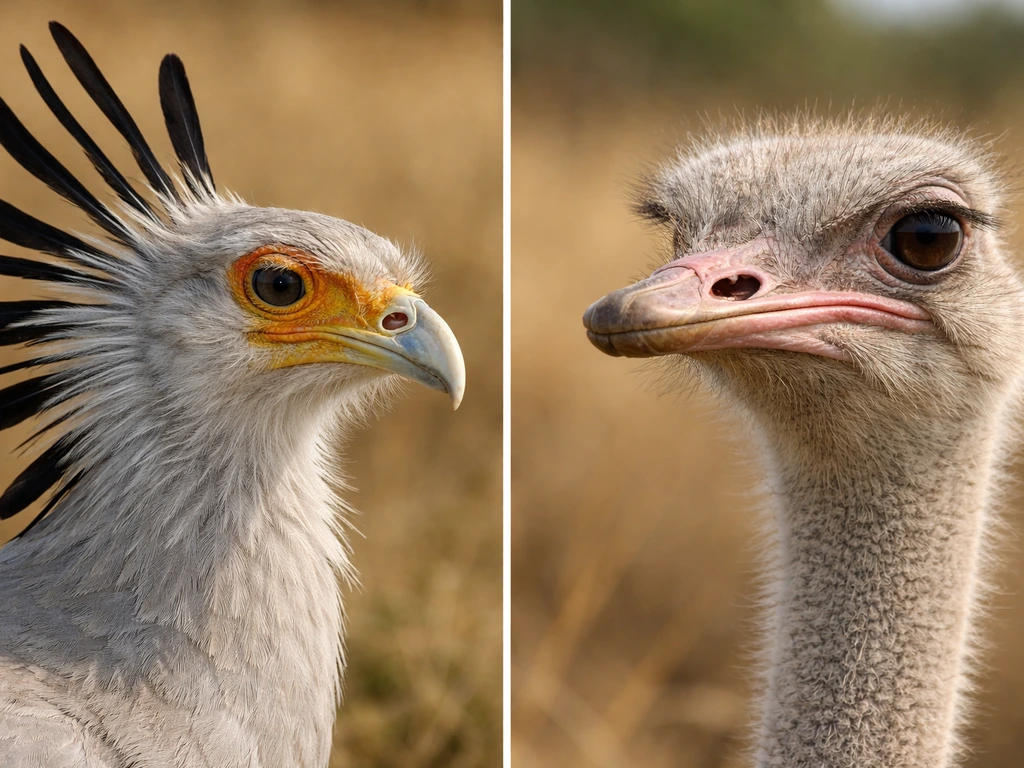
The secretary bird's head is the single most reliable identification feature you have. Adults carry a dramatic fan of long black crest feathers projecting from the back of the head, historically likened to quill pens tucked behind a secretary's ear (which is where the name likely comes from). The face itself is bare skin, colored a vivid reddish-orange in adults, with a hooked, curved bill that immediately reads as 'raptor.' The eye area shows yellowish to reddish-orange bare skin. Juvenile secretary birds have yellow rather than orange bare facial skin and generally browner, less defined plumage, so if you're looking at an immature bird, the crest will still be visible but the face color will be cooler-toned.
The ostrich head is almost the opposite. There's no crest at all. The bill is short and wide rather than hooked. The eyes are famously large and set off by thick black eyelash-like feathers that give the ostrich a slightly theatrical look in close-up photos. The neck is long and largely bare-skinned, and in adult males the skin on the neck and thighs tends to flush pink or red during the breeding season. The overall head-and-neck impression is 'small head on a long bare stalk,' nothing like the raptor-headed, crest-crowned look of the secretary bird.
Legs, feet, and how each bird moves
Secretary bird legs are long, bare in the lower half, and covered in thick scales that serve a real protective function: they help guard against snakebite. When you zoom in on a secretary bird's legs in a photo, the scaly texture is clearly visible and looks almost reptilian. The overall leg shape is slender and crane-like, built for walking long distances across open grassland.
Ostrich feet are structurally unusual even among birds. Ostriches are didactyl, meaning each foot has only two toes (most birds have three or four). The large inner toe has a hoof-like claw that acts as a powerful anchor during high-speed running. When an ostrich runs, it can reach remarkable speeds, and it does something visually distinctive: it holds its wings out to the sides, using them like a rudder for steering and braking rather than for lift. That wing-out-while-running image is pure ostrich and something you'd never see from a secretary bird.
Secretary birds walk steadily and deliberately across the ground, covering significant distances daily while hunting. Their gait is purposeful rather than fast, more of a patrol than a sprint. When they do move quickly, it's usually in short bursts to close in on prey.
How each bird hunts and what it eats
The secretary bird is an active predator. It hunts entirely on the ground, stalking through grassland and using its powerful feet to stomp on prey, including snakes, lizards, small rodents, amphibians, grasshoppers, and occasionally birds' eggs. The stomping behavior is its signature move: it will repeatedly strike prey with rapid downward stamps to stun or kill it before swallowing. It's also been observed stomping near shrubs to flush hidden prey into the open. This hunting style is completely unlike any grazer, and watching a secretary bird work a field is one of the clearest behavioral clues you can get.
Ostriches are primarily vegetarian grazers. They eat vegetation, seeds, roots, and whatever plant matter is available, though they'll supplement with insects and occasionally small reptiles when the opportunity arises. Their foraging style is browsing and grazing, moving steadily across open ground and picking at the vegetation with that short, wide bill. They can also go for extended periods without drinking water, pulling moisture from their food. Watching an ostrich feed looks nothing like watching a secretary bird hunt: one is methodically stalking and stomping, the other is leisurely grazing.
Flight: one can, one can't
This is probably the most commonly misunderstood aspect of the secretary bird vs ostrich comparison. If you are also looking for the secretary bird vs python difference, the key cues are still mostly about the bird’s head, legs, and hunting behavior rather than how a snake might look secretary bird vs ostrich comparison. This helps clear up the “secretary bird vs cassowary” confusion people sometimes run into when they rely on broad silhouette alone. Ostriches are completely flightless. Their breastbone lacks the keeled structure that anchors the powerful flight muscles in flying birds, which is the anatomical reason all ratites (ostriches, emus, rheas) can't get airborne. Their wings exist but function purely for display, balance, and that steering-rudder role during running.
Secretary birds can fly. They're not aerial hunters, and they spend the vast majority of their time on the ground, but they do use flight when they need to: primarily to reach their nests, which are built in flat-topped acacia trees, and during courtship displays. Their wingspan of about 2.1 meters gives them real aerial capability. It's just that hunting from the air isn't their strategy. This is an important distinction if you're doing any kind of behavioral observation or range-mapping, since a large long-legged bird you've spotted flying overhead in Africa is categorically not an ostrich.
Where each bird lives (and where ranges overlap)
Both birds are native to Africa, which is the geographic reason they get compared at all. Secretary birds occupy sub-Saharan savannas, grasslands, shrublands, and open woodland, with a preference for short open grasslands that have scattered acacia trees for roosting and nesting. They're birds of dry uplands and avoid dense forest cover entirely.
Ostriches range across Africa in open arid and semi-arid habitats, including savannas and the Sahel zone north and south of the equatorial forest belt. The common ostrich (Struthio camelus) is primarily a grazer on open savanna, while the Somali ostrich tends toward bushier, more vegetated terrain. In terms of habitat overlap, both species can theoretically share open savanna and grassland ecotones, so if you're on safari in open East or Southern African savanna, seeing both in the same general area is genuinely possible. The key is that secretary birds are tied to areas with at least some tree cover (for nesting) while ostriches are comfortable in more purely open, even desert-fringe conditions.
Common misconceptions and a photo-checklist
The two biggest misconceptions that drive this confusion are 'they're both flightless' (wrong: only the ostrich is) and 'they're the same kind of bird' (wrong: one is a raptor, one is a ratite). People also often compare a secretary bird with an eagle, but they differ in anatomy and hunting style. A third misconception worth addressing is that they look identical at a distance. They genuinely don't, once you train your eye. The secretary bird's black head crest and eagle-like head on scaly-legged crane stilts is a completely different visual signature from the ostrich's small bare head on a massive barrel body.
It's also worth noting that the secretary bird gets compared to other large African birds in its own right. This is where people sometimes run into similar look-alikes, including seriema species, and the details you check can help you tell them apart secretary bird gets compared to other large African birds. It shares certain visual traits with the kori bustard and with seriemas (a South American relative), and it draws comparisons to eagles for obvious raptor-family reasons. The kori bustard can also look confusingly “ground-plodding” from a distance, but its body plan and head features are quite different from the secretary bird. But those comparisons belong in their own discussions. Against an ostrich specifically, the secretary bird is much smaller, far more 'raptor-headed,' actively predatory, and capable of sustained flight.
Quick photo-checklist: secretary bird vs ostrich
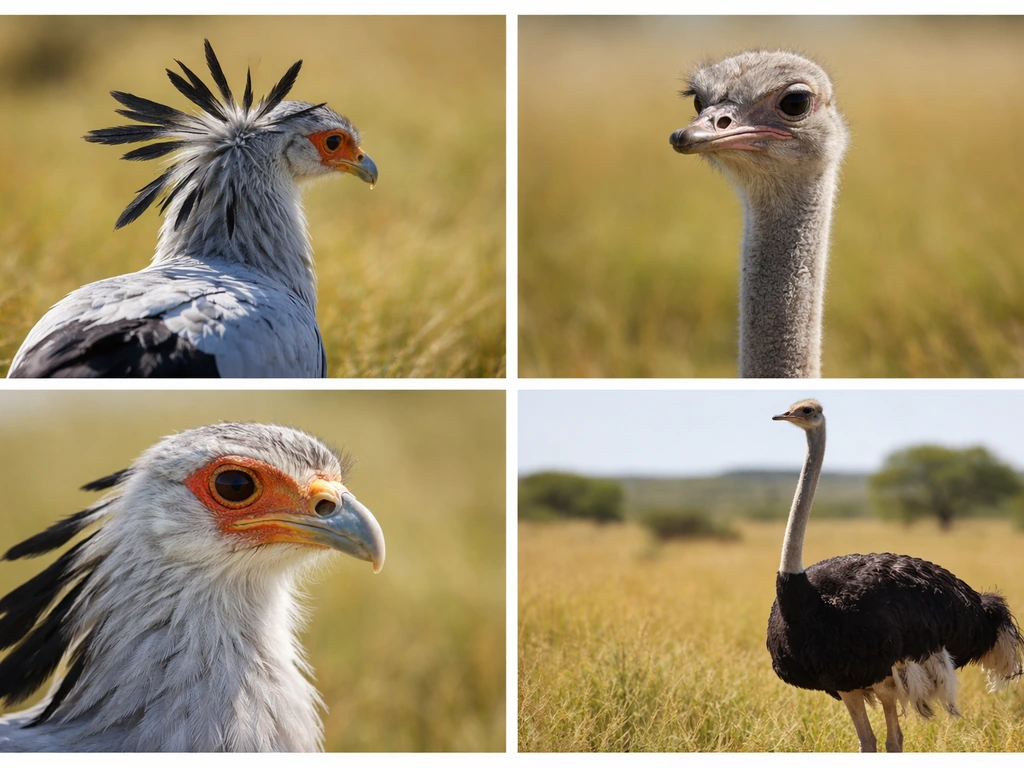
- Black crest feathers fanning off the back of the head: secretary bird. No crest at all: ostrich.
- Bare reddish-orange face with a curved, hooked bill: secretary bird. Short wide bill with thick black lash-like eye feathers: ostrich.
- Compact, slender raptor body on long scaly legs: secretary bird. Massive barrel body with a long bare neck and tiny head: ostrich.
- Bird is actively stomping the ground or striking at prey: secretary bird. Bird is grazing on vegetation with a relaxed browsing gait: ostrich.
- Bird running with wings held out like a rudder: ostrich. Bird taking flight to reach a treetop: secretary bird.
- Two toes visible on each foot (hoof-like inner claw): ostrich. Slender scaly legs with typical raptor foot structure: secretary bird.
- If you see the bird in flight at all, it's a secretary bird. Ostriches never leave the ground.
If you're working from a single distant photo or a brief sighting, go straight to three things: head crest, body shape, and bill. The crest is your fastest confirmation for the secretary bird, and the massive thick trunk with a small bare head is your fastest confirmation for the ostrich. If you've got behavioral context, add the hunting-vs-grazing distinction and you'll have a confident ID every time. Bird siren vs harpy is a similarly confusing comparison, but the key traits and behavior cues differ secretary bird vs ostrich.
FAQ
If I see a secretary bird flying overhead, how can I tell it apart from an ostrich?
Yes. Secretary birds can fly, but their flight is usually short and functional (to reach nesting trees or during displays), not sustained soaring while hunting. If you see a long-legged bird that is actively hunting on the ground with repeated stomps, treat it as a secretary bird even if it briefly takes off.
What’s the quickest field clue if both birds are moving fast?
Look for wing usage while running. Ostriches typically hold their wings out to the sides as they sprint, acting like a rudder for steering and braking. Secretary birds do not use an outstretched wing-running “rudder” posture.
How do I identify a juvenile secretary bird vs an ostrich if colors look muted in photos?
In juveniles, the secretary bird’s crest should still be present, but the facial skin color tends to be more yellow or less vivid than in adults, and the overall plumage looks browner. Ostriches also have a different baseline silhouette (thick trunk, short wide bill, no crest), so juvenile color alone should not be your only ID cue.
Can breeding-season coloration make an ostrich look like a secretary bird?
A clear “no crest, short wide bill, huge barrel body” pattern points to an ostrich, even if the neck color changes. For example, during breeding season, an ostrich’s neck and thigh skin can flush pink or red, but it will still lack the secretary bird’s black crest feathers and hooked, raptor-like bill.
If I only know the habitat, can I estimate whether I’m more likely seeing a secretary bird or an ostrich?
Secretary birds are strongly tied to habitats that include some tree cover for roosting and nesting, often near acacia. Ostriches can use more open, arid, and even desert-fringe conditions. If you are in a landscape with little to no tree cover, ostrich becomes more likely, but still confirm with head and body shape.
Are there posture or gait cues besides head crest and bill that help at a distance?
Yes, posture can help. Secretary birds look like a small eagle on very long, scaly stilts, and they move with a deliberate, stalking or patrolling gait. Ostriches have a heavy trunk-dominated stance with a small head carried on a long bare neck, and their movement while feeding looks like grazing.
What behavior should I watch for if the birds are too far away to see fine details?
Use behavior, not just appearance. Secretary birds hunt on the ground and use repeated downward stomps to stun or kill prey, often near grass or shrubs to flush hidden animals. Ostriches mostly browse and graze with picking and chewing movements, and they do not perform the stomp-hunting pattern.
What’s the best way to handle a blurry or distant photo where the head isn’t clear?
If you only have a blurry silhouette, prioritize body mass distribution. Ostriches look “barrel-thick” in the torso with a tiny head, while secretary birds look more compact-bodied with the dominant feature being the head crest and the long scaly legs.
What are the most common mistakes people make when comparing secretary birds vs ostriches?
Misidentifications often come from the “flightless” idea and from focusing on long legs alone. A practical checklist is: (1) crest feathers at the back of the head (secretary bird), (2) thick trunk and small head with no crest (ostrich), and (3) stomping hunting vs grazing feeding.
If I see both birds in the same area, what’s a good step-by-step way to confirm my ID quickly?
If you’re tracking a specific individual across moments, watch for wing-out while running and grazing posture to confirm ostrich, versus head-crest plus hunting stomps to confirm secretary bird. Also, secretary birds’ scaly, protective lower legs are visually distinctive up close, which helps when you get a second glance.
Next Articles
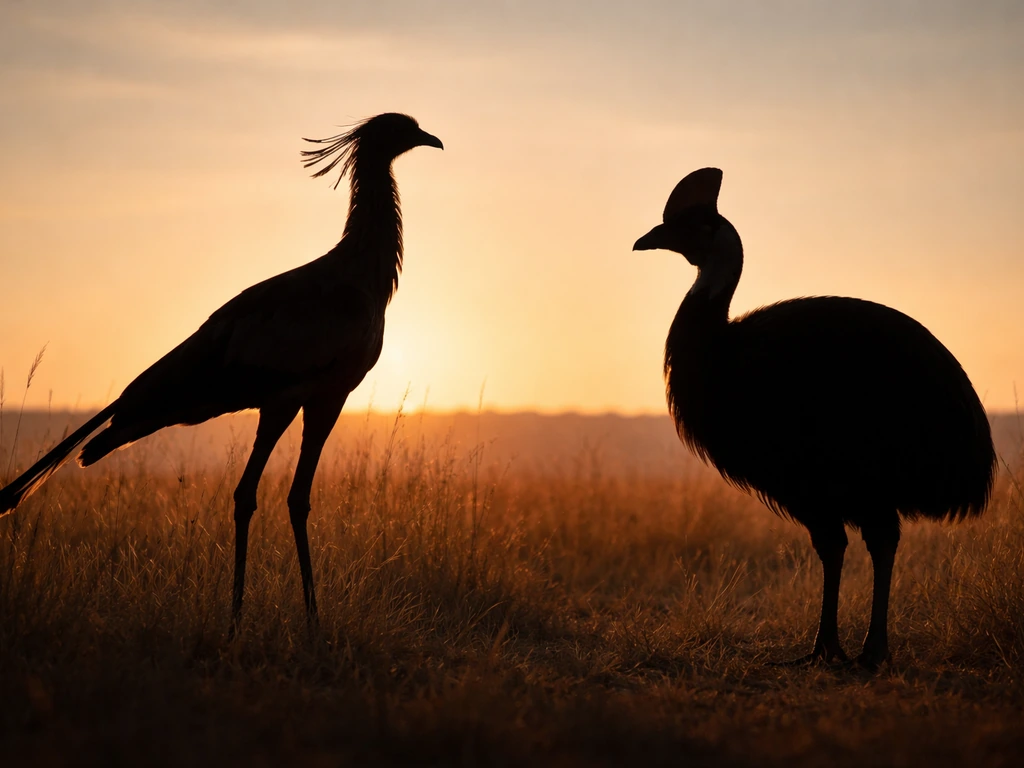
Secretary Bird vs Cassowary: Key Differences and ID Guide
Compare secretary bird vs cassowary with a quick ID guide covering looks, feet, beaks, habitat, diet, behavior, and safe
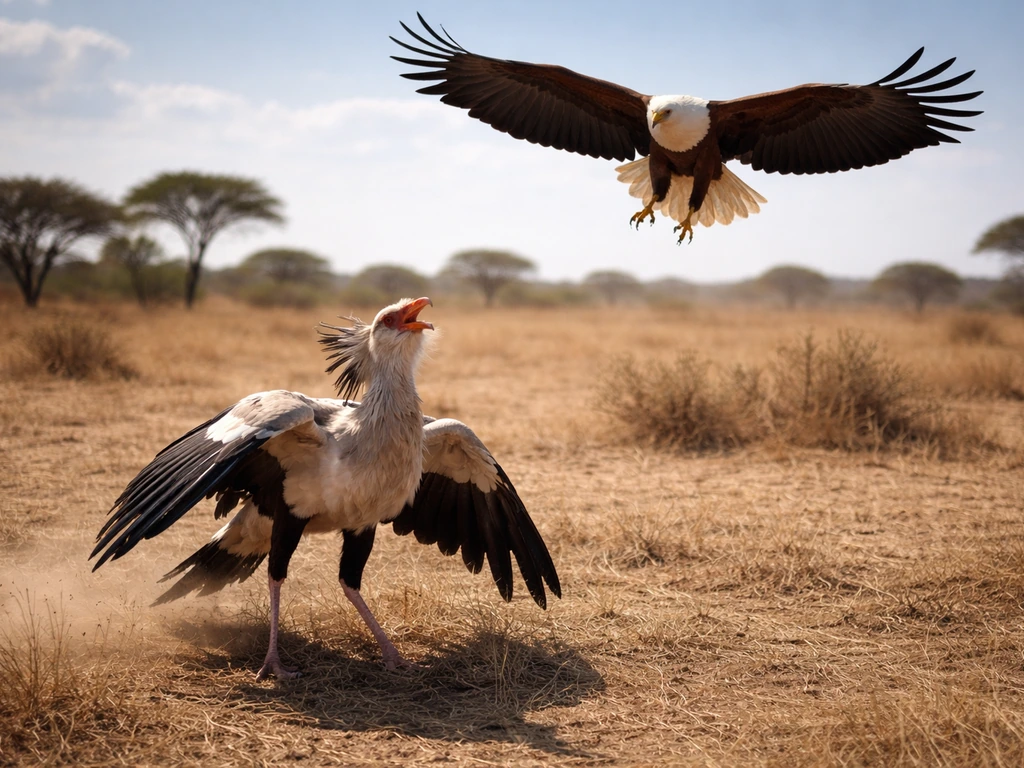
Secretary Bird vs Eagle: Who Would Win a Fight?
Ground-savanna fighter or aerial predator? Compare secretary bird vs eagle by size, speed, hunting weapons, and key vari
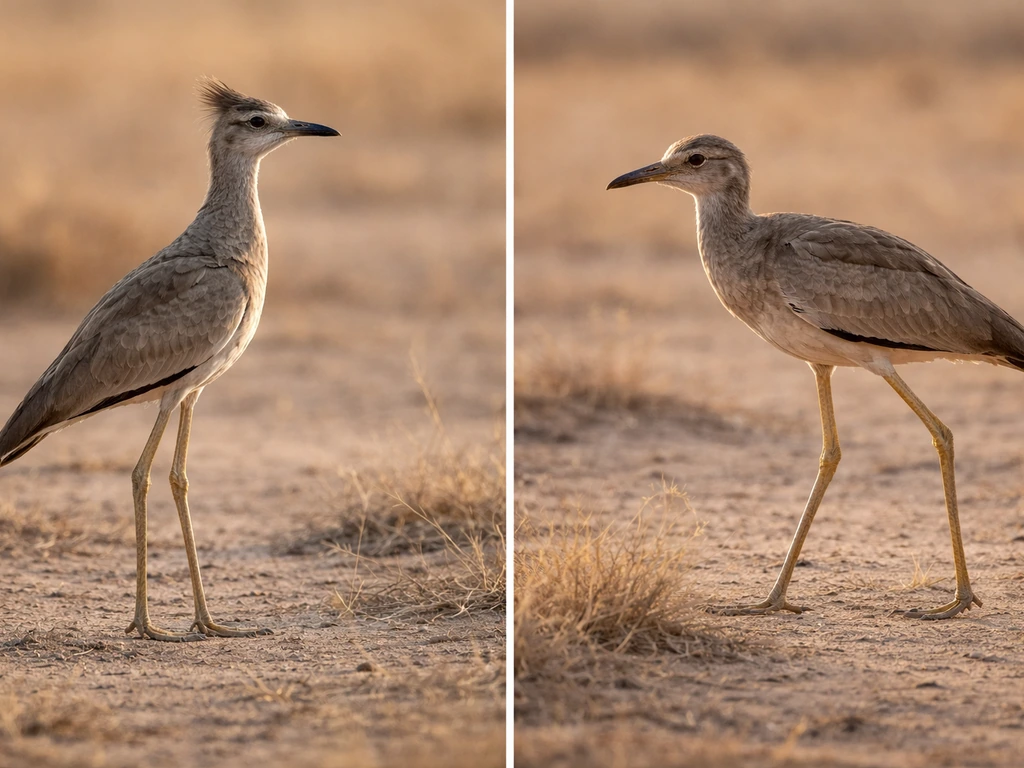
Seriema vs Secretary Bird: How to Tell Them Apart
Learn fast, reliable cues to tell seriema from secretary bird by size, bill, legs, hunting, habitat, flight, and calls.