The moa and the emu are both large, flightless, long-necked birds, but they are not closely related, did not share a continent, and one of them has been extinct for roughly 600 years. Moa were a diverse group of New Zealand ratites (order Dinornithiformes) that ranged from turkey-sized to the tallest birds ever recorded, had no wings whatsoever (not even tiny vestigial ones), and vanished after Polynesian settlers arrived in the 13th century. The emu (Dromaius novaehollandiae) is a living Australian ratite in the order Casuariiformes, stands up to about 1.9 metres tall, runs at speeds exceeding 48 km/h on three-toed feet, and is genetically closer to cassowaries than to any moa species. The single most distinctive separation between the two: moa had literally zero wing bones, while the emu retains small but real vestigial wings, and molecularly, the two lineages sit on entirely different branches of the palaeognath family tree.
Moa Bird vs Emu: Key Differences in Size, Anatomy & Habitat

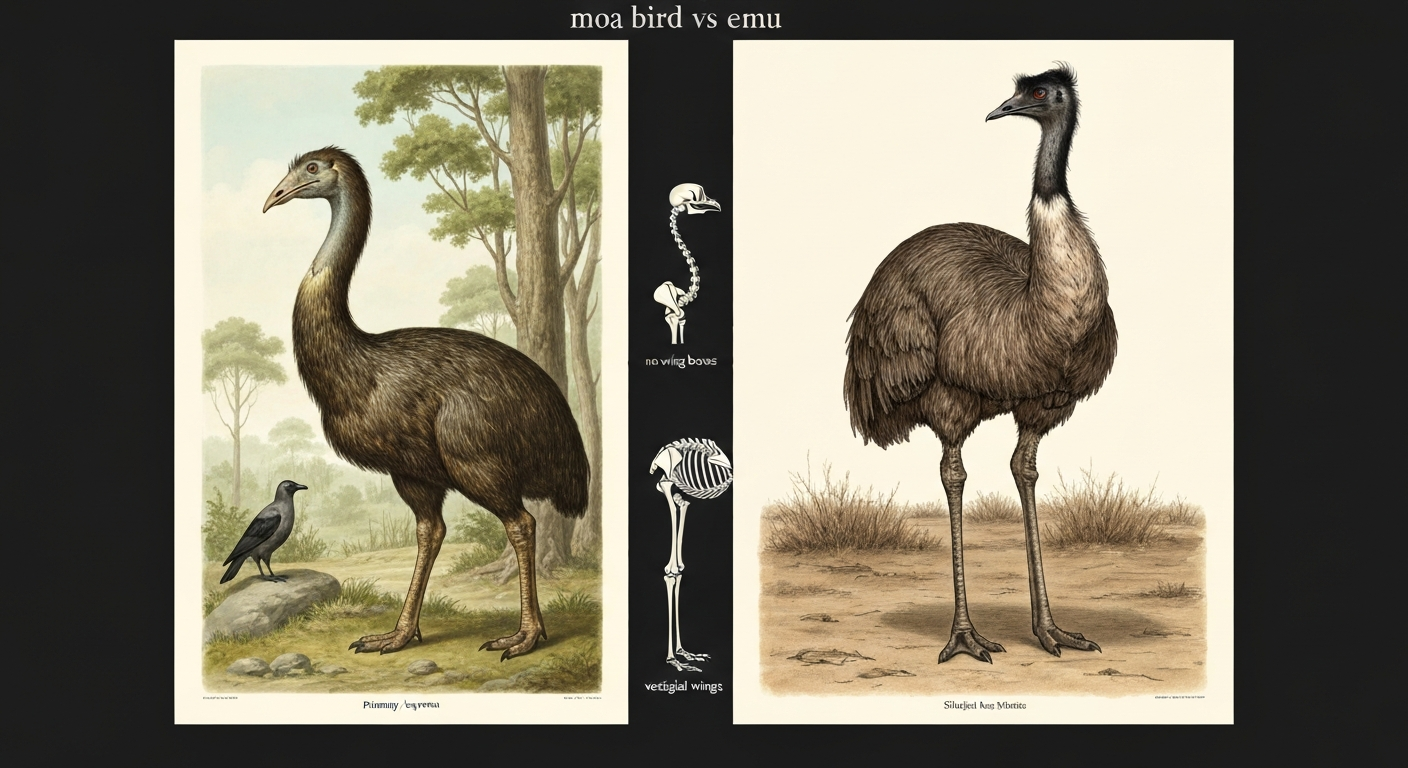
Quick comparison at a glance
- Wings: moa had no wings at all — no forelimb bones survive in any specimen; emu has small vestigial wings with reduced forelimb bones
- Status: all moa species are extinct (last populations gone by approximately 1440 CE); emu is a thriving living species
- Location: moa lived only in New Zealand; emu is native to mainland Australia
- Order: moa belong to Dinornithiformes; emu belongs to Casuariiformes
- Closest living relative: moa's closest genomic relatives are tinamous (South American flying birds); emu's closest relative is the cassowary
- Size range: moa ranged from roughly 20 kg up to an estimated 230–250 kg; emu tops out around 60 kg
- Toes: most moa genera had three main weight-bearing toes (some with a variable digit I); emu has three forward-pointing toes
- Neck vertebrae: moa had 17–19 cervical vertebrae depending on genus; emu has around 17
- Diet: moa were browsers and grazers inferred from coprolites and beak morphology; emu are omnivores eating plants, insects, and seeds
- Eggs: moa eggs were enormous and thin-shelled in large species; emu eggs are dark green, roughly 13 cm long, and thick-shelled
One-line ID tip for museum mounts and reconstructions: if you are looking at a skeleton with no trace of forelimb bones at all, you are almost certainly looking at a moa. If the mount has even small flipper-like wing stubs, it is not a moa.
Taxonomy and where these birds fit among ratites
Both moa and emu are palaeognaths, the ancient lineage of birds that includes ostriches, rheas, kiwi, cassowaries, tinamous, and the extinct elephant birds. Within that broad group, however, they occupy very different addresses. Moa are placed in their own order, Dinornithiformes, and the Birds New Zealand 2022 checklist recognises six genera from Holocene deposits: Dinornis, Megalapteryx, Pachyornis, Emeus, Euryapteryx, and Anomalopteryx. Those genera contain multiple species, though the total count was dramatically reduced once molecular work (Huynen et al., 2003) revealed that many separately named 'species' were actually just the female and male of the same biological species, female moa were often strikingly larger than males, a case of extreme sexual size dimorphism.
The emu sits in a completely different order, Casuariiformes, alongside the three living cassowary species. Taxonomically it is Dromaius novaehollandiae (Latham, 1790) and is the sole surviving species in its genus, two island forms, the King Island emu and the Kangaroo Island emu, were driven to extinction by European settlers in the early 19th century. Major checklists (IOC, ITIS, Clements, Birds of the World) treat the mainland emu as a single species, with subspecific recognition of woodwardi and rothschildi handled inconsistently across authorities.
The popular notion that all ratites form a natural, unified group (a clade) descended from one flightless ancestor has been overturned by genomic work. Harshman et al. (2008, PNAS) and Baker et al. (2014) demonstrated that 'ratites' as traditionally defined are paraphyletic, tinamous, which can fly, keep turning up nested inside the ratite radiation in molecular trees. Some analyses even recover a moa-tinamou association. Mitchell et al. (2014, Science) showed that elephant birds are sister to kiwi, not to other large African or Australian ratites. The upshot is that flightlessness evolved independently multiple times across palaeognaths, meaning moa and emu lost their flight separately and are not each other's closest relatives by any reasonable modern measure.
Fossil evidence, phylogeny, and the wider world of giant flightless birds
The moa fossil record is remarkably rich by the standards of Quaternary birds. Bones, mummified remains, preserved feathers, eggshell fragments, and even intact eggs have been recovered from New Zealand caves, swamps, and archaeological sites. The record extends back millions of years and documents a long evolutionary history on a geographically isolated archipelago. Bunce et al. (2009, PNAS) used ancient DNA from multiple moa species to reconstruct a complex radiation and found Megalapteryx (the upland moa, the last surviving moa species) in a phylogenetically basal position relative to many other genera, which prompted some rethinking of family-level groupings within Dinornithiformes.
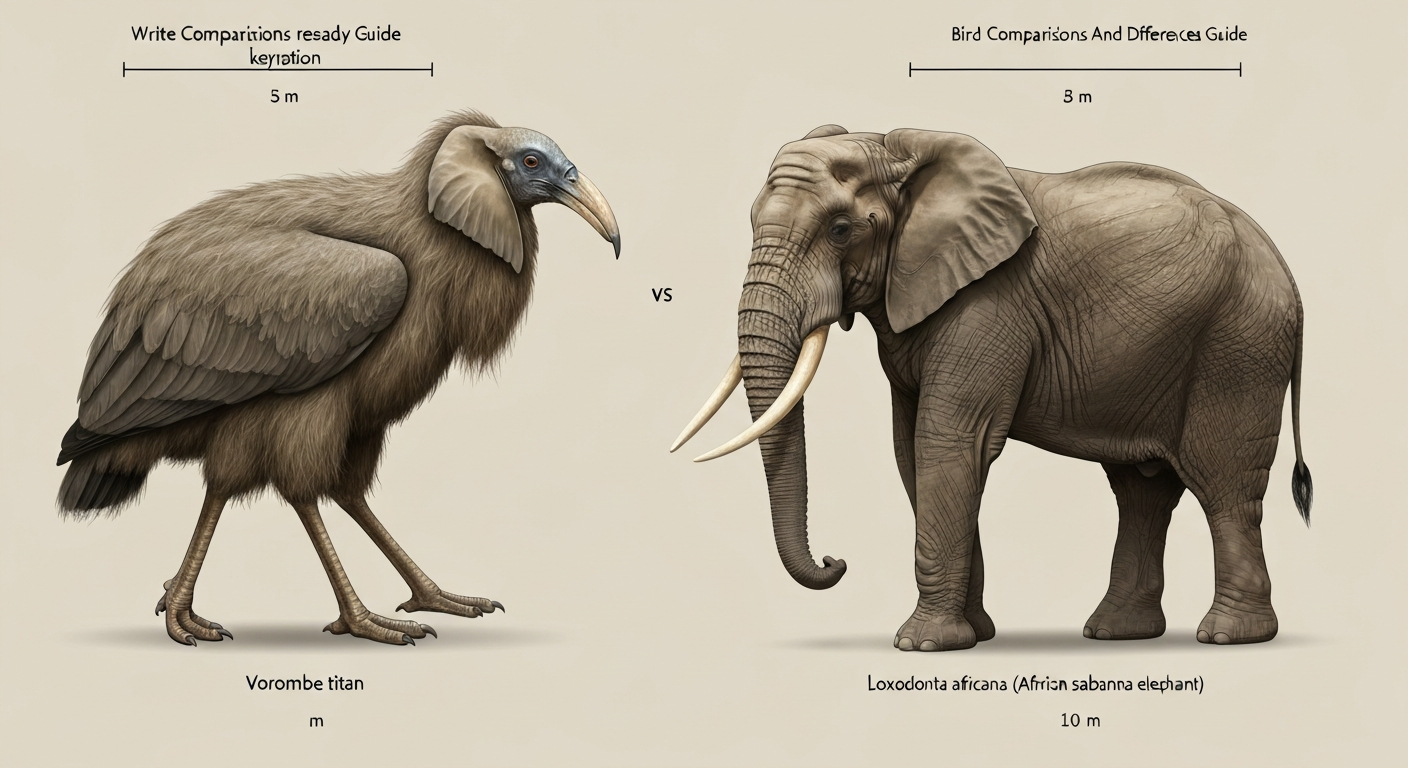
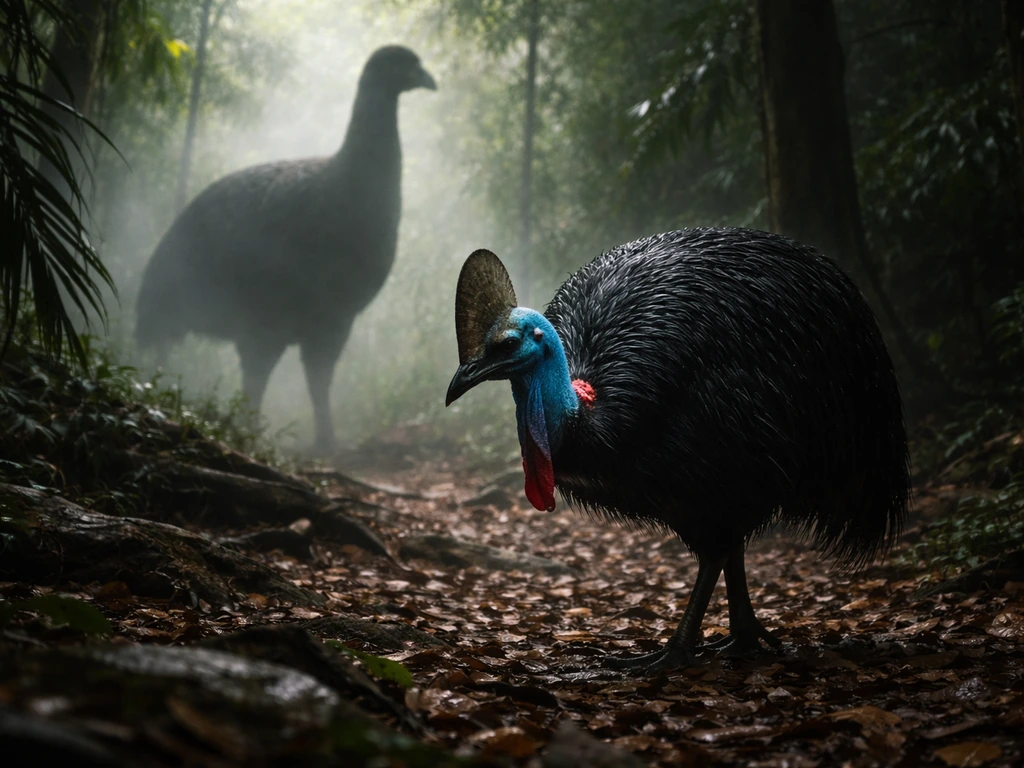
Comparing moa to the other extinct giants is worth doing here, because the confusion between these birds turns up in museums and popular media constantly. For a direct size-and-impact comparison between giant extinct birds and humans, see the elephant bird vs human overview for useful context. For direct comparisons with other giant extinct birds, see the elephant bird vs elephant page for further context. Madagascar's elephant birds (Aepyornithiformes), including the heavyweight champion Vorombe titan (estimated at 650–800 kg), were the heaviest birds that ever lived and were genetically sister to kiwi, not to moa or emu. The terror bird Kelenken (Phorusrhacidae) from South America was a predatory, carnivorous bird with a massive hooked beak and was not a ratite at all. See a direct comparison in kelenken vs elephant bird. Cassowaries, the emu's closest living relatives, are sometimes confused with smaller moa species because of their size and aggressive reputation, but cassowaries have a prominent casque (bony helmet) on the head, three toes with a prominent dagger-like inner claw, and bright facial wattles, none of which moa had. For an unrelated comparison of a large invertebrate and birds, see goliath birdeater vs bird. The ostrich (Struthio camelus) is Africa's giant ratite, has only two toes, and is the tallest living bird, but even the largest ostrich falls well short of the giant moa Dinornis robustus in estimated height.
Allentoft et al. (2014, PNAS) delivered one of the most important findings about moa ecology: population genomic analyses of multiple species showed large, genetically stable populations right up to the point of human arrival in New Zealand. There was no long-term pre-human decline. Moa were not going extinct on their own schedule. They were thriving when Polynesian settlers arrived, and fossil and archaeological evidence points to rapid, hunting-driven extinction between roughly 1280 CE and 1440 CE, one of the clearest documented cases of human-caused megafaunal extinction in the Pacific.
Anatomy and skeletal differences up close
The wing question (the biggest anatomical distinction)
No moa species preserved any forelimb bones. The pectoral girdle in moa is massively reduced, there is no furcula (wishbone), the coracoids are vestigial or fused to the sternum in unusual configurations, and no humerus, radius, ulna, or wing-digit bones have ever been found. This is unique among birds. Every other living ratite, including the emu, retains at least some forelimb skeleton. The emu has small but real vestigial wings, roughly 20 cm long, with a reduced set of forelimb bones including a small humerus and a single functional claw at the wrist tip. Functionally they do nothing aerodynamic, but structurally they are present, which is why the complete absence of wing bones is the single most diagnostic skeletal character separating moa from every other bird, including emu.
Skull, beak, and cranial anatomy
Moa skull and beak diversity across genera is striking and was used by Worthy and Scofield (2012) as a core taxonomic tool. Pachyornis and Euryapteryx had broad, rounded bills suited to cropping vegetation close to the ground. Emeus and Anomalopteryx had narrower, more elongated bills. Dinornis, the giant moa, had a relatively narrow skull with an upward-curved beak profile. The moa cranium is dorsoventrally shallow (relatively flat from top to bottom) compared to the rounder, deeper skull profile of the emu. Emu beaks are broad, somewhat flattened, and well suited to picking up a wide range of plant matter and invertebrates.
Neck and vertebrae
Moa necks were long and mobile, supported by 17 to 19 cervical vertebrae depending on genus, this elongated neck let the larger species browse high in the forest canopy, essentially filling an ecological niche more like a giraffe than a ground-foraging bird. The emu has around 17 cervical vertebrae and a long neck too, but tends to use it for low-to-ground foraging, sweeping the head side to side while walking. Moa neck posture in life is still debated, some reconstructions show a more upright, nearly vertical neck in Dinornis, while others suggest a more horizontal posture during foraging.
Legs and feet
Moa leg bones vary enormously by genus, and those differences are directly useful for identifying isolated bones in collections. Worthy and Scofield (2012) document that Pachyornis had short, very robust femora and tibiotarsi, heavy, stout limbs suited to carrying a barrel-shaped, heavily muscled body through dense forest. Dinornis had comparatively elongate, gracile limb proportions for its great height. Ichnological evidence (fossil tracks) for most moa genera shows three main weight-bearing toes, though digit I (the inner toe) varies in its development across specimens and genera. High‑resolution coproecology: using coprolites to reconstruct the habits and habitats of New Zealand’s extinct upland moa (Megalapteryx didinus), Jackson et al. (PLoS ONE) includes discussion of moa foot morphology and track variability that complements the ichnological evidence mentioned here High‑resolution coproecology: using coprolites to reconstruct the habits and habitats of New Zealand’s extinct upland moa (Megalapteryx didinus) — Jackson et al. (PLoS ONE / PMC article includes foot/track discussion and museum specimen notes). Emu limbs are built for speed: a detailed dissection study (Lamas, Main, and Hutchinson, PeerJ 2014) documents a long tibia-to-femur ratio, substantial pelvic-limb musculature, and specialised tendon architecture including a large patellar mechanism that act together to enable fast running. Emu feet are tridactyl with three forward-pointing toes, one of which is well-armed for kicking, and this three-toed configuration is a handy field distinction from the two-toed ostrich.
Feathers and integument
Emu feathers are double-shafted, giving the bird its characteristic shaggy, hair-like appearance. Each feather grows from a single follicle but splits into two roughly equal-length shafts, providing insulation across Australia's variable climates. For moa, integumentary evidence is limited but genuinely remarkable where it exists. Preserved mummified legs and foot skin patches have been recovered from cave sites, and Megalapteryx specimens have yielded feather fragments showing that moa had fully developed, pennaceous (proper vaned) feathers extending down the leg to the foot. Feather-pit impressions on moa tibiotarsi confirm feathering in multiple genera. So while the emu's feathers are well-documented from living birds, moa feathering is inferred from exceptional cave preservation rather than daily field observation.
Eggs
Moa eggshell and complete eggs in museum collections reveal considerable variation in size across the group. Eggs attributed to large Dinornis individuals can exceed ostrich eggs in length, though the shells were comparatively thin-walled. Eggshell microstructure and pore morphology differ between moa genera enough that palaeogenomics has been applied successfully to species-level identification from archaeological eggshell fragments. Emu eggs are easier to characterize: they are roughly 13 cm long, dark green to nearly black, with a heavily pitted, granular surface and a thick, hard shell. Emu eggs weigh around 450–650 g and are incubated entirely by the male, an unusual reproductive strategy compared to the inferred moa system, where isotopic and nest-site evidence suggests incubation duties may have fallen to the smaller male moa as well.
Size and weight: how the numbers stack up
Size is where the popular imagination most often goes wrong about moa. Not all moa were enormous, some species were genuinely modest in build, and even the giants are often exaggerated in popular media. The table below sets major moa species alongside the emu for a direct comparison.
| Bird / Species | Estimated Height | Estimated Mass | Status |
|---|---|---|---|
| Dinornis robustus (South Island giant moa, female) | Up to ~3.6 m (neck extended) | ~230–250 kg | Extinct (~1440 CE) |
| Dinornis novaezealandiae (North Island giant moa, female) | Up to ~3.0 m | ~150–180 kg | Extinct (~1440 CE) |
| Pachyornis elephantopus (heavy-footed moa) | ~1.0–1.2 m at back | ~160 kg | Extinct |
| Euryapteryx curtus (stout-legged moa) | ~0.9–1.1 m | ~75–85 kg | Extinct |
| Megalapteryx didinus (upland moa) | ~0.9–1.0 m | ~17–25 kg | Extinct (last surviving moa species) |
| Anomalopteryx didiformis (little bush moa) | ~0.5–0.7 m | ~20–30 kg | Extinct |
| Dromaius novaehollandiae (emu) | ~1.5–1.9 m | ~30–60 kg | Extant (Least Concern) |
A few things jump out of that table. First, the largest female Dinornis robustus was genuinely in a different size class from any living bird except the emu and ostrich, and it dwarfed both. Second, several moa species were actually smaller than or comparable to a large emu in mass, Megalapteryx and Anomalopteryx were both lighter than a typical adult emu. Third, Pachyornis elephantopus, despite being shorter than a big emu, was dramatically heavier because of its extreme robustness, earning its common name 'heavy-footed moa' honestly. Height estimates for moa are also often given with the neck stretched vertically, which can be misleading, shoulder-height comparisons are a more reliable indicator of body size.
Behavior, diet, reproduction, and how they moved
What moa behaviour looks like from the fossil record
We cannot watch a moa walk, but we can reconstruct a surprising amount of behaviour from bones, coprolites (fossil dung), pollen records, stable isotopes, and trackways. Coprolite analysis (notably Jackson et al., published in PLoS ONE) from Megalapteryx sites in the upland South Island shows the upland moa ate twigs, leaves, bark, and a wide range of plant types, suggesting browsing behaviour adapted to montane scrub and forest. Beak morphology corroborates this: broader-billed genera like Pachyornis and Euryapteryx probably grazed low shrubs and herbs, while the tall, narrow-billed Dinornis could reach higher canopy. The robust, short-limbed Pachyornis almost certainly moved slowly through dense bush rather than open sprinting. Megalapteryx, smaller and lighter with more gracile limbs, likely navigated steep, rocky upland terrain. Fossil trackways confirm a confident, deliberate striding gait rather than a running-biased locomotion in moa.
Emu ecology and movement in the field
Emu behaviour is well-documented and genuinely interesting. They are nomadic across much of inland Australia, following rainfall and food availability over distances of hundreds of kilometres. Their diet is broadly omnivorous: seeds, fruits, flowers, insects, and small vertebrates all feature depending on season. Emu running mechanics are a showcase of ratite evolution, the long tibia relative to the femur, powerful gastrocnemius musculature, and specialised patellar tendon (documented in the Lamas, Main, and Hutchinson 2014 dissection study) allow sustained speeds of around 48 km/h and quick-turn agility. Emus also swim competently when needed. In terms of gait, emu use a bouncy, energy-storing striding run with a characteristic forward lean and a pendulum-like neck motion, quite different from the more upright, deliberate carriage reconstructed for the larger moa.
Reproduction: who incubates?
Emu reproduction is male-dominated in an unusual way: the female lays the eggs (typically 5 to 15 per clutch) and then largely departs, leaving the male to incubate for roughly 56 days without eating or drinking significantly. The male continues brooding and protecting the chicks for up to 18 months. Isotopic and nest-site evidence from moa suggests a similar male-incubation pattern may have applied, at least in some species, which aligns with the pattern seen across several ratite lineages. Moa chick bones identified at archaeological sites suggest relatively slow growth trajectories for the largest species, potentially taking a decade or more to reach full adult size in Dinornis.
Geographic range, habitat, and moa extinction
Emu occupy most of mainland Australia, from coastal shrublands to arid interior grasslands, avoiding dense tropical rainforest and the driest deserts. They are abundant enough to have been the target of the famous (and embarrassing) 1932 Australian 'Emu War', a military attempt to cull a migrating emu population in Western Australia that ended in effective defeat for the armed forces involved.
Moa occupied the full length of New Zealand's two main islands, with species distributed across habitats from coastal lowland forest to subalpine scrub. Different genera were specialists: Megalapteryx is consistently found in upland South Island sites above the treeline, while Dinornis bones are distributed more broadly across forest and forest-edge environments. Prior to human arrival, moa had no mammalian predators except Haast's eagle (Hieraaetus moorei), a massive raptor that itself went extinct once moa disappeared.
The extinction timeline for moa is now fairly well constrained. Polynesian settlers (ancestors of the Maori) arrived in New Zealand around 1280 CE. Archaeological sites show intensive moa hunting: butchered bones, cooking residues, and moa feathers in cultural deposits are well documented. Allentoft et al. (2014) showed the moa gene pools were large and healthy right up to that arrival point. By approximately 1440 CE, all moa species were gone, a total extinction event compressed into roughly 160 years, driven overwhelmingly by direct hunting and habitat clearance, not climate change or disease.
Common misidentifications and practical ID tips
In museum settings, the most common confusion I see involves mixing up moa and emu skeleton mounts, and occasionally conflating moa with cassowary or ostrich. Here are the most useful separation points when you are standing in front of a mount or a reconstruction. For a quick comparative visual guide to identifying very large birds in museums and media, see the behemoth vs bird watcher guide.
- Check for forelimb bones first. No wings at all, not even stubs? That is a moa. Any vestigial wing structure present? Could be emu, cassowary, ostrich, kiwi, or rhea — but definitely not a moa.
- Look at the skull shape. A very flat, shallow cranium with a curved or broad bill in a large, robust skeleton is likely Pachyornis or Euryapteryx. A tall, narrow skull on an extremely large skeleton points toward Dinornis.
- Count the toes on mounted feet. Emu and most moa have three main forward-pointing toes. Ostrich has two. Cassowary has three but with an unmistakable long, straight inner claw.
- Look for a casque. A bony head crest means cassowary, not moa and not emu.
- Check relative leg proportions. A skeleton with unusually short, very stocky limb bones relative to body depth is much more likely Pachyornis moa than emu. Long tibia-to-femur ratio with lighter build points toward emu.
- Egg colour and texture in exhibit cases: dark green, thick-shelled, heavily pitted eggs are emu. White to pale green, thinner-shelled, very large eggs (sometimes larger than a football) are moa.
- Geographic context always helps. New Zealand fossils and Maori cultural sites: moa. Living Australian specimens or Australian archaeological contexts: emu.
Conservation lessons and what moa tell us today
The moa extinction story carries a direct conservation message that is as relevant in 2026 as it was when the genomic evidence first crystallised. These were not animals on their way out. Allentoft et al.'s population genomic finding, that moa had large, stable gene pools with no signal of pre-human decline, demolished the idea that moa were ecologically fragile relics destined to disappear. They were robust, successful birds eliminated in a geological instant by human hunting. That pattern echoes in modern threats to ratites: emu populations are stable, but cassowary (the emu's closest relative) populations in Queensland are threatened by habitat loss, road strikes, and disease, and the same rapid-impact dynamic applies.
For readers who want to go deeper, the best physical collections are at Te Papa Tongarewa in Wellington (New Zealand's national museum, which holds the world's most comprehensive moa skeletal material and mummified specimens), the Canterbury Museum in Christchurch, the Natural History Museum in London, and the American Museum of Natural History in New York. For emu anatomy, the Museum Victoria collections in Melbourne and the Australian Museum in Sydney both hold excellent comparative material. Worthy and Scofield's 2012 paper in the New Zealand Journal of Zoology remains the essential starting reference for moa taxonomy and skeletal morphology, and Allentoft et al. (2014, PNAS) is the key paper on moa population history and extinction.
FAQ
What is the short answer to “moa bird vs emu” — what most distinctly separates them?
Moa (order Dinornithiformes) were an extinct, diverse group of flightless New Zealand palaeognaths with varied body plans (from small to very large, often with robust legs and species‑specific beak shapes), whereas the emu (Dromaius novaehollandiae) is a single living Australian species in Casuariiformes with long limbs adapted for running, shaggy double‑shafted feathers, and a consistent body form. Key distinguishing features are: moa are an extinct New Zealand radiation known from bones/ancient DNA with highly variable skeletons and egg sizes (Worthy & Scofield 2012; Bunce et al. 2009); emu is extant, long‑legged, and anatomically adapted for cursorial locomotion (Lamas, Main & Hutchinson 2014).
How do moa and emu differ taxonomically and phylogenetically?
Taxonomy: moa are placed in the extinct order Dinornithiformes (multiple genera such as Dinornis, Pachyornis, Megalapteryx, Anomalopteryx, Euryapteryx, Emeus per Birds New Zealand 2022 and revised by Worthy & Scofield 2012). Emu is Dromaius novaehollandiae (order Casuariiformes). Phylogeny: genomic and ancient‑DNA studies show traditional 'ratite' groupings are not monophyletic — moa represent a distinct New Zealand lineage often recovered nearer tinamous in some molecular trees, while emu groups with cassowaries (Harshman et al. 2008; Baker et al. 2014; Mitchell et al. 2014). Flightlessness evolved multiple times within palaeognaths (Mitchell et al. 2014).
What are the main skeletal and anatomical differences (skull, beak, legs, toes, feathers)?
Skull/beak: moa skulls and beak shapes vary widely by genus (broad bills in Pachyornis/Euryapteryx vs narrow in Anomalopteryx/Emeus); emu has a relatively uniform, long, shallow bill. Limbs: moa femora/tibiotarsi vary from short/robust to elongate/gracile between genera; emu show elongate limb proportions, long tibia/femur ratio and muscle/tendon specialisations for running (Lamas et al. 2014; Worthy & Scofield 2012). Toes/foot: emu are tridactyl with three strong toes; moa pedal morphology varies among genera and many show tridactyl prints but with different toe proportions and digit I presence/position (ichnology and osteology literature). Feathers/integument: emu has shaggy double‑shafted ('hair‑like') feathers; moa feathers are known from cave/mummified remains and feather impressions — they had developed feathers, sometimes extending onto legs, but plumage details vary and are less completely known than emu (Worthy & Scofield 2012).
How do moa and emu eggs compare in size and structure?
Moa eggs show enormous interspecific variation: some Dinornis eggs were extremely long relative to width (in some cases longer than ostrich eggs but more elongated) and eggshell microstructure/pore patterns vary by genus; eggshell fragments and aDNA have been used to identify taxa (Allentoft et al. 2014; Huynen et al. 2003). Emu eggs are large, robust, and dark green in colour with well‑documented shell structure in ornithological literature. Egg morphology and shell microstructure are diagnostic for moa taxa in palaeontological and archaeological work.
What were the size and weight ranges for moa species compared to emu? (simple table)
Table: approximate adult size ranges (length/height and mass) — ranges from literature; exact values vary by specimen and interpretation. - Dinornis (giant moa): height up to ~3.6–3.9 m (neck‑extended) / mass ~200–250+ kg. - Pachyornis (stout moa): height ~1–1.4 m / mass ~70–150 kg depending on species. - Megalapteryx (upland moa): height ~1–1.3 m / mass ~30–50 kg. - Euryapteryx / Anomalopteryx (small/medium moa): height ~0.8–1.5 m / mass ~20–80 kg. - Emu (Dromaius novaehollandiae): height typically 1.5–1.9 m / mass ~30–60 kg (wild adults variable by population). Sources: Worthy & Scofield (2012); Birds New Zealand (2022); field guides and size summaries for emu.
How did moa and emu differ in behavior, diet and locomotion?
Locomotion/behavior: emus are cursorial omnivores/browsers that run efficiently using elongate limbs and specialised musculature; they are mobile, capable of sustained running and seasonally nomadic movements (emu anatomical studies). Moa locomotion likely varied by genus — some large moa had limb proportions indicating slower, powerful gait (robust Pachyornis), while gracile taxa (Dinornis) likely had longer strides; trackways and limb anatomy indicate variable mobility. Diet: most moa were herbivorous browsers or mixed feeders — coprolite studies and stomach/feather remains show browsing of shrubs, leaves, seeds and some ground material (Jackson et al. PLoS, other studies). Emus eat a mix of plants, fruit, seeds and invertebrates. Reproduction: emu breeding is well documented (male incubation, brood care in some cases), while moa nesting and clutch data come from eggshell, coprolites and nesting site finds — moa clutches and egg sizes varied, and some moa probably had male incubation (inferred from egg‑mass and sexual dimorphism patterns plus nesting associations). Sources: PeerJ ontogeny/emu anatomy; coprolite and DNA studies for moa (Allentoft, Jackson, Huynen, Worthy & Scofield)."},{"question":"When and why did moa go extinct, and how does that compare to emu persistence?","answer":"Moa extinction: convergent evidence from radiocarbon dating, ancient DNA and population genomics indicates moa populations were stable until Polynesian (Māori) colonisation of New Zealand (13th century CE) and then declined rapidly to extinction by the 15th century in most regions — primary causes: hunting by humans and associated habitat change (fragmentation, fire, loss of forest), with perhaps some later impacts from introduced predators (Allentoft et al. 2014; Bunce et al. 2009). Emu persistence: emus survive as a widespread Australian species despite historical declines in some island/dwarf populations due to human activity; they remain extant and are subject to conservation management where needed (ITIS; Birds of the World)."},{"question":"What fossil and ancient‑DNA evidence supports moa reconstructions and species limits?","answer":"Fossils and subfossils: abundant moa bone material, complete skeletons, eggshell and occasional soft‑tissue (mummified legs, feathers) from caves provide morphological data. Ancient DNA: nuclear and mitochondrial aDNA studies (Huynen et al. 2003; Bunce et al. 2009; Allentoft et al. 2014) clarified species limits (showing sexual dimorphism explained some supposed species), phylogenetic relationships and population histories. These combined lines (osteology + aDNA) underpin modern moa taxonomy and museum reconstructions (Worthy & Scofield 2012)."},{"question":"How do moa compare to other large extinct or living flightless birds (elephant bird, Vorombe, cassowary, kelenken, ostrich)?","answer":"Comparative points: elephant birds (Aepyornithidae, Madagascar) and Vorombe (largest named elephant bird) were massive, island‑endemic flightless palaeognaths unrelated to moa — genomic work places elephant birds nearer kiwi (Mitchell et al. 2014). Ostrich (Struthio) is Africa’s large, two‑toed ratite; cassowaries (Casuariidae) are close relatives of emu (same group Casuariiformes). Kelenken is a giant South American phorusrhacid (terror bird) — not a palaeognath but a large predatory flightless bird. Moa are a unique New Zealand radiation distinct from these taxa — similar only in convergent flightlessness and often large size. Molecular phylogenies show multiple independent losses of flight among these lineages (Harshman et al. 2008; Mitchell et al. 2014)."},{"question":"What are common misidentifications between moa and emu in museum mounts or reconstructions, and how can I tell them apart?","answer":"Common confusions: 1) assuming any large, ostrich‑like mount is a moa — many moa had different proportions (shorter necks, differently shaped pelvis/legs). 2) miscounting toes — both can be tridactyl in appearance, so toe count alone can mislead. ID tips: check limb proportions (emu has long tibia/femur ratio and gracile limb bones; many moa have shorter, more robust limb elements in some genera), skull/beak shape (emu’s bill is uniform and shallow; moa bills vary greatly), and presence/position of feathering on legs (emu shaggy feathers vs moa known from specific feather/mummified records). For mounts, ask museums for specimen catalogue numbers and provenance — that reveals whether assembly used real moa bones or cast elements (Worthy & Scofield 2012; osteological guides)."},{"question":"Which museum exhibits and collections are recommended for seeing authentic moa material and good emu specimens?","answer":"Recommended types of exhibits: New Zealand natural history museums (e.g., Te Papa Tongarewa, Canterbury Museum) hold extensive moa subfossil skeletons, eggs and contextual displays with up‑to‑date taxonomy and ancient DNA interpretations; major Australian museums (e.g., Australian Museum, Melbourne Museum) have emu specimens, life mounts and anatomical displays. Check exhibit labels for provenance and recent revision notes and look for displays that cite modern sources (Worthy & Scofield; Bunce; Allentoft)."},{"question":"What identification resources and further reading should I use to learn more (authoritative sources)?","answer":"Key references: Worthy & Scofield (2012) for moa osteology and taxonomy; Bunce et al. (2009) and Allentoft et al. (2014) for ancient‑DNA phylogeny and extinction timing; Huynen et al. (2003) for molecular species limits; Mitchell et al. (2014) and Harshman et al. (2008) for palaeognath phylogenetics; Birds New Zealand (2022) checklist for Holocene moa genera. For emu anatomy and behavior: ontogenetic and functional studies (Lamas, Main & Hutchinson 2014) and standard species accounts in Birds of the World. Museum collections, peer‑reviewed PNAS/Science/Nature papers and regional natural history museums are good starting points."},{"question":"What conservation lessons do moa extinctions teach that are relevant to protecting species like the emu today?","answer":"Lessons: island megafauna like moa were driven rapidly to extinction by human hunting and habitat alteration, showing how quickly populations can collapse after human arrival even when previously stable (Allentoft et al. 2014). For extant species such as emu, lessons include: monitor population trends, protect habitat, manage hunting/land‑use impacts, and guard against invasive species and island‑population vulnerability. The moa case highlights the value of rapid conservation action, long‑term population monitoring and integrating ecological, archaeological and genetic data to guide management."},{"question":"If I want to cite specific claims in an article comparing moa and emu, which primary sources should I reference?","answer":"Primary sources to cite: Worthy & Scofield (2012) — moa osteology and taxonomy; Bunce et al. (2009, PNAS) — moa phylogeny; Huynen et al. (2003, Nature) — aDNA species limits; Allentoft et al. (2014, PNAS) — population genomics and extinction timing; Mitchell et al. (2014, Science) and Harshman et al. (2008, PNAS) — palaeognath phylogenomic context; Lamas, Main & Hutchinson (PeerJ 2014) — emu limb anatomy and function; Birds New Zealand (2022) checklist for Holocene moa genera. These cover taxonomy, osteology, genetics and extinction dynamics.