The phoenix and the griffin are both birdlike creatures from ancient mythology, but they are fundamentally different things. The phoenix is a solitary, immortal bird of fire and rebirth, drawing its core identity from Egyptian, Greek, and Roman traditions. The griffin is a hybrid predator with the body of a lion and the head and wings of an eagle, rooted in Near Eastern and Central Eurasian iconography as a guardian and symbol of strength. If you are trying to tell them apart in art, heraldry, or literature, the simplest rule is this: if it has four legs and looks like it could pin you to the ground, it is a griffin; if it is entirely birdlike and associated with flames or a nest of spices, it is a phoenix.
Phoenix Bird vs Griffin: Origins, Traits & Power Compared

Marcus Hendricks
27 Jul 2026
Quick answer: phoenix vs griffin
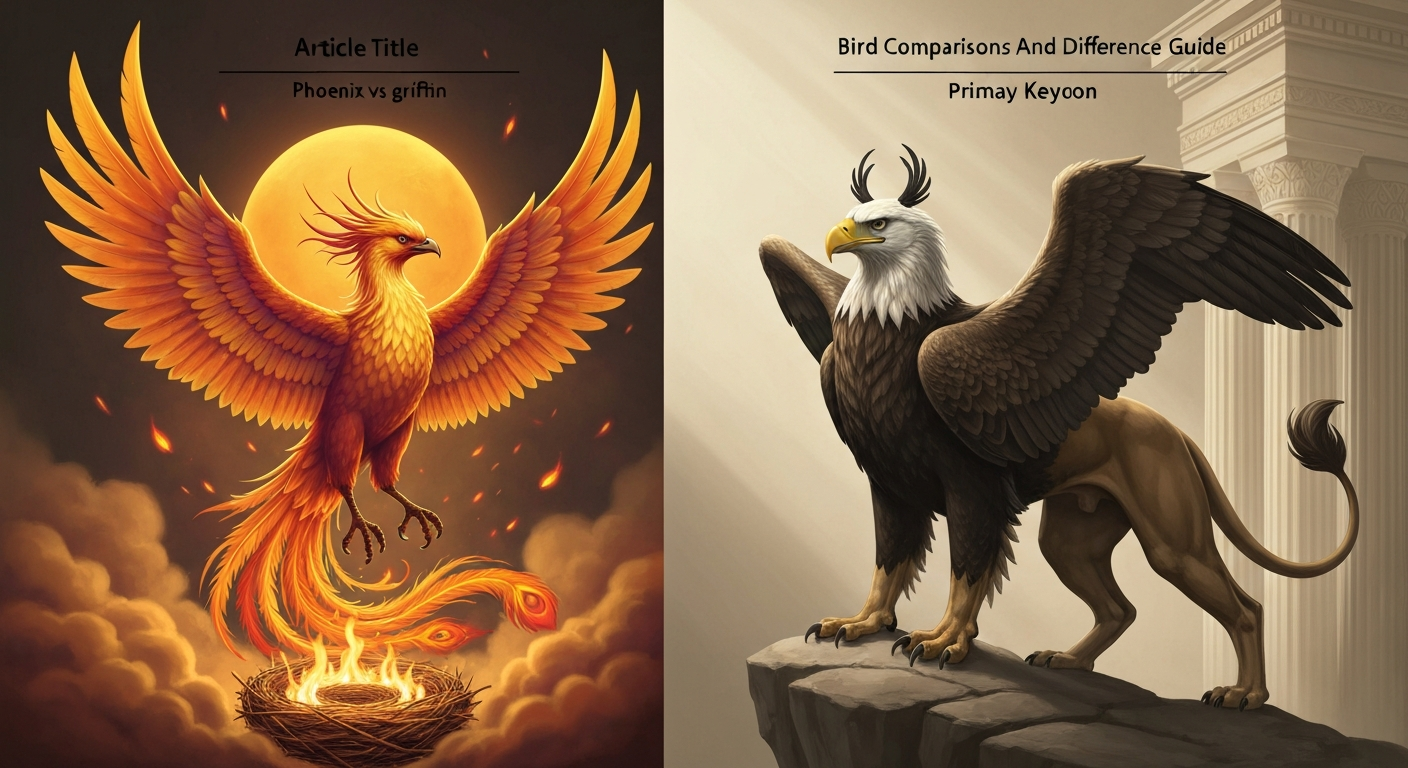
The phoenix is a wholly avian creature, appearing like an extraordinarily large and brilliant bird, most often described as resembling an eagle or heron adorned with gold and scarlet plumage. It lives and dies in a cycle of self-immolation and resurrection, making it the ultimate symbol of renewal. The griffin has an eagle's head, beak, wings, and forelegs combined with a lion's hindquarters and tail, making it a quadrupedal apex predator. It guards treasure and sacred places, and its dual nature (eagle plus lion, sky plus earth) made it a universal symbol of divine power across dozens of cultures. Neither creature has a basis in real ornithology, but both are built from very recognizable real-animal anatomy, which is exactly what makes them so easy to confuse in passing glances at decorative art.
Side-by-side at a glance
| Feature | Phoenix | Griffin |
|---|---|---|
| Body form | Entirely avian (bird only) | Hybrid: eagle head/wings + lion body/hindquarters |
| Legs | Two bird legs | Four legs (eagle forelegs, lion hind legs) |
| Size in tradition | Comparable to an eagle or larger | Larger than a lion; massive wingspan |
| Core element | Fire | Air and earth |
| Lifecycle | Dies and resurrects from its own ashes | Mortal but nearly invulnerable; guards for eternity |
| Primary role | Cosmic renewal, solar symbolism | Guardian, protector of treasure and sacred places |
| Key cultural origins | Egyptian (Bennu), Greek, Roman | Near Eastern, Scythian, Greek, medieval European |
| Wings | Yes (primary appendages) | Yes (in addition to four limbs) |
| Heraldic attitude | Often shown rising from flames ("reborn") | Often shown rampant or passant as a guardian |
| Associated with royalty? | Yes, solar and imperial power | Yes, strength and vigilance |
| Solitary or social? | Always solitary | Typically solitary or paired as sentinels |
| Attacks humans? | No — peaceful solar bird | Yes, depicted as a ferocious predator |
Where they come from: origins and cultural contexts
Neither creature appeared in a single culture overnight. Both accumulated layers of meaning as they traveled across civilizations, and understanding those layers is the key to interpreting them correctly when you encounter them in art or heraldry.
The phoenix: from Egyptian Bennu to Roman bestiaries
The oldest ancestor of the phoenix is the Egyptian Bennu bird, a heron-like deity associated with the sun god Ra and the creator god Atum at Heliopolis. The Bennu appears in the Pyramid Texts, the Coffin Texts, and the Book of the Dead, where transformation spells allow the deceased to assume its form. James P. Allen, The Ancient Egyptian Pyramid Texts (standard modern edition, cited in Egyptological literature) blank" rel="noopener noreferrer">James P. Allen — The Ancient Egyptian Pyramid Texts (standard modern edition — cited in Egyptological literature). James P. Allen's modern edition of the Pyramid Texts and R.O. Faulkner's translations of the Coffin Texts and Book of the Dead are the standard scholarly references for these passages. The Bennu was closely tied to the benben stone, the primordial mound of creation at Heliopolis, cementing its identity as a creature of cosmic beginnings rather than simple fire. When Greek travelers encountered this tradition, they absorbed and reshaped it. Herodotus, writing in his Histories (Book II, chapter 73), recorded that the phoenix visits Heliopolis approximately every 500 years, carrying its father's embalmed body in a ball of myrrh from Arabia. Pliny the Elder later catalogued it in his Naturalis Historia (Book X) under what he honestly called 'fabulous birds,' noting the 500-year cycle and the nest of cinnamon and spices, which became the definitive Roman-era account that medieval writers would copy for centuries.
The phoenix story was then mediated into Christian Europe largely through illuminated bestiaries. The Aberdeen Bestiary, available today as a digitized manuscript, contains one of the best-known medieval phoenix illustrations alongside Latin text that explicitly reads the bird's resurrection as an allegory for Christ's death and rebirth. This Christianized phoenix became a standard motif in medieval art, appearing on church stonework, manuscript marginalia, and heraldic devices across Britain and continental Europe.
Related phoenix traditions: Zhuque, Thunderbird, and the Liver Bird
Several other great avian figures are frequently compared to or conflated with the phoenix, and it is worth being precise about the distinctions. For a focused comparison, see Liver Bird vs phoenix, which contrasts Liverpool's civic emblem with the mythic phoenix and explains how their meanings and visual cues differ. The Chinese Vermilion Bird (Zhuque, 朱雀) is one of the Four Symbols (Si Xiang) that map the four quadrants of the sky onto the twenty-eight lunar mansions, representing the southern sky. The Huainanzi, translated authoritatively by John S. Major and colleagues, and the work of historian of Chinese astronomy David W. Pankenier establish that Zhuque is fundamentally an astronomical and cosmological symbol, not a resurrection myth. It is sometimes visually merged with the fenghuang (the Chinese ritual and imperial phoenix-like bird), but they are distinct: the fenghuang is an auspicious omen of virtuous rulership while Zhuque is a directional celestial symbol. These are genuinely separate traditions.
The Thunderbird of Indigenous North American traditions is another creature often grouped with the phoenix as a 'great fire-bird,' but this comparison is superficial and risks flattening the specific sacred meanings held by distinct nations. For a focused comparison between those traditions, see the discussion titled phoenix bird vs thunderbird. Among the Ojibwe/Anishinaabe, the Thunderbird is documented in sources such as Edward Benton-Banai's The Mishomis Book; Haida traditions are carefully recorded in John R. Swanton's Haida Texts and Myths (Bureau of American Ethnology, 1905) and Robert Bringhurst's scholarship. The Smithsonian's National Museum of the American Indian holds numerous Thunderbird objects with provenance from specific nations, which makes clear that 'Thunderbird' is not a single pan-Native tradition but a family of distinct sacred beings with different powers and roles depending on the community. Grouping all of these under 'phoenix-like' does a disservice to their specificity.
Liverpool's Liver Bird is a more grounded comparison. The two famous copper Liver Birds atop the Royal Liver Building (completed 1911) were designed by sculptor Carl Bernard Bartels and fabricated by the Bromsgrove Guild. Bartels's role was effectively erased during World War I due to his German heritage but has since been rehabilitated in local historical accounts. The Liver Bird itself traces back to Liverpool's civic seals from at least the medieval and early modern period and bears a branch of laver seaweed in its beak. It is categorically a civic heraldic emblem, not a creature of fire or rebirth, though it shares the 'mysterious great bird' visual category that connects many of these symbols.
The griffin: from Pazyryk felt to medieval heraldry
Griffin imagery is archaeologically traceable across a broad sweep of West and Central Eurasia. Among the earliest and most striking examples are the felt and leather saddle-cover plaques from the Pazyryk kurgans (burial mounds) of the Scythian culture, now held in the State Hermitage Museum in St. Petersburg. These objects, dating to around the 5th to 4th century BCE, show griffin figures with eagle heads and lion bodies in vivid, curvilinear animal-style compositions. Achaemenid Persian glyptic (seal stones) and architectural reliefs, Greek vase painting, and Near Eastern ivory carvings all contribute to an iconographic record showing the griffin's anatomy was remarkably consistent across cultures: eagle head with upright ears, curved beak, feathered wings, eagle forelegs with talons, and a lion's hindquarters and tail. Comparative mythologist Adrienne Mayor, in The First Fossil Hunters, proposed a provocative and widely discussed (though debated) argument that Scythian encounters with Protoceratops fossils in Central Asia may have contributed to griffin imagery, since the skull shape and general anatomy of those dinosaurs loosely match the described griffin form. The theory is worth knowing even if it remains contested.
Cultural sources and iconography: what the historical record actually shows
For the phoenix, the primary textual sources form a clear chain: the Egyptian Pyramid Texts and Coffin Texts for the Bennu, Herodotus for the Greek oral tradition, Pliny for the Roman natural-history tradition, and the Aberdeen Bestiary and related manuscripts for the medieval Christian reception. Each link in that chain shifts the creature slightly. The Egyptian Bennu is primarily a solar and cosmogonic deity; the Greek phoenix of Herodotus is a remarkable animal that performs a periodic ritual; the Roman phoenix of Pliny is a natural curiosity; and the medieval bestiary phoenix is an allegory for resurrection. In art, you can often date a phoenix depiction by which tradition it follows: a heron-like bird near a solar disk is Bennu-influenced; a bird building a nest of spices is classical-era; a bird rising from flames with outstretched wings is the medieval and Renaissance type that dominates Western iconography today.
For the griffin, the iconographic record is more archaeological than textual. The Hermitage's Pazyryk collection provides the most studied ancient examples. Greek architectural friezes, Achaemenid gold plaques, and medieval European heraldic manuscripts all contribute. In heraldry, the griffin became standardized with very specific positional vocabulary: a griffin rampant stands upright on its hind legs, a griffin passant walks with one foreleg raised, and a male griffin (sometimes called an opinicus or alce) may be shown without wings but with spines or rays instead. These distinctions matter enormously if you are trying to read a coat of arms accurately.
Physical traits and anatomy: a bird versus a beast with bird parts
From a strict anatomical perspective, the phoenix is an oversized bird. Every account describes it in purely avian terms: feathers (usually described as gold, scarlet, and purple, or occasionally blue and green in some traditions), a beak, two legs, two wings, and a tail. Herodotus compared it to an eagle in shape. This means if you frame the phoenix through an ornithological lens, it looks like a very large raptor with improbable coloration. For a helpful side-by-side comparison of reptile and bird anatomical features, see bearded dragon vs bird. The closest real-world analogue in body plan is a large eagle or a grey heron for the Bennu-type illustrations.
The griffin's anatomy is explicitly non-avian in its lower half. It has the forelegs and talons of an eagle combined with the haunches, hind legs, and tail of a lion. This makes it a six-limbed creature (four legs plus two wings) in many depictions, or occasionally four-limbed (with the eagle talons serving as the forelegs) depending on the tradition. In nearly all representations, the defining visual markers are the upright feathered ear-tufts, the hooked raptor beak, the feathered chest transitioning to a tawny lion coat on the rear, and the long leonine tail. The wings are large and eagle-like, giving the creature an imposing profile even at rest.
- Phoenix: entirely avian, two legs, two wings, raptor-like beak, brilliant multicolored plumage in red, gold, and purple tones
- Phoenix: no secondary limbs; flies as a bird flies; builds a nest (of spices in classical tradition, or flames in later tradition)
- Griffin: eagle head with hooked beak and erect feathered tufts, eagle talons on forefeet, feathered chest and wings
- Griffin: lion body from the midsection back, tawny or golden coat, long leonine tail often shown with a tuft
- Griffin: four-legged and winged; heavier and more physically massive in proportion to any real bird
Lifecycle, symbolism, and behavior: rebirth and fire versus guarding and predation
The phoenix's entire identity is organized around its lifecycle. In the classical tradition established by Herodotus and elaborated by Pliny and later writers, the bird lives for approximately 500 years (some accounts say 1,000 or even longer). As it approaches the end of its life, it builds a nest of aromatic spices, and either spontaneously combusts or ignites through the concentrated heat of the sun. From the ashes, a new phoenix is born or the old one is resurrected. The bird then travels to Heliopolis to deposit the remains of its predecessor (or its own former self) at the altar of the sun. This ritual, solitary journey and the absolute singularity of the creature (there is always and only one phoenix alive at a time) are defining characteristics. The phoenix does not attack, does not guard, and does not have territory in any predatory sense. It exists as a kind of cosmic clock, marking the renewal of time itself.
The griffin's behavior is almost the inverse. It is predatory, territorial, and vigilant. Classical and medieval sources consistently depict griffins as fierce guardians of gold deposits and sacred places, particularly in Central Asian and northern traditions. They were said to build nests of gold and were notoriously aggressive toward horses and any creature that threatened their hoard. In Aeschylus and later authors, the gold-guarding griffins of the Arimaspians (a legendary Scythian people) is a recurring image. This behavioral tradition made the griffin a natural heraldic choice for families and institutions that wanted to project the combined virtues of an eagle (acute vision, mastery of the sky) and a lion (strength, courage, nobility). The phoenix, by contrast, was chosen to symbolize immortality, perseverance through destruction, and solar glory.
Powers and typical portrayals: who is more powerful?
This is a question I see come up constantly from mythology enthusiasts, and it deserves a honest answer rather than a handwave. In raw physical confrontation, the griffin has every advantage. It is depicted as a massive predator with the strength of a lion and the aerial agility of an eagle, capable of carrying off horses in some accounts. The phoenix, in almost every tradition, is not a fighter at all. It does not attack, has no venom, no great physical strength beyond that of a large bird, and its fire is bound to its own lifecycle rather than deployed as a weapon. In a straightforward contest of combat ability, the griffin wins.
The more interesting question is about cosmic power, which is where the phoenix shifts the balance entirely. The phoenix cannot be permanently destroyed. Fire, which kills almost everything else, is literally the mechanism of its renewal. Even if a griffin killed a phoenix in physical combat, the phoenix would rise again. In terms of endurance, the phoenix is ultimately indestructible in a way the griffin is not. Medieval theological readings of the phoenix saw precisely this as its most significant power: the capacity to survive the worst thing that can happen and return transformed. In terms of narrative and symbolic weight, they are roughly matched but in entirely different categories. The griffin is the most powerful combatant; the phoenix is the most powerful survivor.
| Power/Attribute | Phoenix | Griffin |
|---|---|---|
| Physical combat strength | Low — not a fighter | Very high — lion strength plus eagle talons |
| Flight capability | High — fully avian | High — large wingspan, but heavier body |
| Immortality/rebirth | Yes — dies and resurrects cyclically | No — mortal, though often near-invulnerable |
| Fire affinity | Core to its nature — self-immolates and renews | No fire association in primary sources |
| Healing or restorative power | Tears said to have healing properties (medieval tradition) | No healing associations |
| Guardian power | None — not territorial | Very high — actively defends gold and sacred sites |
| Vulnerability | Can die temporarily; no combat defenses | Can be killed permanently; mortal |
| Symbolic dominance | Solar, cosmic, eternal renewal | Royal authority, divine power, earthly and celestial strength combined |
In heraldry and visual art, the griffin is by far the more common choice for active power symbols, coats of arms, institutional logos, military insignia, because its aggressive guardian role translates clearly into visual language. The phoenix appears more often in personal emblems, Renaissance imprese (personal devices), and religious art where the theme is endurance and transformation rather than conquest.
How the phoenix and griffin compare to other great mythic birds
The phoenix sits in a family of great avian creatures from world mythology, several of which are explored in detail elsewhere on this site. The Egyptian Bennu is arguably the direct prototype of the phoenix rather than a separate creature, making it the closest parallel: both are solar, both are associated with a sacred precinct (the benben stone at Heliopolis), and both mark cosmic time. The Chinese fenghuang and the astronomical Zhuque (Vermilion Bird) share the phoenix's visual register of brilliant feathers and imperial/cosmic significance, but lack the defining rebirth cycle. For a focused comparison of the Zhuque (Vermilion Bird) and the phoenix, see our dedicated discussion titled Vermilion Bird vs phoenix, who is more powerful Vermilion Bird vs phoenix — who is more powerful. The Thunderbird traditions of Indigenous North American nations share the 'great bird with elemental power' concept but are tied to storms, thunder, and the relationship between sky and earth rather than fire and renewal.
The dragon comparison is the most structurally interesting. For a focused comparison of phoenix and dragon motifs, see our guide titled phoenix bird vs dragon, which contrasts their symbolism, visual traits, and roles in myth. In European tradition, the dragon and the griffin both occupy the role of elemental predator and treasure guardian, which is why they appear together so frequently in heraldry. The key distinction is that the dragon is typically associated with fire (and evil or chaos in Christian tradition), while the griffin is associated with hybrid divine power and is almost always positive or noble. The phoenix, uniquely, has fire as a personal and redemptive element rather than a weapon or symbol of destruction. The Liver Bird is the outlier in this family: it is a civic heraldic creature with a specific local and political identity rather than a cosmic or elemental one, making it far more grounded and bounded in meaning than the others.
| Creature | Cultural Origin | Fire Association | Resurrection | Hybrid Anatomy | Primary Role |
|---|---|---|---|---|---|
| Phoenix | Egyptian/Greek/Roman | Yes — central to lifecycle | Yes | No — fully avian | Cosmic renewal, solar symbol |
| Griffin | Near Eastern/Scythian/Greek | No | No | Yes — eagle + lion | Guardian, predator, royal emblem |
| Bennu | Egyptian | Indirect (solar) | Yes (form of Ra/Osiris) | No — heron-like | Cosmogony, solar deity |
| Vermilion Bird (Zhuque) | Chinese | Yes — fire/south | No | No — avian | Celestial directional symbol |
| Thunderbird | Multiple Indigenous North American nations | Sometimes (lightning) | No | No — avian | Storm, elemental power, sacred protector |
| Dragon (European) | Indo-European/Near Eastern | Yes — breath weapon | No | Yes — serpent + limbs + wings | Chaos, guardian, adversary |
| Liver Bird | English/Liverpool civic | No | No | No — avian | Civic heraldic emblem |
One practical note for visual identification in art: the phoenix is almost always shown alone, often against or within a background of flames or a radiant sky. The griffin is almost always shown in an active pose, either rampant (rearing up), in flight with something in its talons, or flanking an object symmetrically with another griffin as a pair of guardians. If you see two identical bird-lion creatures flanking a doorway, a throne, or a coat of arms, those are almost certainly griffins. A single radiant bird rising upward from fire is almost certainly a phoenix. These conventions are consistent enough across Western art and heraldry that they work as reliable identification shortcuts in most contexts.
Visual identification tips for art and heraldry
- Check for a lion's body: if the lower half is clearly feline with a tufted tail, you are looking at a griffin regardless of how impressive the eagle head appears.
- Count the limbs: a creature with four legs plus two wings is almost always a griffin or a dragon; a creature with only two legs and two wings is avian, pointing toward the phoenix.
- Look for flames or a nest: a bird surrounded by or emerging from flames or an aromatic nest is following the phoenix iconographic formula across all periods.
- Check the posture: paired guardian figures flanking something symmetrically are overwhelmingly griffins in European and Near Eastern traditions.
- Read the colors: a phoenix is conventionally shown in red, gold, and purple or orange tones; heraldic griffins are most commonly shown in gold (or) on a field, or in natural tawny colors.
- Look for ear tufts: upright feathered tufts on an eagle-headed creature are a reliable griffin marker not typically seen on phoenix depictions.
- Context of the object: funerary or solar art suggests phoenix; treasure chests, gate posts, or military insignia suggest griffin.
The bottom line
The phoenix and the griffin occupy adjacent but non-overlapping spaces in the mythology of powerful birds. The phoenix is the ultimate symbol of death and renewal, entirely avian in form, and it derives its power from its indestructibility over time. The griffin is the ultimate symbol of combined earthly and celestial authority, hybrid in form, and it derives its power from physical dominance and vigilance. In combat, the griffin is the stronger combatant; in endurance and cosmic meaning, the phoenix is the more durable symbol. Knowing which tradition a particular image draws from, whether that is the Egyptian Bennu material, Herodotus's Greek account, the Pazyryk Scythian goldwork, or a medieval bestiary, is what separates a superficial identification from a genuinely informed reading of the creature in front of you.
FAQ
Quick answer — what is required to write an evidence‑based, ornithology‑framed comparison of the phoenix and the griffin?
You need: (1) primary literary and textual sources for each tradition (Egyptian Pyramid/Coffin Texts, Herodotus/Pliny/Strabo for classical phoenix; Han texts and Chinese astronomical corpora for Zhuque; regional ethnographies for Thunderbird; municipal records for Liver Bird; archaeological reports for griffin contexts); (2) a primary iconographic corpus (museum object records, digitized manuscripts, glyptic and textile finds such as Pazyryk); (3) modern scholarly analyses in Egyptology, classical studies, Chinese studies, archaeology, and comparative mythology (e.g., Allen, Major, Pankenier, Adrienne Mayor); (4) high‑quality, licensed image resources with catalogue metadata (Hermitage, British Library, NMAI, Historic England, museum collections and manuscript digitizations); and (5) an interpretive framework that treats anatomical/avian features descriptively (plumage, beak, wing posture) and separates cultural/ritual function from biological analogy.
Which primary textual sources should be consulted for the phoenix tradition?
Essential primary texts: Egyptian Pyramid Texts, Coffin Texts and Book of the Dead passages mentioning the bennu/ben‑ben (use modern editions/translations by Allen, Faulkner, de Buck); Herodotus (Histories 2.73) for the Heliopolitan/Greek phoenix cycle; Pliny the Elder (Naturalis Historia, Book X) and Strabo (Geographica) for classical and Hellenistic reception; medieval bestiary manuscripts (e.g., Aberdeen Bestiary) for Christian allegorical reception. Cite editions/translations and link to digitized folios where possible.
Which primary and object‑level sources support griffin iconography and anatomy?
Key corpora: Near Eastern glyptic and ivories, Achaemenid reliefs, Scythian/Pazyryk burial finds (saddle plaques, felt rugs—Hermitage catalogues), Greek vase and architectural depictions, and later medieval heraldic examples. Use museum catalog records (Hermitage, British Museum, local archaeological reports) with catalogue IDs and high‑resolution images to document beak shape, wing attachment, forelimb musculature depiction, and composite anatomy across regions.
Which Chinese, Native American, and civic sources are needed for related bird traditions (Vermilion Bird, Thunderbird, Liver Bird)?
Vermilion Bird: Han and pre‑Han astronomical/ritual texts (Huainanzi), studies on the Four Symbols and Twenty‑Eight Mansions (Pankenier and specialists). Thunderbird: region‑specific ethnographic corpora and museum object records—e.g., Ojibwe/Anishinaabe, Haida collections (Swanton; Bringhurst), and NMAI catalogue entries. Liver Bird: Liverpool municipal seals, town records, and Historic England listing for the Royal Liver Building (artist/craft documentation for Carl Bernard Bartels and Bromsgrove Guild). Avoid generic pan‑Native sources—use community‑specific scholarship and museum provenance.
What scholarly analyses and secondary literature should be used?
Use discipline‑standard scholarly works: Egyptological editions/translations (James P. Allen; Faulkner), classical scholarship on Herodotus/Pliny/Strabo, Chinese studies (John S. Major on Huainanzi; Pankenier on ancient astronomy), archaeological and iconographic analyses of griffin motifs (journal articles on Pazyryk, Scythian art), and comparative works like Adrienne Mayor for debated hypotheses (fossil→griffin). Include peer‑reviewed articles, museum catalogue essays, and recent monographs; flag debated interpretations and cite object records alongside synthetic arguments.
Which image and iconographic resources should be collected and how should licensing/provenance be handled?
Collect high‑resolution, catalogue‑level images with provenance/IDs from: Hermitage digital collection (Pazyryk objects), British Library/Bodleian/Aberdeen Bestiary digitizations, museum databases (British Museum, Smithsonian NMAI), Historic England for Liver Birds, and digitized manuscript folios. Prioritize images with open‑access or licensed reproductions; record catalogue number, object title, date, culture, and credit line for each image. For restricted images, request permissions and note usage terms in captions.